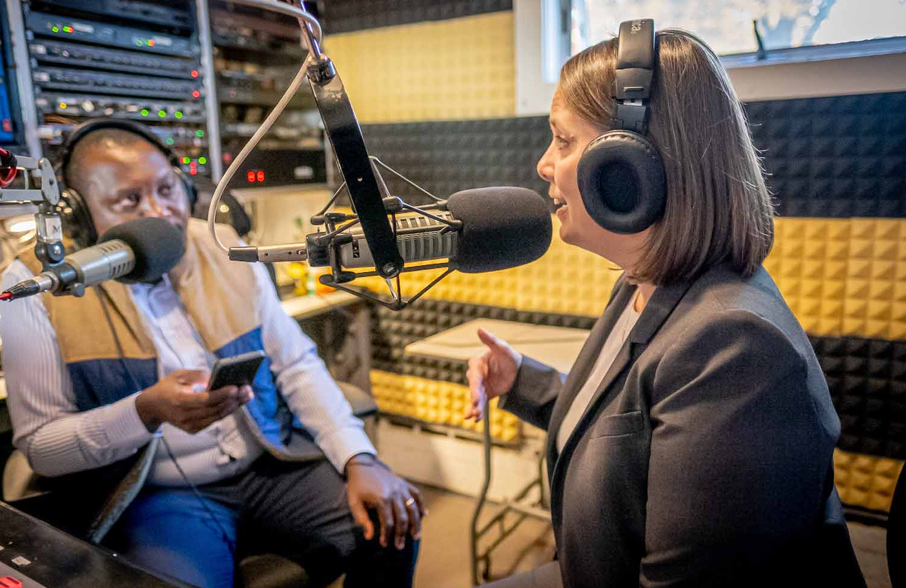
As Maine prepares for the Nov. 3 General Election, Secretary of State Shenna Bellows has a message for eligible voters who are uncertain about the process, worried about intimidation, or wondering whether their ballots can make a difference: They have a right to participate, and their votes matter.
“Sometimes I hear from people, ‘Does my vote really make a difference?’” Bellows said in an Oct. 20 interview with Amjambo Africa. “When you wonder, does my vote really matter? It really does when we see these examples of a one-vote difference in an election.”
Bellows oversees voter registration, ballots, voting equipment, training local election officials, and transparent vote counting. But she said one of her biggest concerns this year is fear.
“My biggest concern is fear itself,” she said. “I’m afraid that some of the nasty rhetoric coming from the politicians and even coming from the highest levels will scare people away from voting.”
Her message is especially relevant for immigrants and refugees who have become U.S. citizens, as well as people who may be unfamiliar with the country’s election system or uneasy about whether voting could bring unwanted consequences.
“In the United States of America, if you are a citizen, you have that right to vote,” she said. “And no one can take it away from you, particularly in a state like Maine.”
Who can vote — and how to register
In Maine, U.S. citizens who will be at least 18 on Election Day can register and vote, Bellows said. That includes people who were born in the United States and those who became citizens through naturalization.
Maine allows same-day voter registration. People who are eligible but have not registered can register when they go to vote, including on Election Day, Nov. 3.
Voters are generally asked to show proof of identity and residency. A Maine driver’s license or state ID is one option; other documents may include a student ID, tribal identification, or a lease. Bellows said voters lacking standard documents may be able to sign an affidavit.
“Every citizen, 18 or older, has the right to vote. No exceptions,” Bellows said, describing Maine’s rules. She specifically mentioned people experiencing homelessness, university students, and people with criminal records or who are incarcerated.
For people from countries where elections are restricted or associated with risk, the system can be confusing. Bellows said the United States also has a history of restricting voting. Early voting was largely limited to white male property owners; women gained the constitutional right to vote nationwide in 1920, and Native Americans in Maine faced restrictions much later.
“Discrimination has unfortunately been part of our history,” she said. “But today, I think because everyone has that right to vote, it brings new responsibility.”
For new citizens, she said, voting is both a right and a way to help build a more inclusive society.
Early voting and key dates
Maine offers no-excuse absentee voting, allowing eligible voters to vote early without giving a reason. Voters can request a ballot from their municipal clerk and return it by mail or in person, or vote early at City Hall or a town hall.
ADVERTISEMENT

Bellows identified Oct. 29 as the final day for early voting. She said polls across Maine close at 8 p.m. Eastern time on Nov. 3, Election Day.
Voters should confirm instructions and deadlines with their municipal clerk or the Secretary of State’s office.
Her office reaches young people and new citizens through naturalization ceremonies, campus registration events, voter registration forms sent to schools, and public education sessions. “We will speak anywhere that anyone wants to ask us to talk about voter security,” she said.
Paper ballots and public counting
Maine’s election system relies on paper ballots, which can be reviewed and recounted when needed. The machines voters use to submit ballots are tabulators, Bellows said, and are not connected to the internet. “So they can’t be hacked by cybercriminals or foreign adversaries,” she explained.
Clerks track who has voted to prevent duplicate voting. Absentee envelopes are signed, recorded, and secured before processing to protect voter privacy. Representatives of both major parties, candidates, nonpartisan observers, and the media may watch the count, Bellows said.
“If you are a very good accountant or you like bookkeeping, you should be an election official,” Bellows said, describing the paperwork required to ensure each voter votes once and each ballot is counted. She described transparency and careful recordkeeping as central to public confidence in the results.
Misinformation and intimidation
Bellows warned voters to be cautious about election information on social media, especially official-looking messages or websites. Misleading claims can frighten people away from voting, while fake websites may collect personal information.
Her advice: Use trusted sources. She pointed to vote.gov, which directs users to official state election information, and said websites ending in “.gov” are government sites.
“In some countries, to say, ‘Trust the government’ is certainly questionable,” Bellows acknowledged. “But I will say vote.gov is a good website that links to all of the state websites about information about voting.”
Intimidation and interference with voting are illegal, she said. Voters who feel threatened should report it to their municipal clerk.
She cited anti-voting flyers, intimidating photography, and other pressure tactics, including those aimed at new Mainers and students. “There may be people that try to tell you that voting doesn’t matter,” she said. “If voting didn’t matter, the politicians would not be spending hundreds of millions of dollars on negative advertising against each other.”
Bellows also addressed concerns about immigration enforcement at polling places. “There cannot be ICE at polls. There cannot [be] federal law enforcement at polls, you can’t be arrested at the polls,” she said. “You have that constitutional right to vote.”
Voting in Maine state and federal elections requires U.S. citizenship.
Making voting accessible
Bellows said voters with disabilities can use an ExpressVote system that offers options such as a touchscreen, headphones, and an audio ballot. The system produces a paper record that voters can review before submitting it for tabulation.
Voters who need language assistance can choose someone they trust to help translate or complete a ballot, she said. The voter must identify that person when requesting assistance, and the person helping must follow the voter’s wishes rather than direct how the voter should vote.
Community organizations can share accurate information, provide interpreters, or arrange rides, Bellows said, but they cannot pressure people to support a candidate at the polling place.
Bellows wants more local election materials in multiple languages, including audio ballots, and more state authority to ensure municipal elections are accessible.
One vote can decide a race
Maine has strong participation compared with other states, Bellows said, though turnout tends to be lower in local elections. Those races still shape everyday life.
To explain why participation matters, Bellows recalled a 2024 state House of Representatives race that appeared tied on election night. After a recount, one candidate won by a single vote.
The ballot at issue included a mark for the candidate and the candidate’s name written in the write-in area. Under the rules, Bellows said, the vote counted for that candidate.
“That meant that candidate went and served in the House of Representatives from 2024 until 2026,” Bellows said. “So when you wonder, does my vote really matter? It really does.”
The Legislature decides state budgets, funding for schools, roads, and bridges, and issues such as immigrants’ access to health care, she said.
She encouraged voters to research candidates without feeling they must answer every question. Voters can skip a race and still have the rest of their ballot counted.
“Voting is not a test, or if it is, it’s open book,” she said. “You can look on your phone if you want to Google information about the candidates.”
Bellows urged voters to be patient with election clerks and to vote according to their values and hopes for the future.
“Keep calm and carry on,” she said. “Voting is fun. It’s exciting.”
For eligible voters who still have questions, Bellows said her office is available to help them find accurate information. “It’s my job as secretary of state to make sure the election is safe and secure and make sure that every eligible Mainer has the right to vote,” she said. “If you have any questions or concerns at all, no matter who you are or where you live, send me an email or make a phone call to my office. We will do our best to get your questions answered so that you have the facts and you have what you need to vote.”