
By Sheila Ponnie
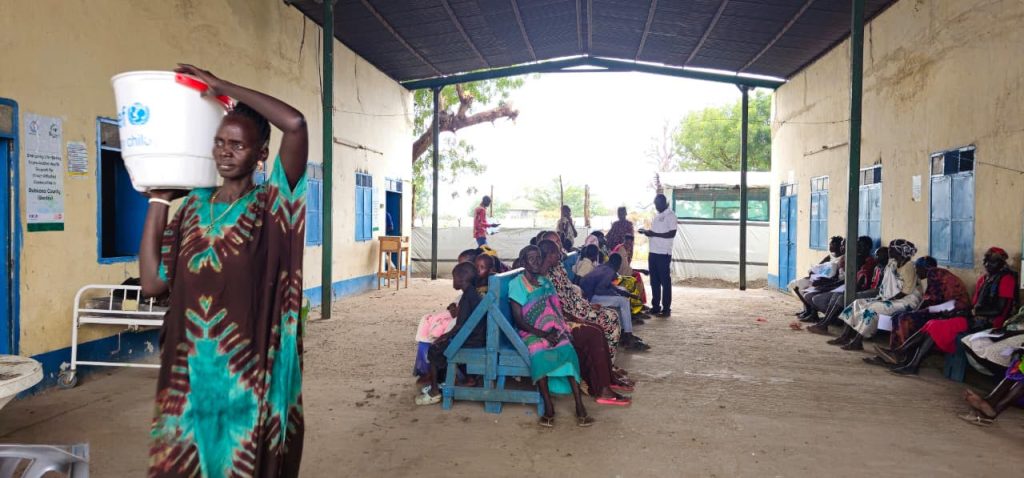
His hands and face bear visible scars as Andrew Makwee Ngatok, a maternal and child health worker, sits quietly on an old chair at the entrance of Budaang Primary Health Facility. Tucked away in South Sudan’s remote and flood-prone Unity State, the facility has been his workplace since 2019 — and the site of both hope and violence.
The scars, Ngatok says, are reminders of the price he has paid for doing his job.
One incident still haunts him. It happened on October 7, 2022, when an armed civilian stormed into the health center, accusing staff of providing family planning services to a young girl who had been forcibly married to an elderly man.
“But the girl did not want to marry him or give birth,” Ngatok recalled. “She wanted to continue her education. I gave her a long-term family planning method to protect her from early pregnancy.”
At the time, the girl was just 15 years old. Her family had married her off in exchange for a herd of cattle — a common practice in parts of South Sudan, where girls are often viewed as sources of family wealth.
Six months into the marriage, the absence of pregnancy raised suspicion. The girl was taken to a nearby police station, beaten, and forced to confess that she had received contraception from Budaang Primary Health Facility.
“She mentioned the name of the center,” Ngatok said. “That is when they came for me.”
He was beaten severely. The teenage girl was punished as well.
Stories like this have shaped Ngatok’s years at Budaang — a mix of life-saving care and constant risk. He says he has witnessed a steady rise in forced marriages, early pregnancies, and gender-based violence.
Joyce’s quiet resistance
Not all women seeking family planning services are children.
One of them is Joyce — not her real name, used to protect her identity.
By the time Joyce turned 22, she had already given birth to two children. Her story differs from that of the teenage bride Ngatok tried to protect, but it is driven by the same forces: poverty, patriarchy, and limited choices.
Joyce returned from Sudan with her husband in 2019, carrying their first child, then just three months old. Her husband has not had formal employment since. Two years later, Joyce gave birth again. Today, she sells tea by the roadside to keep her family afloat.
ADVERTISEMENT

“The demand for more children comes up in every family discussion,” Joyce said. “But the responsibility of feeding them is on me.”
She has chosen to use birth control — secretly.
“I didn’t make this decision with my husband,” she said. “He believes you cannot prevent yourself from giving birth. I use it secretly because I know he would not accept it.”
Patriarchy despite scarcity
South Sudan remains deeply patriarchal. Men are allowed to have multiple wives, and women are expected to prove their value through repeated childbirth. Children are widely seen as a form of wealth.
“According to the culture of most communities in South Sudan, women are supposed to give birth to as many children as possible,” said Juan Roy, a sexual and reproductive health officer with HealthLink South Sudan.
Yet the country is facing a severe humanitarian crisis. According to the 2025 Integrated Food Security Phase Classification (IPC) report, approximately 7.56 million people — more than half the population — are experiencing crisis-level food insecurity.
This contradiction forces many women to quietly seek contraception.
At Budaang Primary Health Facility alone, Ngatok says an average of 70 women seek family planning services every day.
Almost half of them, Roy says, come in secret.
“Some arrive very early in the morning or during market hours,” he explained. “If they spot relatives at the facility, they turn back.”
Health workers have learned to recognize the signs.
“They whisper. They keep checking the door,” Roy said. “We protect their privacy — quick services, coded appointments — because confidentiality can save lives.”
The risks are real. Some women are beaten after their husbands notice implant marks. Others are forced to remove contraceptives within days.
Maternal health at stake
Beyond social pressure, health concerns weigh heavily.
“Giving birth without proper spacing weakens the uterus and increases complications in the next delivery,” Roy said.
Joyce knows this well.
“I gave birth in 2022 and again in 2024. I need time to recover,” she said. “Most men don’t understand what our bodies go through with every pregnancy. I cannot give birth now.”
Ngatok says cases of gender-based violence linked to reproductive decisions are increasing, even as services expand.
“Care exists,” he said. “But reaching it — and surviving afterward — is the hardest part.”
Dr. Hussein Hassan, a senior sexual and reproductive health official with the United Nations Population Fund (UNFPA) in South Sudan, says resistance to family planning remains widespread.
“In some communities, we face myths and misconceptions, including false beliefs that family planning causes infertility,” Dr. Hassan said.
He added that addressing resistance requires sustained engagement.
“The best way is clear, consistent communication and correct information,” he said. “We work closely with health authorities and influential community leaders, but changing attitudes takes time.”
UNFPA — a UN agency aimed at improving reproductive and maternal health worldwide — coordinates sexual and reproductive health and gender-based violence services in Unity State with the Ministry of Health, the Ministry of Gender, Child and Social Welfare, and NGOs including HealthLink and Cordaid, with funding from the Korea International Cooperation Agency.
A fragile pause, not rejection
For women like Joyce, contraception is not a rejection of motherhood. It is a fragile pause — a way to survive poverty, protect health, and delay another burden in a country where choice often comes at a cost.
Despite living in fear of being discovered, Joyce urges other women not to surrender to pressure.
“The reason I’m using family planning is because of the situation and because I want my health to be good,” she said. “I won’t give birth to children I cannot support.”
Though the scars on Ngatok’s face make the past impossible to forget, both he and Joyce hold on to a quiet hope — that one day, women in South Sudan will be able to make decisions about their own bodies without having to wade through danger to do so.