Daniel Minter on art, power, and remembering who we are.
By Eloge Willy Kaneza

The sculpture, painting, and assemblages of acclaimed visual artist Daniel Minter of Portland, Maine are exhibited widely in galleries, museums, and exhibitions both in the U.S. and abroad. Minter is also a renowned children’s book illustrator. This summer, his latest local installation, In the Voice of Trees, will open as part of Deconstructing the Boundaries, a multi-year project of Indigo Arts Alliance and Coastal Maine Botanical Gardens exploring the relationships of Black and Brown communities with the land.
In this wide-ranging interview with Amjambo Africa, Minter reflects on In the Voice of Trees as well as ancestry, resistance, and the power of art to uphold what systems often deny. Minter’s work invites individuals and communities to “remember who we are, recognize each other’s humanity, and resist being erased.”
Rooted in trees, clay, and community
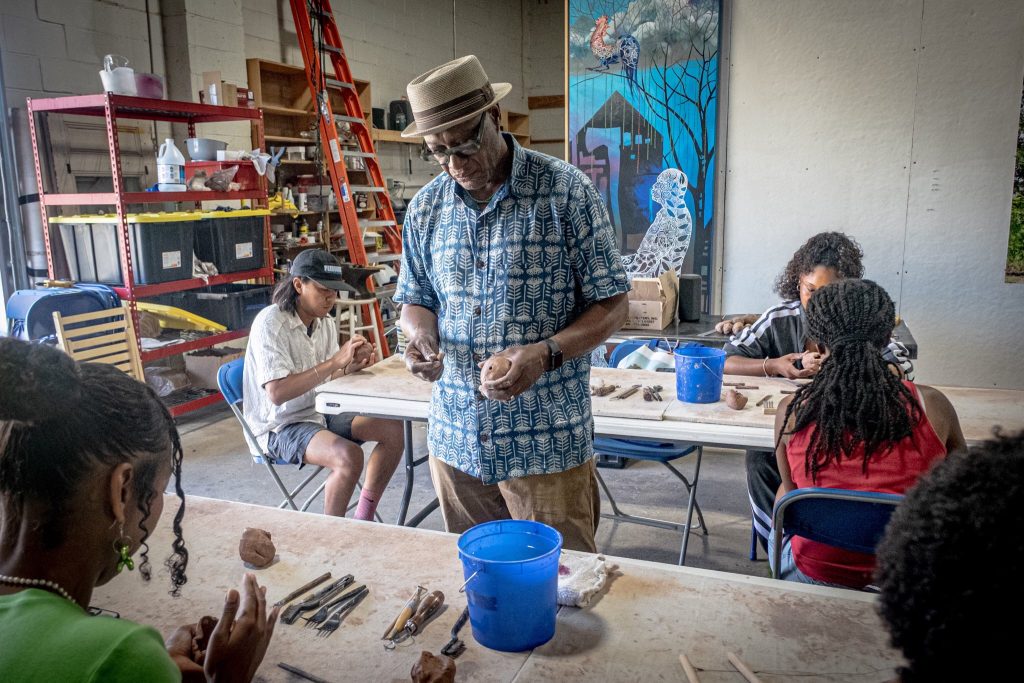
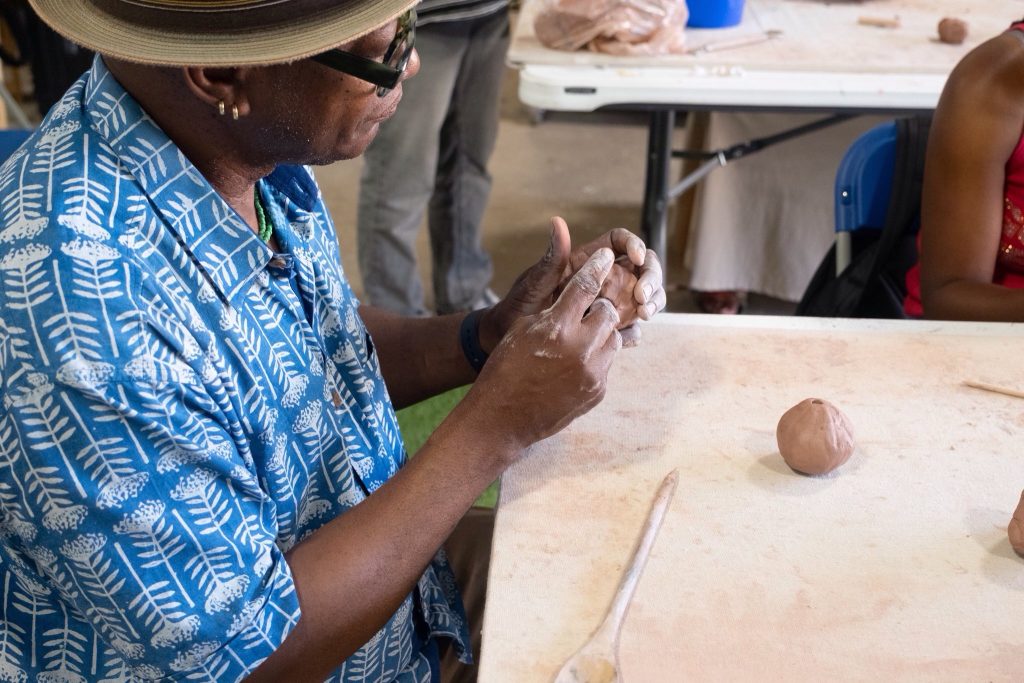
Minter’s installation at the Coastal Maine Botanical Gardens will bring together a grouping of uncarved trees bound together and adorned with handmade clay beads shaped by hand by community members in workshops held in various locations in Maine over a period of months. The work is grounded in the intention to demonstrate the power that emerges from people working together.
“[The installation is] a physical manifestation of the African proverb: sticks in a bundle are unbreakable,” he explains. “Each bead represents a presence, an energy, a voice. Even if you don’t think of yourself as an artist, you can embed yourself into the earth. That’s power…This project isn’t about me finishing something. It’s about people showing up, shaping clay, and leaving a trace of themselves in the earth.”
A global thread: In Slavery’s Wake
Minter’s philosophy of remembrance and repair has also shaped his contribution to In Slavery’s Wake: Making Black Freedom in the World, an international exhibition uniting Black artists from across the diaspora in an effort to explore and reframe the legacies of slavery, colonialism, and freedom on an international scale.
Minter’s contribution, titled Universe of Freedom Making, is a large-scale installation. “Slavery tried to strip us of everything—name, voice, shape, beauty. But we still made things. We passed down stories, rhythms, and images. That is resistance. That’s art.”
Previously on view at the National Museum of African American History and Culture, In Slavery’s Wake travels next to Rio de Janeiro.
What to do when your voice is taken
Minter champions the importance of the individual voice, and encourages people to find their own way to share their ideas and experiences with the broader community.
ADVERTISEMENT

“When your voice is denied, you can shout with color. When your words are denied, you can sing. When your rights are denied, you can speak through images, through texture, through clay. Your art can say what the world refuses to hear…Even when our rights are taken, even when our words are silenced—there’s still music, there’s still clay, there’s still color. That’s where we speak next.”
Systems of control and the power of turning to each other
Oppressive governments act intentionally to control the population, according to Minter.
“Governments are trying to pit people against each other. They’re stripping away our support systems and feeding us fear—because fearful people are easier to manipulate,” he said.
However, ordinary people hold power, Minter said.
“When people realize the systems are broken, they start turning to each other. That’s when change begins.”
Minter remains hopeful.
“I’m the kind of person who looks at broken things and says, ‘We can fix this. We can do better.’ I’m not saying it’s easy. I’m saying it’s possible.”
For Minter, resistance doesn’t have to be loud to be important.
“Say hello. It’s easy—but radical. It means: ‘I see you. You’re human. You belong.’ You don’t have to own everything to have enough. You don’t have to compete. There’s space for all of us—if we build it.”
Shaped by family, teachers, and mentors
Minter said his upbringing in a large family taught him about community.
“I grew up in a family of 13 children. In a big family, you know your role. Each sibling brings something different, and that difference is honored…That’s how I learned about community. You go to one person for one thing, another for something else. And when you leave home, you carry that with you.”
He also said that his teachers played pivotal roles in who he has become.
“Two of my teachers taught all my siblings—and even my mother. They knew us. I also had a great art teacher in high school who really prepared me.”
He also honors the impact of his mentors.
“John Biggers, David Driskell, Ashley Bryan—these weren’t just mentors in art. They were mentors in life. You need mentors at every stage of life. Even now, in my 60s, I still need mentors.”
A diaspora of recognition
Minter spoke of the need for African Americans and African immigrants to reach across what can sometimes seem like a huge divide to get to know each other better.
“I’m an African who never knew my mother,” Minter said. “But when Africans come here today, they’ve known our mother. I want them to tell me about her.”
Minter’s art weaves together movement, sound, gesture, and memory.
“What I learned in my small Southern town? I see it in Haiti, in Nigeria, in Brazil. We’ve carried these ways across oceans. That’s what I put into my art…The trees in this project (In the Voice of Trees) aren’t carved or manipulated. They just are. The only thing added is the community’s voice—beads strung from their hands.”
Creating so we’re not erased
For Minter, the African diaspora is at the core of who he is, and he hopes others feel the same. Change starts with recognition, he said. Voice begins with presence. And even when we are erased by systems of oppression, we can draw ourselves back into the frame.
“If we don’t show up for each other, we disappear. If we forget our brothers and sisters, we forget ourselves. And worst of all—we won’t recognize our mother when she calls us…That’s why I keep making the work. That’s why I keep repeating it. Because our memory is our home—and without it, we’re lost.”