
By Sheila Ponnie
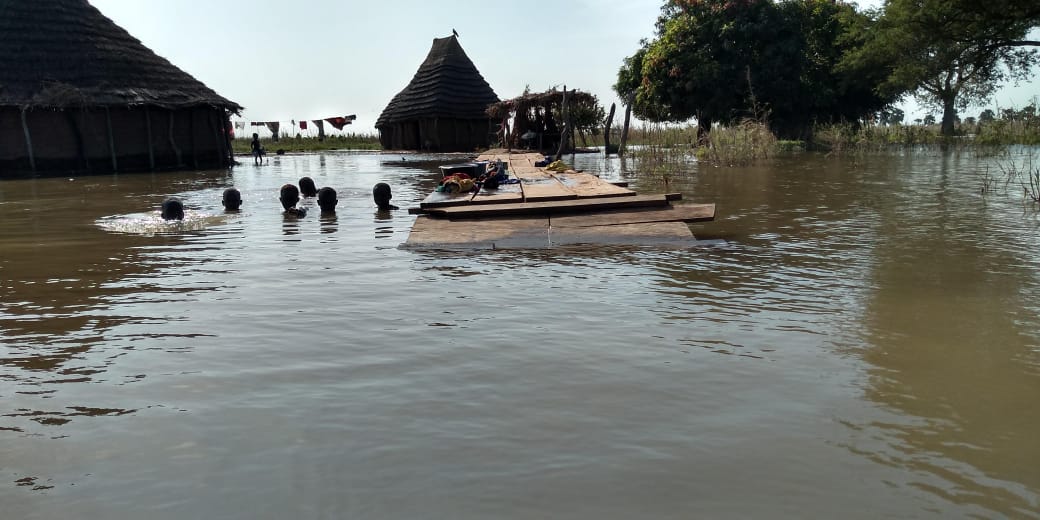
A vast grey sheet of floodwater stretches in every direction. It swallows trees, grazing lands, and the fragile mud homes that once dotted the landscape, erasing the landmarks villagers once relied on to find their way home in Rubkona County.
For years, this northern corner of South Sudan has lived on the frontline of climate extremes, where the Bahr el Ghazal River routinely bursts its banks, creating some of the highest humanitarian needs in the country. That reality is well known to 21-year-old Thai Nhial Mut.
“When we were in our village, life was simple,” Thai recalled, sitting on a wooden bench beside stacked firewood and a few chickens. “But our village was submerged. We had no idea how to build canoes.”
We moved with plastic sheets
When the floodwaters rose, families improvised with whatever they had.
“We used plastic sheets and tied them together,” Thai explained. “We put the children inside with the few things that survived, and they pushed through chest-deep water full of snakes. We tried to protect what we had, but we could not do anything.”
Thai’s family once owned 100 head of cattle. Conflict during South Sudan’s civil war wiped out part of the herd. The floods finished the rest.
In Unity State, Rubkona’s subtropical climate brings a rainy season every year from May to September. But since 2020, residents and aid agencies said the flooding has become relentless, trapping villages such as Pakur, Bilnyang, Panhiany, and the outskirts of Bentiu in what many now describe as a permanent “cycle of submersion.”
Looking back
Thai remembered the months of 2021 when the rains intensified and water began creeping into homes. By July, grazing lands and farmland had vanished. By August, even the islands the community believed would always remain above water were gone.
The family fled toward Bilnyang, one of the few areas still on habitable ground. But even there, the water followed.
The community attempted to build a small dike on its own. “The water submerged that one too,” Thai recalled. “That’s when we realized it was beyond us.”
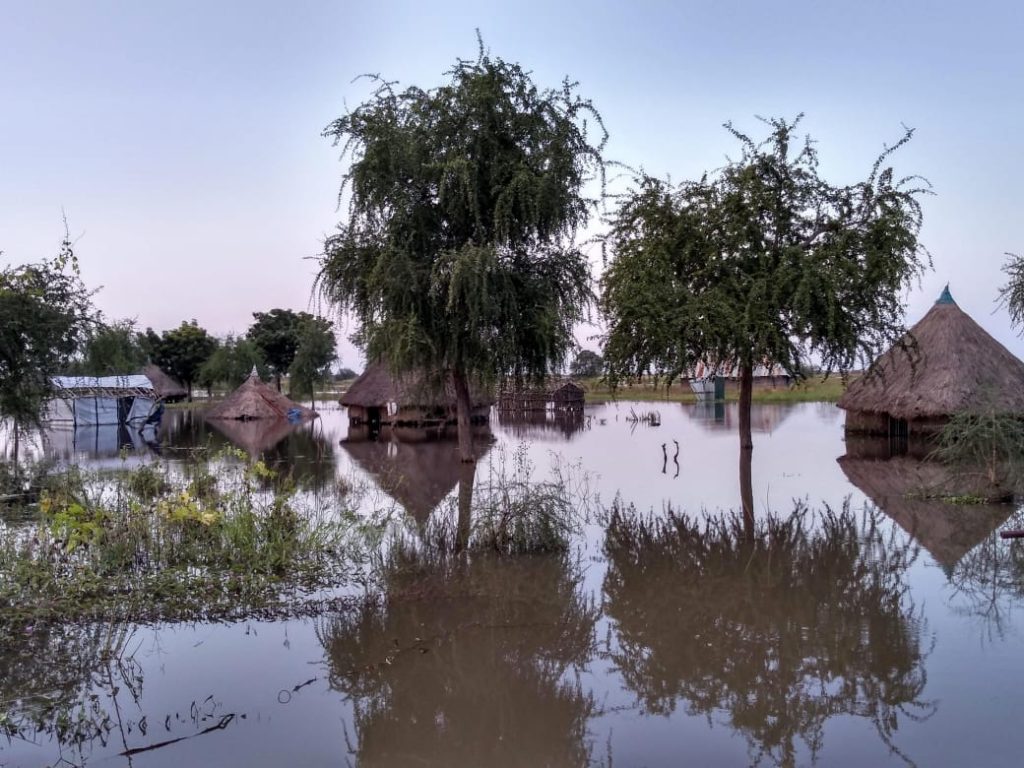
Photo: Homes left by the owners due to floods
Dikes as lifelines
Hope arrived in the form of larger, stronger flood barriers built by the International Organization for Migration under the Enhancing Community Resilience and Local Governance Project Phase Two, funded by the World Bank.
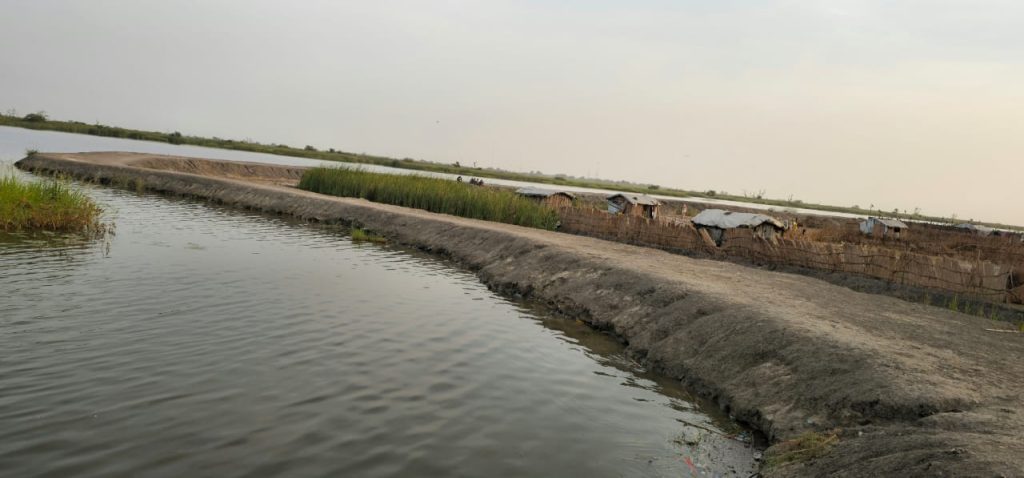
The dike and drainage system now stretches more than 52 kilometers around Bentiu and Rubkona, protecting over 100,000 people who would otherwise be living in open water.
ADVERTISEMENT

According to Miriam Mutalu, Head of the International Organization for Migration sub-office in Bentiu, Unity State, without the dikes “this place would have been submerged.”
She explained that communities themselves identified the projects. “They knew exactly what they needed to survive.”
The program includes 33 community-selected interventions across the state — schools, water yards, health facilities, and flood-protection infrastructure — but the dikes remain the most visible and vital.
Engaging the community on unstable ground
Standing beside a newly raised stretch of earth, Tombe Anthony Jadalla, Senior Field Engineer for the project, explained that behind the dikes’ simple appearance lies complex engineering.
“One of our biggest challenges is erosion,” he said. “It degrades the size of the dike and leads to breaches that require constant rehabilitation.”
The soil in Rubkona is loose and unstable. Engineers must compact it repeatedly and raise the structure based on projected water levels. Emergency spillways are designed to handle peak discharge and withstand constant pressure.
“If one section weakens, the whole line is at risk,” Jadalla explained.
The system relies heavily on community participation. Residents identify early warning signs — where water first seeps through, where animals cross, and where cracks appear. Engineers then translate that local knowledge into designs meant to last beyond a single rainy season.
Community volunteers shovel mud into weakened sections, while heavy machinery repairs breaches too dangerous for manual labour.
A vulnerable position
For local authorities, the stakes remain painfully high.
Ruon Machar, Payam administrator and chairperson of the Payam Disaster Risk Management Committee, described the situation as one of constant vigilance.
With tools from the International Organization for Migration and partners such as Welthungerhilfe, a German humanitarian organization focused on food security and resilience, and Integrated Social and Economic Development Services (ISFEDS), a South Sudanese organization working on community development and disaster preparedness, Machar’s committee monitors the dikes daily, repairing minor leakages and reporting major ones.
Looking forward
Machar warned that water levels are rising again. His committee continues to issue alerts to families still living near submerged areas.
“We tell them to move to higher ground now, before anything happens,” he said.
At the same time, new hope is emerging. Under the project, an additional 17.7-kilometer dike extension is reclaiming land that had been underwater for years.
“Now the community can cultivate again and graze their animals,” Machar explained. “Life will not only depend on fishing.”
Learning a different approach
For Thai, the floods took nearly everything — his home, livestock, and farmland. But displacement also introduced him to something entirely new.
“When I was in my village, I didn’t even know there was something called a school,” he says. “Here, I learned ABCDE. Education taught me that if one thing fails, you can switch to another to survive.”
He began school in 2023 after helping his family rebuild and move their remaining cattle to higher ground. Now in Primary Two, he pays his school fees by raising and selling chickens.
He recently stopped fishing after armed thieves began stealing canoes. “I’m scared for my life,” he said quietly. “So now I sell chickens instead.”
His dream is to finish school and work in Unity State’s oil fields — to understand why, in an oil-producing county, so little reaches the community.
“I want to know where the oil money goes,” he said. “And how it can help my people.”
Counting the losses
Nyakuka Both, a 42-year-old mother of six from Barmalual village, struggled to list everything she has lost.
“Before the flooding, we could cultivate,” she explained. “When the water came, it destroyed our farm. We could not feed our children. All my cattle died. My goats died. My tukul collapsed. Even my farmland is gone. I have lost so much I cannot count it.”
We need services, not survival
Years of conflict, climate shocks, and economic collapse have eroded basic public services across South Sudan. In Rubkona, many residents feel aid agencies have filled a gap that should belong to the state.
“We are your citizens,” Thai said in a message to national and state leaders. “Please unite the country and bring development so that we can unlock our potential.”
A look to the future
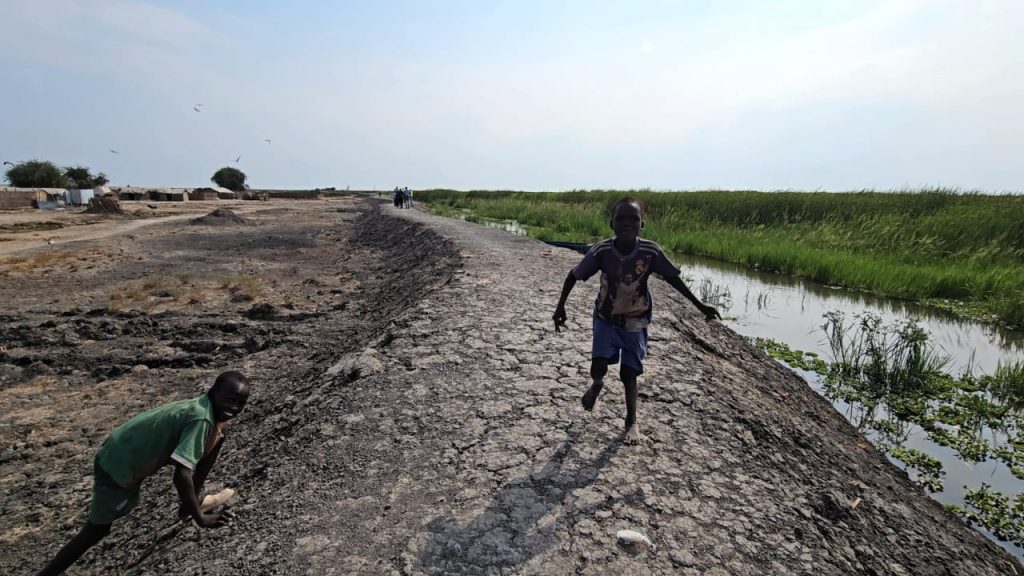
Along the raised dikes, children run barefoot on hardened earth that keeps their homes above water. Women carry firewood, and boys fish in dark pools along the swamp’s edge.
Most residents believe the water will return — this year or next.
For now, the dikes are holding. And life in Rubkona — fragile, improvised, but quietly hopeful — continues on the brink.








