By Éloge Willy Kaneza
When Samia Suluhu Hassan became Tanzania’s first female president in 2021, many people in the East African nation exhaled with cautious relief. Hassan’s calm demeanor, conciliatory rhetoric, and promises of openness, following on the heels of the authoritarian regime of John Pombe Magufuli, suggested a new era. Journalists were freed, the president recognized opposition candidates, diplomatic ties were restored, and a nation still grappling with pandemic denialism dared to hope for change.Yet, recent elections – and the horrific violence that has followed – have now shattered that optimism.
Election violence
Suluhu was re-elected for a second term as president on Oct. 29 with 98 percent of the vote. Since that time, the people of Dar es Salaam, the economic capital, and Dodoma, the political capital, as well as Mwanza, Kilimanjaro, and Mbeya, have been living in fear.
The powerful opposition party – Party for Democracy and Progress – known as Chadema, has reported that hundreds of people have gone missing in those cities because of post-election repression, and at least 1,000 people have been killed (some reports indicate the figure may be much higher, between 1,000 and 3,000 people).
Volker Türk, the United Nations High Commissioner for Human Rights, reports injuries and arbitrary detentions as well as deaths, and says that over 150 individuals – including children – have been arrested since polling day, many charged with treason.
Türk describes families that are “desperately searching everywhere for their loved ones, visiting one police station after another and one hospital after another.” He has called for the unconditional release of all opposition figures, and has demanded that due process be observed for those detained.
“There are disturbing reports that security forces have been seen removing bodies from streets and hospitals and taking them to undisclosed locations in an apparent attempt to conceal evidence,” Türk added.
The repressive atmosphere and climate of terror has constrained free speech in the universities as well as in the political sphere. A lecturer at the University of Dodoma, who requested anonymity due to fear of reprisal, said, “Professors and students fear speaking openly. Public discourse is silenced not by law but by terror. Citizens remain indoors while soldiers and police roam freely. Access Now reports coordinated internet shutdowns, censorship, and harassment of journalists and civil society.”
The volatile security situation, accompanied by internet shutdowns, have made verifying exact casualty figures impossible.
Kenyan journalist Rael Ombuor speaks out
Kenyan journalist Rael Ombuor has traced the repression to deeper political patterns: “This goes back to 2015 under the previous president, John Pombe Magufuli. That’s when repression began sneaking into the country’s politics. Media restrictions, arbitrary arrests, and a culture of intimidation started then, culminating in the COVID denial policies of 2020.”
She continued, “When Suluhu came in as vice president and then president, people hoped for change. Some political prisoners were released, and party gatherings reinstated, but the deeper issues persisted. Citizens demanded a real constitution and a multiparty democracy. That threat to the ruling party’s authority has never been tolerated.”
Ombuor has been documenting the widespread violence across the country. “In Kilimanjaro, I spoke to someone who lost seven friends – football teammates – three of whose bodies were never recovered. In Dar es Salaam, a teacher named Jocelyn was shot at a roadblock with her child. A university engineering student was gunned down at a restaurant while trying to reach home. One mother was handed a document with a false cause of death. These deaths cut across age, gender, and social status,” she said.
According to Ombuor, the media is being carefully controlled, in an effort to keep news of the violence from circulating.
ADVERTISEMENT

“Most Tanzanian newspapers could not report because of restrictions, and social media became the only source,” Ombuor said. “When the internet was cut off, even basic reporting became impossible. This was coordinated, pre-planned, and lethal. … This is systematic state terror.”
The free speech of professors and students at the University of Dodoma has been constrained. “[At one point] students at the university whispered rumors of colleagues arrested for merely discussing the elections. Classes went on, but the tension was palpable. People would pause mid-sentence, as if speaking too freely might summon police to their doorstep,”Ombuor continued.
Meanwhile, political figures advocating constitutional reform, such as Tundu Antiphas Mughwai Lissu, a chairperson of Chademu, have been arrested, and face charges of treason – one of the many examples of the regime’s intolerance for dissent.
Mediocrity of authoritarianism
Burundian journalist and political analyst Athanase Karayenga compared the leadership of Suluhu to that of Mwalimu Julius Kambarage Nyerere, who is widely revered and considered the father of the nation by most Tanzanians.
“Mwalimu Julius Nyerere, a remarkable personality embodying a responsible and respectable Africa, must have turned in his grave,” said Karayenga.
Nyerere served for two decades as first president of Tanzania following independence from colonial rule and the formal formation of the nation in 1964. The honorific “mwalimu” which means “teacher” in Swahili, is generally used in front of his name to denote respect and appreciation for his leadership style.
“Samia Suluhu Hassan is terribly disappointing! Tanzania is sinking into the usual mediocrity of African dictators,” Karayenga said.
On the question of whether women are capable of leading as ruthlessly as men, Karayenga added, “Power does not soften because a woman holds it. Authoritarianism has no gender – only interests.”
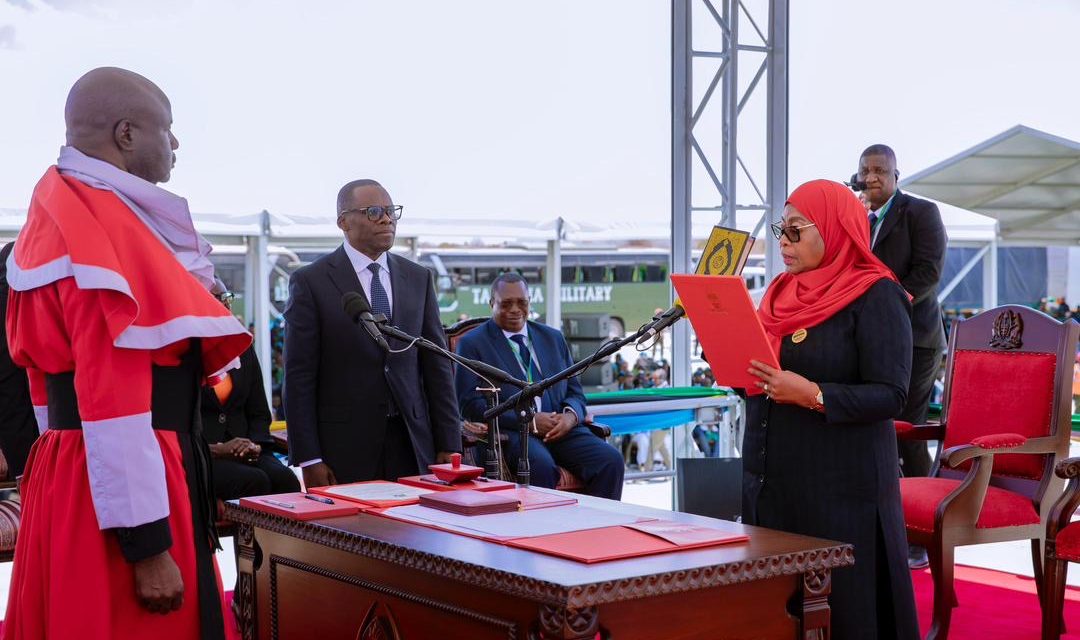
Suluhu was sworn in on Nov. 3, 2025, at a heavily secured military site. Only four African leaders attended: Daniel Chapo (Mozambique), Hakainde Hichilema (Zambia), Évariste Ndayishimiye (Burundi), and Hassan Sheikh Mohamud (Somalia). Each is associated with regimes accused of authoritarian practices.Chapo’s FRELIMO government has been in power for 50 years. They are widely accused of rigging the 2024 elections by crushing protests, killing over 400 people, and arresting more than 7,000 people. Ndayishimiye’s ruling party won all parliamentary seats after denying opposition leader Agathon Rwasa the right to compete. Human rights groups have accused the regime of targeted killings.
Internet, electricity blackouts
Amnesty International has confirmed widespread nationwide internet and electricity shutdowns since the elections, to silence dissent. Vongai Chikwanda, Amnesty International Deputy Regional Director, East and Southern Africa (ESARO), warned, “For close to a week now, many people in Tanzania have suffered nationwide internet and electricity shutdowns. Amnesty International is particularly alarmed by reports that amidst the blackouts, security forces have used excessive force to suppress and disperse ongoing post-election protests, resulting in the deaths and injuries of protesters.”
Chikwanda urged the government to uphold the human rights of the population. “Authorities must immediately refrain from suppressing protests and instead respect, protect, and facilitate the right to peaceful assembly. They must immediately and unconditionally release all those arrested solely for exercising their right to peaceful assembly.”
And those who have committed crimes must be held accountable, and victims compensated. “Authorities should promptly, thoroughly, independently, impartially, transparently, and effectively investigate all killings by security agents and bring to justice in fair trials those suspected of being responsible,” Chikwanda said. “Authorities must also provide victims and their families with access to justice and effective remedies.”
Amnesty International has documented the interruption of mobile data service and social media platforms during the election period, which has happened three times in less than a year. Partial resumption of services was reported on Nov. 3, 2025, but monitoring revealed ongoing censorship and intimidation.
Emphasizing the importance of media freedom, Chikwanda said, “The authorities must allow both local and international media to freely report on the human rights situation and refrain from restricting access to information, both online and offline, including by immediately restoring internet access and access to basic public services. The ongoing restrictions are making it difficult to verify information, and to document election-related human rights violations.”
Meanwhile, Suluhu has appointed both her daughter and her son-in-law to ministerial positions, a move widely viewed as nepotistic. Ombuor noted, “This is a slap on the face at a very delicate time. Nepotism may be common across Africa, but doing this while the country is bleeding politically is particularly provocative.”
Mass killings, detentions, cover-ups
According to eyewitness accounts from members of civil society, children and adults have been gunned down in homes, hospitals have been turned into hunting grounds, morgues conceal dozens of bodies, and thousands have been detained and extorted for bribes. Of the young football players who are alleged to have been murdered by operatives of the government, only one body has been recovered.
Reports suggest that foreign mercenaries, who are believed to be Ugandan, assisted Tanzanian forces in the attacks.
Kenya, Malawi, Rwanda, and Zambia have provided safe haven for some fleeing Tanzanians. Describing Kenya’s advocacy, Ombour said, “Kenya has consistently agitated for the freedoms of Tanzanians. Newspapers, lawyers, and human rights organizations in Kenya have amplified these issues while the Tanzanian government frames this activism as foreign interference, which is misleading and dangerous.”
A Nov. 17 statement released by the East African Civil Society alleges the deliberate targeting of civilians, including abductions from hospitals, killings, and mass disappearances, and calls for a regional fact-finding mission, the release of political prisoners, and the formation of a people-driven democratic constitution.
“What is happening in Tanzania is not an internal matter. It is a regional crisis, a humanitarian disaster, and a grave assault on the shared democratic aspirations of the East African people. Any government that clings to power through bloodshed, fear, and manipulation forfeits its legitimacy,” the statement said.
Suluhu and media reactions
On Nov. 14, Suluhu announced that her government had formed a team to investigate reports of the repression.
“I acknowledge as a mother that some young people joined those in protests without understanding the consequences. I urge security agencies to assess the severity of each case and consider dropping charges against those who were merely swept along by the crowd,” she said.
Two journalists covering the elections expressed skepticism. In the interest of safety, they requested anonymity. They said,
“Come to Tanzania, you’ll see. People have seen their neighbours shot dead while they were going to buy food.” And,
“This is laughable. What exactly are they investigating? What happened that she doesn’t know or authorize?”