
By Eloge Kaneza and Violet Ikong
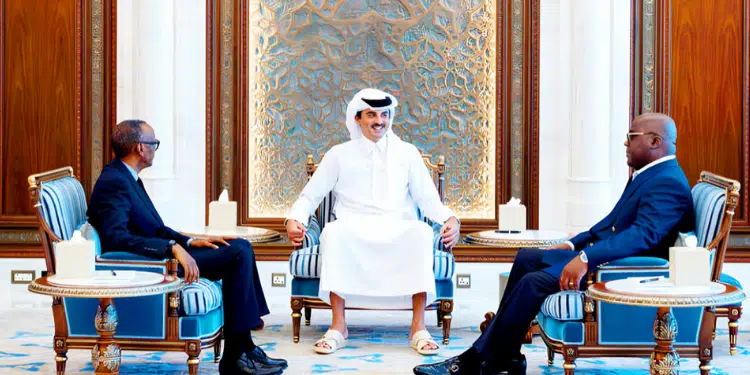
As Presidents Paul Kagame of Rwanda and Felix Tshisekedi of the Democratic Republic of the Congo (DRC) met behind closed doors in Doha, Qatar, in late April, and their respective ministers signed a declaration in Washington, D.C., on April 25, the brutal reality of a humanitarian crisis was playing out in eastern Congo. Rebel groups were expanding their control. Foreign troops were entering Congolese territory. And in what many see as an act of state failure, hundreds of Congolese soldiers and police officers were recently evacuated from Goma – disarmed and under UN protection.
Is U.S.-Great Lakes diplomacy promise or power play?
In Washington, D.C., on April 25, under the auspices of U.S. Secretary of State Marco Rubio, Congolese Foreign Minister Thérèse Kayikwamba Wagner and her Rwandan counterpart Olivier Nduhungirehe signed what observers hailed as a “milestone declaration of principles.” According to Rubio, the agreement reaffirms mutual respect for sovereignty, the need to end all support to armed groups, and lasting solutions for refugees and displaced people.
Wagner stressed, “Peace must be earned – it requires seriousness, transparency, and sincerity.”
Yet there was no handshake between Wagner and Nduhungirehe. Rwanda denies backing the M23 rebels, who have been accused by Kinshasa of seizing major towns in North and South Kivu beginning in January. Kigali, in turn, accuses Congo of colluding with Democratic Forces for the Liberation of Rwanda (FDLR) fighters – remnants of forces behind the 1994 genocide.
Following the high-level meeting, Nduhungirehe credited U.S. President Donald Trump for resetting the tone of diplomacy and focusing on economic cooperation, especially in mining and infrastructure, where U.S. companies are expected to play a major role.
Dr. Oluwole Ojewale, a senior African security expert and regional coordinator for the Institute for Security Studies (ISS) in Dakar, Senegal, gave an exclusive interview to Amjambo Africa, during which he emphasized the decisive role the U.S. must play in resolving the conflict.
“The U.S. is the most consequential country that can midwife this peace,” he said. “It has the power, strategic interest, and financial leverage – particularly over Congo – to bring both parties to the table.”
Ojewale underlined that critical minerals lie at the core of this geopolitical standoff. “Eastern DRC holds two strategic minerals: coltan, used in semiconductors, and cobalt, essential for car batteries. The U.S. needs access to these resources in a peaceful environment.”
He emphasized that Congo is desperate for security guarantees, while Rwanda seeks political recognition and integration of M23 into the Congolese system. “M23 is a special-purpose vehicle used by Rwanda to press strategic interests,” he explained. He said that three previous initiatives – by Luanda, Nairobi, and SADC (Southern African Development Community) – failed largely due to a lack of trust and weak enforcement. “African mediators lack the gravitas the U.S. brings to the table.”
ADVERTISEMENT

In his assessment, the conflict has been dangerously oversimplified. “This is not just a border dispute or a tribal war. This is a struggle for control over critical infrastructure and resources, masked in political and ethnic rhetoric,” Ojewale argued.
In his remarks to Amjambo Africa, Ojewale also highlighted the shortcomings of diplomatic pageantry. “Peace will not be achieved through handshakes and photo ops. We need a credible disarmament and reintegration plan for M23, and mechanisms to rebuild trust among the local population,” he said. “If people on the ground do not feel safe or represented, the cycle of violence will continue.”
He added, “The U.S. has a historical opportunity – but also a responsibility – to prove that its involvement is not just about resource extraction, but about lasting peace. Washington must ensure that peace deals translate into real changes on the ground.”
Ojewale also questioned the role of the international community, particularly MONUSCO, the United Nations Organization Stabilization Mission in the Democratic Republic of the Congo. “If MONUSCO’s presence cannot prevent mass displacement or support Congolese forces effectively, we must ask what strategic shift is needed,” he said. He urged a recalibration of peacekeeping priorities and increased U.S. engagement in peace enforcement – not just monitoring.
Foreign troops, regional conflagration risk
Meanwhile, the ground reality is worsening. In eastern DR Congo, violence and displacement continue unabated. Burundian President Évariste Ndayishimiye confirmed during a France 24 interview that approximately 10,000 Burundian soldiers are now deployed in South Kivu, supporting the Congolese Armed Forces (FARDC) and allied Wazalendo militias against M23.
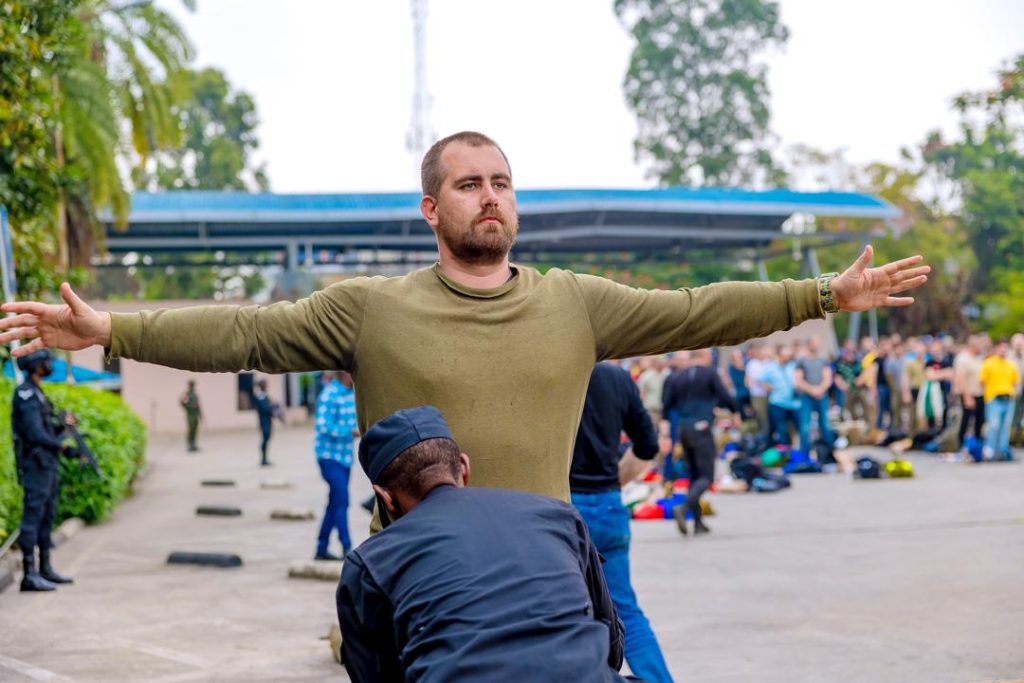
Photo: A European mercenary is searched at the border between the towns of Gisenyi (Rwanda) and Goma (DRC) before being loaded onto a bus to take him back to Kanombe airport in the capital Kigali, January 29, 2025 © SOS Médias Burundi
To the north, Ugandan troops have been present in Ituri and North Kivu since late 2021, officially deployed to fight the Allied Democratic Forces (ADF), a Ugandan insurgent group based in eastern DR Congo. This presence complicates regional dynamics, raising fears of an escalation.
Security expert Delphin Ntanyoma, a Congolese political economist and specialist on armed conflict and governance in the Great Lakes region, warns of a wider conflict. “We are on the edge of a precipice,” he said. “The deployment of foreign troops, continued support to militias, and diplomatic failure to address root causes could lead to an explosion.”
Does Goma evacuation signal state collapse?
Controversy erupted after the sudden evacuation of Congolese soldiers and police officers from Goma on March 30, just one day after the withdrawal of SADC forces. Critics questioned the timing, especially since the SADC mission had used Rwandan territory and airports, despite South Africa’s President Cyril Ramaphosa having accused Rwanda of backing M23.
Kagame angrily denied Ramaphosa’s claims, accusing South Africa of distorting facts and warning that Rwanda would defend itself if necessary.
The evacuation, coordinated by the International Committee of the Red Cross (ICRC) and MONUSCO, involved personnel who had been disarmed and sheltered in Goma for months after being overrun by M23. According to local sources, nearly 500 defected from the Congolese army to join M23 before the evacuation, raising serious concerns about cohesion within the Congolese army.
François Moreillon, head of the ICRC delegation in the DRC, stated that the operation was conducted with the consent of all individuals involved. “This role of neutral intermediary can help mitigate humanitarian consequences by minimizing harm to affected populations,” he said.
However, many observers saw the evacuation as a humiliating acknowledgment of military weakness. With over 2,000 soldiers and police originally sheltered in Goma, questions loom over the loyalty of forces and the state’s capacity to protect them.
Ability of talks to deliver peace questioned
Ojewale warned that fractured DRC-Rwanda relations and distrust among African states remain significant obstacles. “Only a respected external mediator like the U.S. can make headway,” he emphasized. But he cautioned that peace cannot rest on paper alone. “What comes next must be the rebuilding of communities, re-establishing state presence in eastern Congo, and ensuring M23 is disarmed or integrated.”
“If Rwanda agrees to peace, M23 can no longer operate. But trust has eroded too deeply. Healing must come first,” he concluded.
The stakes are immense, not only for Rwanda and the DRC, but for the Great Lakes region and global actors seeking both peace and profit in one of the world’s most mineral-rich yet unstable zones.
———
From left, Rwandan President Paul Kagame, Qatari Emir Sheikh Tamim bin Hamad Al Thani and DRC President Felix Tshisekedi attend a meeting in Doha on Tuesday. PHOTO/ Qatari Ministry of Foreign Affairs, Twitter







