By Éloge Willy Kaneza
I’m Your Neighbor Books (IYNB), a Portland-based nonprofit dedicated to welcoming immigrant families and fostering inclusive classrooms and communities, was founded on a belief that children’s books are meant not just for reading, but for building bridges across cultures, languages, and generations.
“We build conversations around story,” said Kirsten Cappy, Executive Director and co-founder of IYNB. “We work with schools and libraries all across the country to create spaces where everyone belongs.”
Founded in 2012, over the years IYNB has grown from a local, Maine-based initiative to one that is national in scope.
Weekend of connection
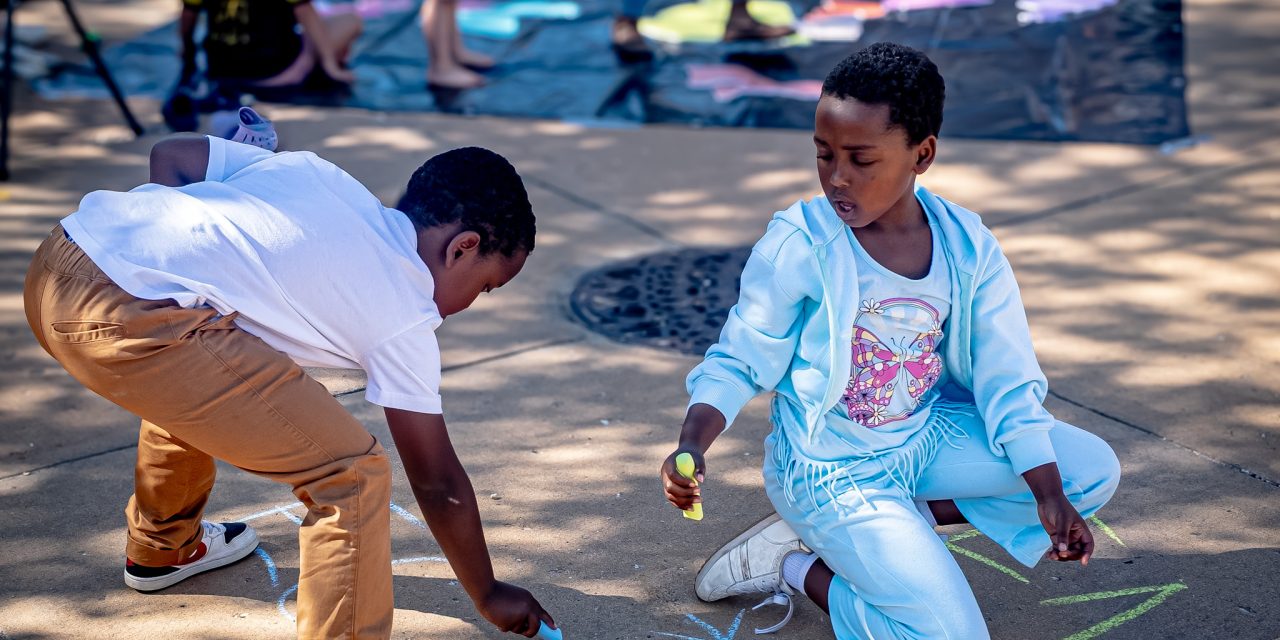
On October 4, I’m Your Neighbor Books brought its mission to Auburn, hosting a gathering that was a celebration of resilience, culture, and storytelling.
“The event was an opportunity to bring together a couple of nonprofits,” Cappy recounted. “One was L/A Arts, which operates in both Lewiston and Auburn, bringing music, art, and conversation to the community. Another was Marvel of Languages, run by Olga Koni, focused on returning home languages to families.” Koni bridges the divide between children who are learning English and their parents, whose languages might be slipping away, Cappy said. “And the Beautiful Blackbird Children’s Book Festival joined as well, celebrating books set in the African diaspora.”
This collaboration highlighted the synergy between language, art, and narrative, creating a day where immigrant families could see themselves represented, while the broader community could engage with stories that reflect the beauty of cultural diversity.
Why multicultural events matter today
Gatherings like the Auburn event carry even more weight in today’s political and social climate, Cappy pointed out.
ADVERTISEMENT

“They’re always important, right? But now, when the government is talking about making English the official language, it’s crucial to highlight multilingualism and inclusion,” she explained. “Research shows that multilingual kids are stronger students – if you hold more than one language in your head, you have a pretty amazing brain. Events like this affirm that all voices are important.”
For immigrant children, seeing their languages, traditions, and experiences validated is more than educational – it is emotional and transformative. “We are a multilingual, multicultural, multiracial nation, and with 26 percent of students now in the U.S. born outside the country or to immigrant parents, events like this are saying those voices matter,” Cappy added.
According to the Migration Policy Institute, “Approximately 17.9 million U.S. children lived with at least one immigrant parent in 2023. They accounted for 26 percent of all 68.9 million children under age 18.”
From Maine to the Nation: Growth through representation
Cappy recalled that a decade ago, she had trouble finding books representative of the immigrant identities present in Maine. Then that picture shifted. “We’ve seen incredible growth in that representation. Publishers are finally interested in stories about communities that have historically been maligned or attacked.”
Major shifts in children’s publishing often begin after periods of political tension – including the first administration of President Donald Trump, and the post-9/11 years. “Teachers wanted to turn to books to talk about the Muslim community, the beauty of their families, and yet there wasn’t a single children’s book with a Muslim family in it in 2001,” she recalled.
Now her organization is part of a growing movement to embrace diversity in literature, ensuring that immigrant and refugee children see themselves reflected in classrooms and libraries.
Story walk making narratives physical, public
One of the organization’s signature programs is Story Walk, an innovative initiative that transforms public spaces into walking narratives.
“Story Walk started in Vermont,” Cappy explained. “A librarian named Anne Ferguson took the pages of a book and stapled them along a path to draw families to the library in winter. It’s now a movement all around the country and the world. Children – and adults – can literally walk through a story.”
The Auburn event featured Kende! Kende! Kende!, a book co-created by Cappy and other community members, telling the story of a Congolese family navigating life from their village to a refugee camp in Uganda, and finally to the U.S.
“We worked with 14 different African community members to make sure the story felt authentic. Every word, every detail was reviewed by people who could confirm its truthfulness,” Cappy noted. “Even the map was vetted. Central Africa rarely gets representation in U.S. publishing, and we wanted to center the DRC.”
Power of seeing self in a story
For all children, being able to see themselves in a book matters profoundly to a sense of self-worth.. “White children in America constantly see families like theirs,” Cappy observed. “But immigrant kids rarely see themselves in books. Since publishing Kende! Kende! Kende!, [we hear that] families love that there’s French, Lingala, Swahili, Portuguese, Kinyarwanda, and Arabic – all voices from the community. Seeing themselves in a story helps kids feel like they belong.”
She emphasized the emotional and cognitive benefits of belonging: children who feel included in classrooms perform better academically and socially. “The most important thing is making sure our kids feel like they belong in the spaces they inhabit. They belong on the playground, in their faith organizations, in school, and in the community,” Cappy added.
The organization is concerned about the emotional needs of children impacted by immigration policies, and is developing ways to respond. “If students have lost a family member to detention or deportation, we put together book packages to help families heal a little. There is literature about separation, and we also include books about joy and community,” she explained.
In some U.S. states like Texas, Florida, and New Jersey, teachers and librarians have faced backlash for including diverse books on their shelves.
“Schools are worried about having these books in case they’re seen as controversial. Some teachers have been fired for having diverse books. We’re adapting, using single books and small community events to keep the conversation alive,” said Cappy.
Literature as tool for compassion
Cappy sees books as more than educational tools—they are instruments for social change and for building bridges: “When we have a positive relationship with someone, we see beyond racial and cultural differences. But we’re not always good at reaching across race and culture. Distrust and anxiety are human conditions. Books allow us to try those relationships in a safe way. Kids turn pages with their parents, see families who look like theirs or are different, and it creates intimacy.”
She said, “There’s a picture book by Jujy Morales called Dreamers. Morales says in that book, ‘We are stories.’ For me, that is the most important message: we are made up of the stories of our ancestors, of our families, and of who we are going to be. Books include us, they give freedom, and that’s transformative.”