By Éloge Willy Kaneza
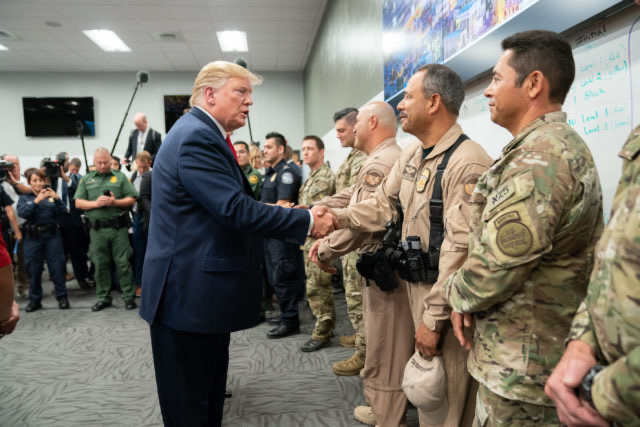
On November 2, President Donald Trump announced on his social media platform Truth Social that he has instructed the U.S. military to prepare for a potential intervention in Nigeria. He cited claims of a genocide by Islamist terrorist groups against Christians in Nigeria. In his statement, Trump accused the Nigerian government of failing to protect Christians from attacks perpetrated by terrorists.
“If the Nigerian Government continues to allow the killing of Christians, the U.S.A. will immediately stop all aid and assistance to Nigeria, and may very well go into that now disgraced country, ‘guns-a-blazing,’ to completely wipe out the Islamic terrorists who are committing these horrible atrocities,” Trump wrote on Truth Social.
He added, “I am hereby instructing our Department of War to prepare for possible action. If we attack, it will be fast, vicious, and sweet, just like the terrorist thugs attack our cherished Christians! Warning: the Nigerian government better move fast!”
Trump’s statements came a day after he labeled Nigeria a “country of particular concern,” highlighting threats faced by Christians.
ADVERTISEMENT

Response from Nigerian authorities
Nigerian President Bola Ahmed Tinubu responded by stating that his administration “has maintained an open and active engagement with Christian and Muslim leaders alike and continues to address security challenges which affect citizens across faiths and regions.” He emphasized Nigeria’s willingness to cooperate with the U.S. government and the international community to enhance national security.
Spokesperson Kimiebi Ebienfa from Nigeria’s Ministry of Foreign Affairs in Qatar stated that the government “will continue to protect all its citizens, regardless of differences in race, creed, or religion.” Ebienfa added, “We remain committed in our resolve to tackle the violent extremism that is fueled by special interests who have helped drive such decay and division in countries across the intersecting West African and Sahel regions. We mourn all the victims of violent extremism and salute our armed forces as they continue to fight against vicious but cowardly foes.”
Public reaction and context
Trump’s remarks have sparked mixed reactions among Nigerians. Since the early 2000s, Nigeria has struggled with numerous security challenges, including banditry, farmer-herder conflicts, and the Boko Haram insurgency, primarily in the northern regions. These groups have targeted both Christians and Muslims.
Meanwhile, the Republic of Chad has closed its border with Nigeria to prevent terrorists from fleeing into its territory. Chad’s president, Mahamat Déby, was quoted as saying: “No armed group or foreign force will be allowed to enter Chadian soil under any disguise.”
This is not the first time Trump has addressed the killing of Christians in Nigeria. In 2018, during his first term, Trump received Nigeria’s former president, Muhammadu Buhari, at the White House, where he described as unacceptable the continued killing of Christians in the country.
About Boko Haram
Boko Haram is an Islamist militant group that originated in northeastern Nigeria around 2002. Its official name is Jama’atu Ahlis Sunna Lidda’awati wal-Jihad, meaning “People Committed to the Propagation of the Prophet’s Teachings and Jihad.” The group opposes Western-style education and seeks to impose strict Islamic law.
Over the years, Boko Haram has carried out bombings, mass killings, and kidnappings. Most notoriously, in 2014, fighters abducted 276 girls from Chibok Secondary School in Borno State. Among them, 82 escaped by themselves, and 103 were released in small groups between 2016 and 2017 in exchange for prisoners. According to a United Nations statement in September 2025, at least 91 of the Chibok girls are either still in captivity or their fate remains unknown.
Boko Haram’s attacks target both civilians and security forces, primarily in Nigeria’s northern regions, and have spilled into neighboring countries like Niger, Chad, and Cameroon. Tens of thousands have been killed and millions displaced, making Boko Haram one of the deadliest extremist groups in Africa.