By Eloge Willy Kaneza
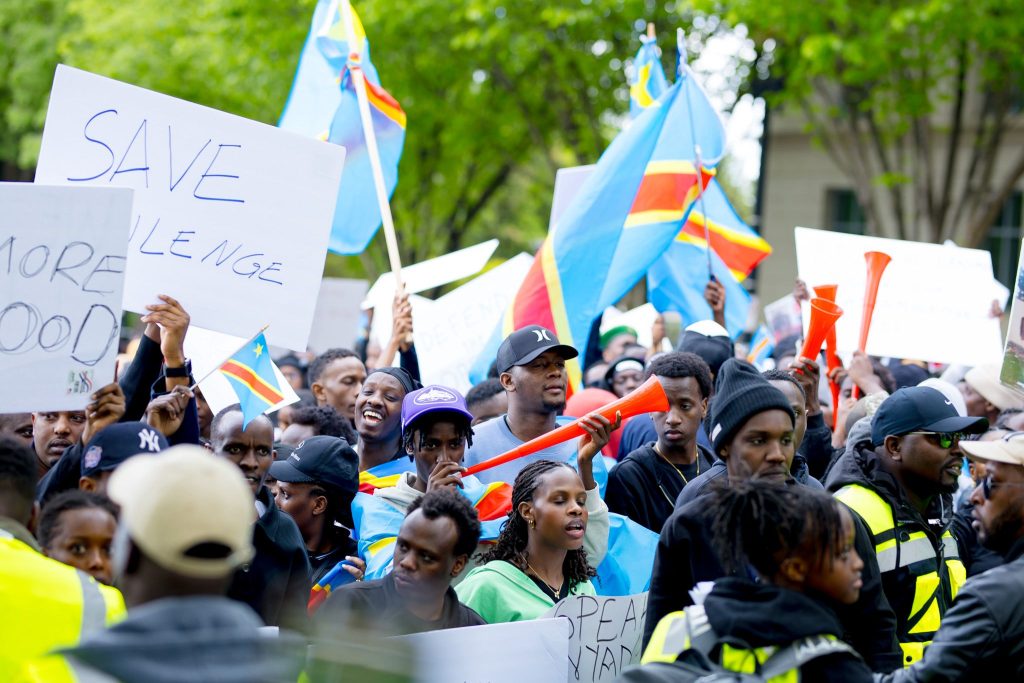
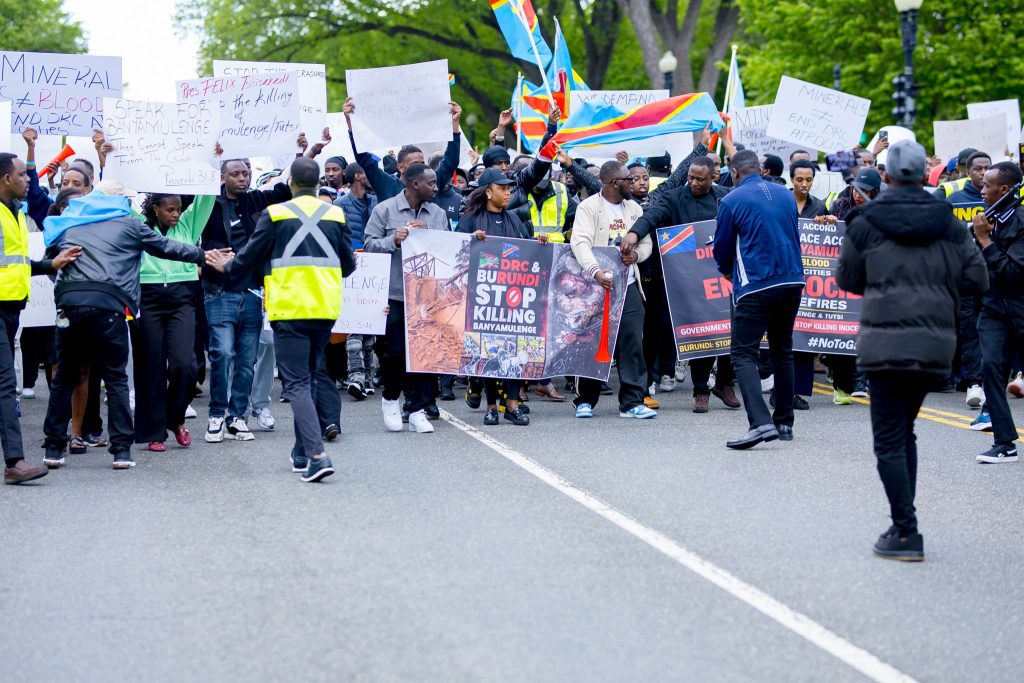
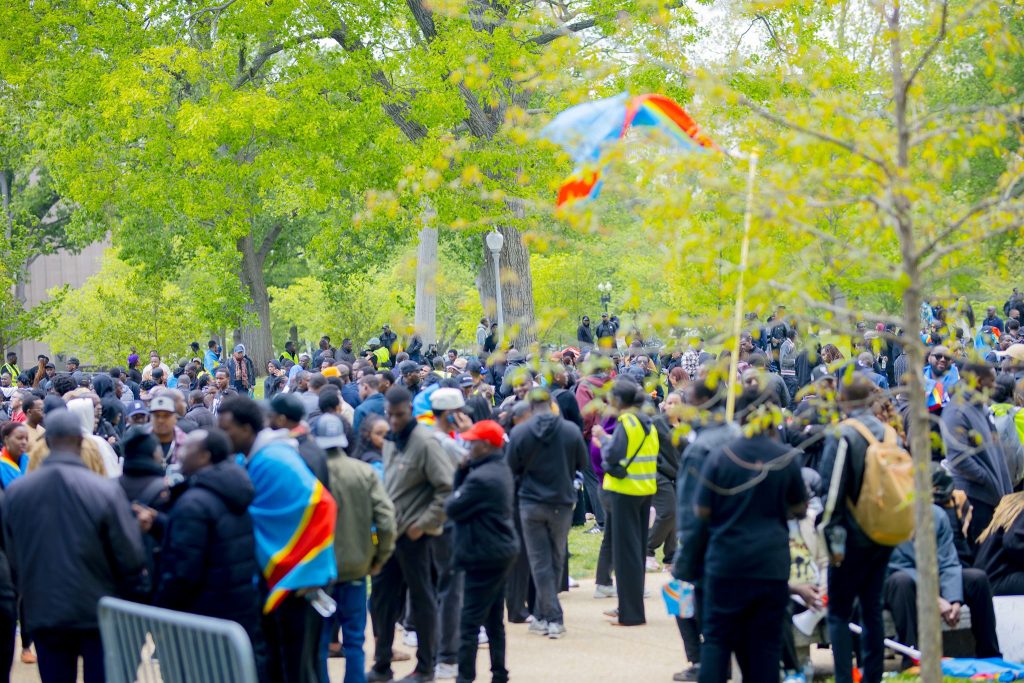
PORTLAND, Maine — More than 3,000 demonstrators gathered on Capitol Hill on Monday, April 20, as members of the Banyamulenge diaspora and their allies called for urgent international action in response to what they describe as a deepening humanitarian crisis in the eastern Democratic Republic of the Congo (DRC).
The rally, organized by the Mahoro Peace Association and partner organizations, brought together participants from 38 states, including a delegation of more than 220 immigrants and refugees living in Maine. The mobilization followed days of meetings with U.S. lawmakers and officials at the State Department, as advocates sought to elevate what they say is a long-overlooked crisis affecting Banyamulenge and other Tutsi civilians in South Kivu.
“We are here to tell the world and the U.S. government that Banyamulenge can no longer breathe,” said Esperance Nyasezerano, one of the rally’s organizers, in an interview with Amjambo Africa. “We are tired of being killed day and night. Even as we speak, our people are dying — by bullets, by hunger, and by isolation.”
A crisis years in the making
Since 2017, Banyamulenge communities in eastern Congo—particularly in Minembwe and the highlands of Mulenge—have faced escalating violence, displacement, and economic devastation. Advocacy groups warn that the situation bears the hallmarks of mass atrocity risks.
Independent organizations, including Genocide Watch, have placed the crisis on alert, citing patterns of targeted attacks and sustained persecution. Despite repeated calls for intervention, community leaders say the international response has remained limited.
“For nine years, we’ve been pleading with decision makers,” Nyasezerano said. “But they continue to act as if the Banyamulenge do not exist. We are a minority, and because of that, our suffering is ignored.”
“They are not just dying by bullets”
According to organizers and field reports compiled by advocacy networks, the humanitarian situation in South Kivu has reached critical levels. Entire communities are cut off by insecurity and blockades, limiting access to food, health care, and basic services.
“More than 450 villages have been destroyed. Thousands have been killed and displaced,” Nyasezerano said. “But let me tell you this clearly — our people are not just dying from violence. They are dying because they cannot eat. They cannot move. They are trapped.”
Reports from local sources interviewed by Amjambo Africa paint a similarly dire picture.
“Here in our village, we are bombed regularly. Our cows are gone, our homes destroyed,” said a resident in South Kivu who asked to be identified only as Musinga for security reasons. “If people try to go find food, they are targeted.”
Another resident, who only gave his last name, Byiringiro, for safety reasons, described what he called a deliberate blockade. “There is no salt, no sugar, no oil. The goal is to starve us,” he said.
Allegations of regional involvement and military escalation
Several sources in South Kivu, as well as in the port city of Rumonge in southwestern Burundi and the economic capital Bujumbura, confirmed to Amjambo Africa that Burundian troops continue to be deployed via Lake Tanganyika, underscoring ongoing military activity despite diplomatic efforts to de-escalate the conflict. This activity comes amid repeated findings by United Nations experts, who have reported that Rwanda maintains significant military involvement in the eastern DRC, including troop presence and operational support to the M23 rebel group.
Regional dynamics involving armed groups and neighboring countries further complicate the crisis. Community leaders accuse both Congolese forces and allied militias of targeting civilians.
ADVERTISEMENT

Nyasezerano alleged that foreign troops and militias have contributed to the violence, though these claims remain contested and require independent verification.
“What we are asking is simple,” she said. “If the international community doubts us, they should go to Minembwe — not [the DRC capital] Kinshasa — and speak directly to the victims.”
Human rights organizations have also raised alarm. A recent statement by Human Rights Watch described the situation in South Kivu’s highlands as “dire,” warning of abuses by multiple actors and severe restrictions on humanitarian access.
A call for accountability
Protesters in Washington, D.C. outlined a series of demands directed at the U.S. government and international partners. Demands included emergency humanitarian aid, enforcement of a ceasefire, targeted sanctions, and congressional hearings.
“We want accountability,” Nyasezerano said. “Accountability means saving lives, but also holding leaders responsible for crimes against humanity.”
She emphasized the need for investigations conducted on the ground, warning against relying solely on official narratives from authorities.
Diaspora voices and personal stakes
For many participants, the rally was deeply personal. Families traveled long distances — some more than 30 hours by car — to be present, often bringing children.
“When I see parents and kids coming together like this, I see a community refusing to stay silent,” Mike Rurenza Mfashingabo, a Maine-based community member, told Amjambo Africa. “This is not just advocacy. It’s survival.”
Elderly participants also attended the demonstration, underscoring the generational impact of the crisis.
Nyasezerano, herself a survivor of past violence and wounded in the 2004 Gatumba attack in western Burundi that killed more than 150 Banyamulenge refugees in a settlement near the DRC border, framed the mobilization as part of a broader historical struggle. “We have heard ‘never again’ so many times,” she said. “But for us, it keeps happening. So now we say: enough is enough.”
Growing mobilization across the diaspora
Organizers described the turnout as one of the largest mobilizations of the Banyamulenge diaspora in recent years. Similar protests were also held in Kenya, the United Kingdom, and Canada, reflecting growing international coordination among diaspora communities.
“It means that the people are realizing their power,” Nyasezerano said. “When ordinary people take things into their own hands, change becomes possible.”
Participants marched through the streets of Washington, drawing attention from passersby and media. Many carried images and documentation they say show evidence of atrocities. “We brought pictures, testimonies, detailed reports,” Nyasezerano said. “Anyone who sees them cannot deny what is happening.”
A broader regional conflict
The violence in South Kivu is part of a complex and long-running conflict in eastern Congo, involving multiple armed groups, regional actors, and long-standing ethnic tensions rooted in colonial-era divisions.
Armed movements such as M23, as well as local militias and foreign forces, continue to shape the security landscape. Despite recent diplomatic efforts, including U.S.-mediated talks, fighting persists.
Humanitarian agencies warn that millions of civilians across eastern Congo remain at risk, facing displacement, hunger, and disease in what is often described as one of the world’s most protracted crises.
Regional tensions and fragile diplomacy deepen crisis in eastern Congo
The crisis unfolds against a backdrop of fragile regional diplomacy and continued militarization. The M23 rebel movement, reactivated in 2021 and now part of the Congo River Alliance (AFC) led by Corneille Nangaa, controls strategic areas in North and South Kivu, including key mining zones. In South Kivu, M23 has aligned with Twirwaneho, a largely Banyamulenge self-defense group, further reshaping local security dynamics.
Kinshasa accuses Rwanda of backing M23, allegations Kigali strongly denies. However, United Nations experts have reported sustained Rwandan military involvement in the eastern DRC, including troop presence and operational support to the rebel alliance. The Democratic Forces for the Liberation of Rwanda (FDLR), a Hutu armed group linked to the 1994 genocide against the Tutsi in Rwanda, is meanwhile accused of operating with backing from elements within both Congolese and Burundian forces, further deepening regional tensions.
Millions of civilians across eastern Congo continue to live under constant threat of violence, displacement, and deprivation. Camps in Goma, Bukavu, and Ituri remain overcrowded, while humanitarian agencies warn of worsening hunger and disease.
A U.S.-mediated peace agreement signed in Washington on December 4, 2025 brought together Rwanda and the DRC, with President Évariste Ndayishimiye of Burundi attending the signing. The agreement called for disarmament of armed groups, while President Félix Tshisekedi of the DRC described FDLR fighters as “a residual force reduced to banditry.”
Talks held in Switzerland between the Congolese government and the AFC/M23 alliance concluded on April 17, 2026, with a limited agreement focused on humanitarian measures, including aid access, civilian protection, and prisoner releases. However, the deal fell short of a comprehensive political settlement, and fighting continues.
This fragile diplomacy contrasts sharply with conditions on the ground. For Nyasezerano and others, the gap between agreements and reality remains stark. “We have seen agreements before,” she said. “But what matters is what is happening to civilians on the ground. And right now, nothing has changed.”
That concern was echoed by Landry Kwizera, President of the Rwandan Community Abroad — Maine Chapter (RCAM), during Bates College’s April 11 commemoration of the 1994 genocide against the Tutsi in Rwanda.
“Unfortunately, we live in a world where the truth is not just a fact — it’s negotiable,” he said. “What is happening now has happened before, and the world went silent.”
For many observers and members of the diaspora, the warning is clear: without urgent action, history risks repeating itself. Rwandan President Paul Kagame, commenting in December 2025 on the plight of Banyamulenge civilians in eastern Congo, said, “People never ceased to call for help, but there was none to help them.” This remark was widely cited by advocates as a stark reflection of international inaction.
Legal warning on escalating violence
Maître Bernard Maingain, a Belgian attorney affiliated with the International Criminal Court and known for his work in Africa’s Great Lakes region, has warned of the gravity of the situation affecting Congolese Tutsis, including the Banyamulenge and Hema communities.
“There is an atrocious situation that is taking on the appearance of ethnic cleansing, if not genocide,” Maingain told Amjambo Africa. “If this continues, we risk, within a few decades, creating Tutsi enclaves in eastern Congo, much like the reservations imposed on Indigenous peoples in North America.”