
By Violet Ikong
As 2025 winds down, it will be remembered as one of the most complex years ever for U.S.-Africa relations.
From the dismantling of the U.S. Agency for International Development (USAID), to sweeping trade tariffs, security interventions, immigration crackdowns, and pushback by leaders, we examine key moments that shaped diplomatic ties between the U.S. and Africa during the first year of President Donald Trump’s second term.
These moments also offer a glimpse of what to expect in the coming year.
Goodbye, USAID
Shortly after Trump took over the reins of government, his administration began dismantling USAID, explaining that the move was aimed at stopping what it called wasteful spending of taxpayers’ money.
For decades, many African countries have relied on funding and in-kind support from USAID to cover interventions in health, education, and food. So, the sudden move left these countries scrambling to survive without this aid.
From Sudan to the DR Congo and South Sudan, conflict-torn and displaced communities witnessed deep cuts and total suspension of food and cash assistance as humanitarian agencies relying on U.S. foreign aid struggled to function.
The continent’s fight against HIV/AIDS also suffered a major setback. Several programs under the President’s Emergency Plan for AIDS Relief (PEPFAR), focused on HIV prevention, testing, and treatment, were interrupted, affecting close to 30 countries on the continent.
Programs that previously addressed child malnutrition and maternal and newborn mortality also struggled to deliver assistance to women and children due to the freeze on U.S. foreign aid.
Sweeping tariffs and trade act renewal
Trump’s America First policy and his transactional approach to diplomacy played out this year.
Trade tariffs ranging from 15% to 30% were slapped on imports from more than 20 African countries, including South Africa, Uganda, and Nigeria.
ADVERTISEMENT

In response, South African President Cyril Ramaphosa visited the White House in May to negotiate the tariff imposed on his country.
During the meeting, President Trump accused Ramaphosa of failing to address alleged attacks on White Afrikaner farmers. Ramaphosa denied the claims.
Meanwhile, the African Growth and Opportunity Act (AGOA) — a trade act that allows sub-Saharan African countries duty-free access to the U.S. market — expired in September. However, deliberations are ongoing in the U.S. Congress to renew the Act for three years in 2026, with eligible countries remaining hopeful that better times may be ahead.
Security interventions
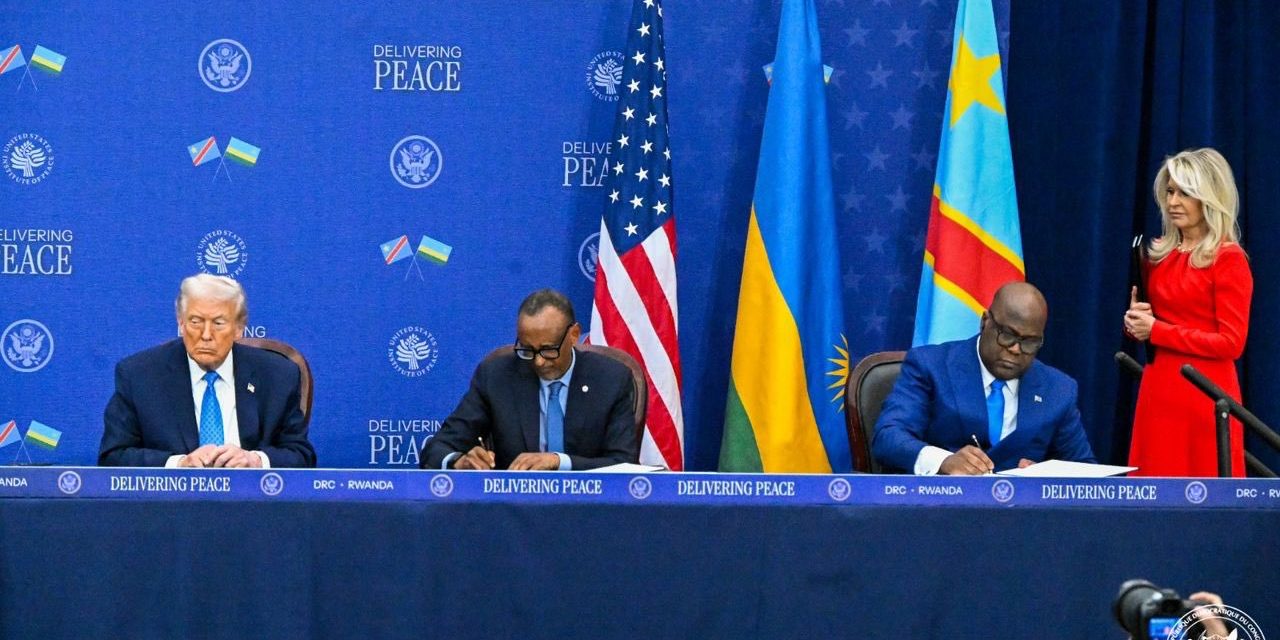
Among the most notable U.S. actions in Africa this year was its role in brokering a peace agreement between the Democratic Republic of the Congo (DR Congo) and Rwanda.
The deal, mediated by Trump, was signed by representatives of both countries to end decades of resource conflict in eastern DR Congo, where Rwanda has been accused of backing the M23 rebels involved in clashes with government troops.
Many have questioned the agreement’s effectiveness as the conflict has continued, killing and displacing many in the weeks following the signing. Meanwhile, Trump has hinted that the U.S. would receive a share of Congo’s minerals as compensation for brokering the peace deal.
In West Africa’s Nigeria, Trump claimed this year that a Christian genocide led by Islamist terrorists was ongoing and threatened U.S. military action in the country.
President Bola Ahmed Tinubu’s Nigerian government denied these claims, saying that while security in Nigeria is a problem, no one religious group is targeted by jihadist groups and terrorists.
U.S. Congressman Riley Moore visited Nigeria in December on a fact-finding mission and posted on social media about meeting with Christians displaced by terrorist attacks.
Moore says the U.S. and Nigeria are now close to signing a strategic security agreement to tackle terrorism in the country.
The ongoing war in Sudan also drew U.S. attention, with the Trump administration accusing the United Arab Emirates of supplying weapons to the Sudanese paramilitary group, the Rapid Support Forces (RSF).
Although Trump had mentioned in November that the U.S. would get involved to end the war in Sudan, all eyes are now turned on 2026 for possible concrete action.
Refugee resettlement and deportations
Trump’s administration has effectively halted resettlement for forcibly displaced Africans, as well as vulnerable people from other regions of the world.
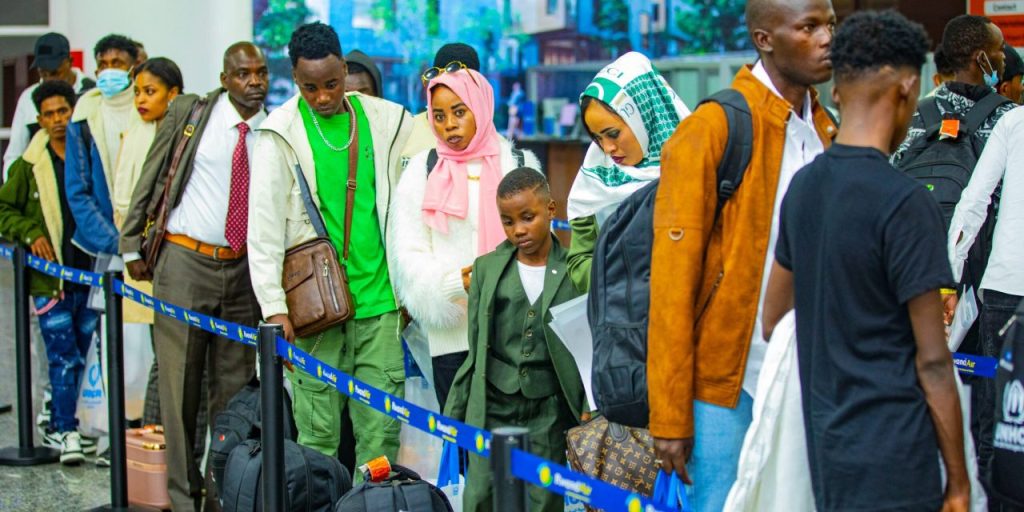
The U.S. resettled approximately 34,000 African refugees in fiscal year 2024 under President Biden. In 2025 the Trump administration granted refugee entry to about 400 people –from the South African White Afrikaner community. For fiscal year 2026, the president has said the U.S. will resettle just 7,500 refugees, primarily White Afrikaners.
On top of restricting entry, Trump also deported African nationals from countries such as South Sudan, Nigeria, and the Gambia.
At the same time, Rwanda, South Sudan, Ghana, and Eswatini accepted Trump’s offer to receive deportees in exchange for financial incentives and the lifting of visa restrictions.
This move was widely condemned by Africans who believe the continent is being treated as a dumping ground for people the U.S. does not want to host.
African leaders pushed back
Despite threats of sanctions and slapped tariffs, 2025 was marked by moments of resistance, as several African leaders pushed back against Trump’s policies and rhetoric.
Notably, South Africa hosted the G20 Summit without President Trump or any U.S. delegates in attendance. This move was widely interpreted as a quiet but firm rebuke amid strained relations over trade tariffs and unfounded allegations of violence against White Afrikaner farmers.
South Africa used the Summit to emphasize multilateralism, South-South cooperation, and Africa’s agency in global governance.
Countries like Nigeria, Uganda, and Burkina Faso rejected requests to receive third-country deportees from the U.S. and were applauded for their stances.
Looking forward
As 2026 approaches, the direction of U.S.-Africa relations will depend not only on American policies but on how firmly African leaders continue to take control in a fast-changing global order
With the African Growth and Opportunity Act (AGOA), renewal negotiations underway, the Sudan conflict heading into its third year, and questions lingering over security agreements, 2026 will test whether the current transactional style of diplomacy will give way to more stable partnerships.