In celebration of National African Immigrant Heritage Month this past September, Amjambo Africa is proud to feature a groundbreaking voice in the national conversation on immigration. Dr. Neeraj Kaushal, a professor of social policy at Columbia University, brings a fresh, evidence-based perspective to a topic often clouded by political rhetoric.
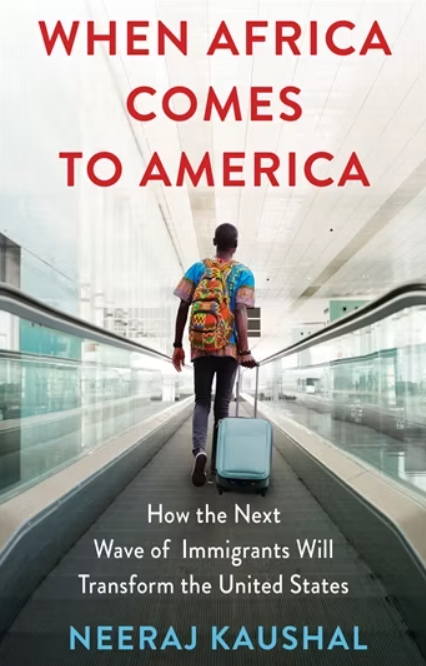
In her latest book, When Africa Comes to America, Kaushal pushes back against traditional narratives surrounding migration. She sat down with Amjambo Africa to unpack a bold and important thesis: Black Africa will become the most indispensable source of U.S. immigration in the second half of the 21st century.
Kaushal, who is of Indian descent, was initially motivated to explore this topic while writing her 2019 book, Blaming Immigrants, which documented growing anti-immigrant sentiment worldwide. Wondering what the long-term future of global migration would look like, she turned to the data.
“My own demographic projections, economic projections, [United Nations development program] projections, and the Census Bureau… everything points me to Africa,” Kaushal explained. “The future of America is in Africa.”
Shifting the narrative: ambition over desperation
When Americans think of immigration from Africa, the popular imagination is often dominated by images of desperation. Sensationalized media and political narratives frequently attribute African migration to hunger, civil war, climate change, and violence.
While acknowledging that these factors exist, Kaushal’s hardcore data tells a vastly different story about the people actually arriving on American shores.

“The cause of immigration from Africa is no different from the causes of rising immigration from the rest of the world, from China or India,” Kaushal noted. “It is primarily that there is a sufficient middle class in African countries who have the aspirations as well as the means to come to the United States.”
Migration, she pointed out, is not inexpensive. The sheer cost of international travel means that African immigrants are “highly positively selected.” They are educated, ambitious professionals seeking to maximize their potential. Furthermore, much of African immigration to the United States is entirely legal, driven by the framework of the 1965 Immigration and Nationality Act.
Rather than bringing “underdevelopment,” as negative stereotypes suggest, these immigrants are importing highly sought-after skills. From Nigerian doctors providing vital healthcare across the United States to Ethiopian professionals driving local economies, African immigrants are deeply embedded in the American workforce. Kaushal noted that even those who arrive as refugees or face hurdles with professional certification, such as former high-ranking government officials or academics working in entry-level jobs, display an unmatched resilience, often working multiple jobs to rebuild their lives and support their families.
Bridging the stubborn wealth gap
ADVERTISEMENT

One of the most striking revelations in Kaushal’s book is the profound economic impact African immigrants and their children are having in the United States, particularly in relation to historical racial disparities.
“The second generation, the children of black immigrants, are far more educated than U.S.-born whites,” Kaushal revealed. “And second-generation black women living in the U.S. have earnings that are equal to those of white women in the U.S.”
For decades, the Black-white earnings gap in America has remained stubbornly high, resisting various policy interventions. Yet Kaushal argues that immigration is organically beginning to bridge that gap. By occupying top-tier professions in academia, law, medicine, and the tech sector, African immigrants are redefining what economic success looks like in real time. Kaushal boldly predicted that Black immigrants will become the country’s next “model minority,” breaking through glass ceilings in corporate America much like Asian and Indian immigrants have done in recent decades.
Demographic destiny: The shrinking West and the rising continent
The working-age populations in many Western nations, and even in massive Asian countries like China and India, are either shrinking rapidly or will soon plateau and decline. In contrast, researches indicate Africa is the only continent where populations will continue to grow robustly due to higher fertility levels.
“In the second half of the 21st century, Africa [will] be a major, primary source of talent and immigration in the U.S.,” Kaushal explains. For the United States to maintain its economic dominance and care for its aging population, it will have to look to Africa. “They have to open their minds, not just their policies, to accepting Black immigration from Africa.”
Transnational identity and “brain circulation”
Unlike some previous immigrant waves, African immigrants navigate a unique cultural terrain. While they assimilate rapidly — learning the nuances of the American workforce, adapting to the language, and eventually engaging in the democratic process — they maintain a fierce and proud connection to their roots.
Kaushal noted an interesting phenomenon on college campuses: While many East Asian students adopt American names upon arrival, African students almost universally keep their given names, enhancing their transnational identity. “There’s that African pride, which I think is very interesting and impressive,” she said.
This transnational identity fuels a powerful two-way exchange between the United States. and Africa. Rather than “brain drain,” Kaushal prefers the term “brain circulation.” The flow of ideas, talent, and capital benefits both the sending and receiving nations. For example, remittances are a massive economic driver; in Ethiopia, annual remittances total roughly $8 billion, far surpassing the country’s $5 billion in annual physical exports.
Kaushal also pointed to sports as a highly visible example of brain circulation. During the recent FIFA World Cup, several African nations fielded highly competitive teams bolstered by athletes who had migrated to, and trained in, Europe. This policy shift allowed them to play for their countries of origin, providing a massive cultural catalyst and creating global role models for African youth.
The complex dynamic with African Americans
When African immigrants arrive in the United States, they are often homogenized into a single racial category, a reality that requires intense adjustment.
“Till they left Africa, they knew they were Black, but they didn’t know that was the only identity they had,” Kaushal observed.
This racial categorization creates a complex, and sometimes tense, dynamic between newly arrived African immigrants and native-born African Americans. African immigrants often actively seek to distinguish themselves to avoid the systemic, institutional racism that has historically marginalized descendants of enslaved Africans in the United States.
However, this does not preclude deep solidarity. History shows that Black immigrants from the Caribbean and Africa have been instrumental alongside U.S.-born Black Americans in fighting racial injustice, from the Civil Rights movement of the 1960s to the modern Black Lives Matter movement. Kaushal hopes that the professional success of highly skilled African immigrants will ultimately “crack the glass ceiling for the rest of the population,” benefiting all Black Americans.
The political reality
Despite the immense contributions of African immigrants, the current political climate can be unforgiving. Communities across the country, including those in Maine, have witnessed an uptick in Immigration and Customs Enforcement (ICE) activity, which has disproportionately struck fear into African immigrant neighborhoods.
Yet Kaushal remains optimistic. She noted that public sentiment toward immigration in the United States operates like a pendulum. “The pendulum went all the way towards the extreme right… but by now, there’s a lot of sympathy and even anger in the American public about what’s going on with ICE,” she stated. General public sentiment, according to the data, is currently swinging back toward a more sympathetic, centrist view of immigration.
When asked what policy makers should do to harness the potential of this rising African demographic, Kaushal’s advice is remarkably straightforward: just get out of the way.
“I am not advocating any change in the policy, but whatever policy we have, let them come. Don’t make it more difficult for them to work or seek education,” she urged.