Kennedy Park came alive on May 30, 2026, for a day combining soccer and Nzango, a traditional game originating from the Democratic Republic of the Congo (DRC). Despite rainy weather that limited attendance from some families, the initiative highlighted the role of sport as a tool for social cohesion, cultural exchange, and community connection in Portland.
The event brought together participants from diverse backgrounds through sporting activities designed to encourage interaction, strengthen community ties, and promote physical and mental well-being. For many families present, it was also a moment of relaxation, social connection, and cultural discovery in a shared public space.
The initiative was led by Landry Mungoma, who aimed to use sport as a bridge between local communities.
“We wanted to bring communities together, create a space where everyone can meet, get to know each other, and discover different cultures,” he said. “We all live here, but we don’t always have the chance to interact. Sport naturally creates those connections.”
He emphasized the cultural dimension of the event, particularly through the introduction of Nzango. “We want to share our culture with our neighbors and friends. Nzango is a traditional game from the DRC, but many people here don’t know it. This event was an opportunity to show that our traditions can also bring people together and be enjoyable,” he added.
What is Nzango?
Nzango is a traditional foot-based game originating in Central Africa, mainly played in the Democratic Republic of the Congo and the Republic of the Congo. It is now considered a cultural practice, a sport, and a social activity deeply rooted in local communities.
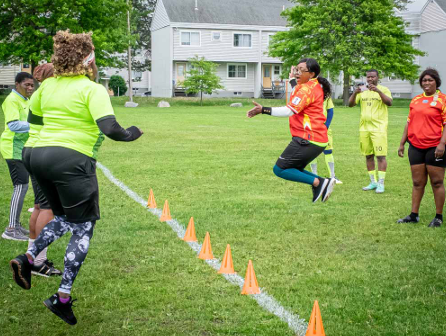
A blend of dance, chanting, gymnastics, and choreography, Nzango is played in a rhythmic and energetic setting where coordination, speed, and teamwork are essential. Two teams face each other, with players performing synchronized foot movements according to specific rules, under the supervision of a referee who awards points based on performance.
Historically, Nzango was played informally in schoolyards, villages, and public spaces, especially during leisure moments and community gatherings. It served both as entertainment and a form of social bonding.
Over time, it became more structured and was officially recognized as a sport, particularly in the DRC in the early 2000s. Today, it is played across several Central African countries, including the DRC, Republic of the Congo, Central African Republic, Cameroon, Gabon, and Burundi.
Beyond sport, Nzango is widely seen as a tool for social cohesion and well-being. It promotes physical activity, reduces stress, and strengthens relationships among participants. In African diaspora communities, it also plays an important role in preserving cultural identity and maintaining a connection to heritage.
A key focus of the event was the inclusion of women. According to organizers, many mothers juggle work, childcare, and household responsibilities, leaving little time for leisure or physical activity.
ADVERTISEMENT
“Many women sometimes feel isolated. They take care of their children and rarely have time for themselves. Staying indoors can affect morale. We wanted to give them an opportunity to come out, move, laugh, and build new friendships,” Mungoma said.
Nzango was placed at the center of the program, while men participated in soccer matches. The traditional game attracted strong participation from women despite the rain.
Karine, one of the participants, described the experience as both physical and emotional. “I loved this activity! Nzango is great for health because it helps us stay active and take care of our bodies,” she said.
She also reflected on the sport’s emotional meaning. “In Congo, we used to play Nzango often. I even participated in competitions. Playing here in Portland felt like reconnecting with a part of my country. It brought back many memories and made me happy,” she said.
Other participants shared similar feelings of nostalgia and joy, saying the game allowed them to reconnect with childhood traditions and cultural identity.
Several women expressed interest in forming an official Nzango team in Portland to practice regularly. “We would really like to form a team. It would allow us to play regularly, stay in shape, and maintain our cultural connection. It would be a great activity for women in the community,” one participant said.
The participant believed such an initiative could have positive effects on both physical and mental health by reducing stress and encouraging social interaction. “When we play, we forget stress. We move, we laugh, we meet people. It’s good for both body and mind,” they added.
Participants also emphasized the importance of passing the tradition on to younger generations growing up in the United States.
“Our children are growing up here. Many don’t know our traditional games. A Nzango team would allow them to discover their cultural heritage and understand where their parents come from,” a participant explained.
Beyond the Congolese community, the event attracted curiosity from other residents of Portland. Several visitors stopped to watch the matches and learn about the game.
An American participant praised the energy of the activity. “I had never seen this sport before. It was fascinating. There was so much energy, coordination, and joy. The participants looked genuinely happy,” she said.
Another visitor highlighted the importance of such initiatives in a multicultural city like Portland. “These activities allow people to discover different cultures in a positive way. You learn by meeting people. This is exactly what our communities need today,” he said.
Spectators appreciated the festive atmosphere created by music, cheering, and constant interaction among participants.
“Even without understanding the rules at first, you quickly get the spirit of the game. There was real solidarity among the players. It was very enjoyable to watch,” one attendee said.
For Mungoma, these reactions reinforce the value of intercultural initiatives. “When people discover each other’s traditions, they develop more understanding and respect. Prejudices fade, and relationships become more natural,” he said.
The event also highlighted the health benefits of sport. Whether on the soccer field or during Nzango activities, participants engaged in physical exercise in a friendly environment.
“Sport is a powerful tool for physical and mental health. It brings people together, reduces stress, and encourages healthier lifestyles,” Mungoma said.
Building on the success of the day, Mungoma hopes to turn the initiative into a long-term community program. Plans include forming an official Nzango team, organizing regular intercultural sports events, and hosting competitions between different communities in the Portland area.
“We want to continue strengthening these connections. We hope to work with more associations, families, and community members. The more people involved, the greater the impact,” said Mungoma.
He also called for volunteers and partners. “I invite all communities to join us. Africans, Americans, everyone is welcome. We need volunteers, partners, and motivated people to help organize more activities. Together, we can build something meaningful for our city,” he added.
Despite rain and logistical challenges, the day left a lasting impression. It brought communities closer, showcased a cultural tradition, and demonstrated the power of sport as a tool for inclusion and unity.
For many participants, the experience should not remain a one-time event. They hope to see Nzango take root in Portland and continue building bridges between communities.
Editor’s Note: This article originally appeared in the early July 2026 print edition of Amjambo Africa.