
By Andy O’Brien
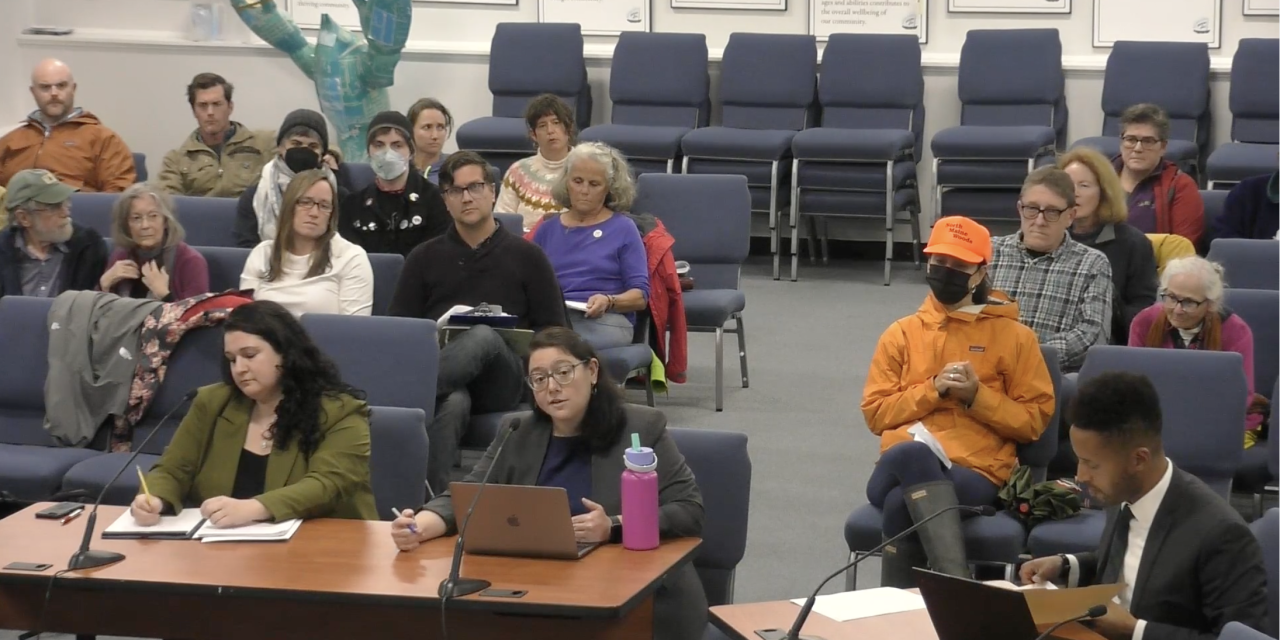
The Rockland City Council voted 4-1 on Nov. 10 to advance an ordinance that would prohibit police and other city employees from assisting or cooperating with federal authorities on immigration enforcement without a judicial warrant. The measure provides an exception for criminal investigations, and where cooperation with federal immigration authority is required by state or federal law or court order. The council could take its final vote on the ordinance as early as Dec. 8, when the ordinance is scheduled for a second reading.
Councilor Kaitlin Callahan, who sponsored the ordinance, said her proposal will send a “clear message” that Rockland “will not be governed by fear.” Her comments drew a standing ovation from members of the public in the council chamber.
“This ordinance amendment is a profound declaration that will define our city’s moral character of standing against the national tide of cruelty and rejection of the fear that seeks to normalize the unprecedented assault on decency we are witnessing. This is not politics as usual. It is a line drawn in the sand against a darkness that history warns us about. A threat we are obligated to resist here on a local level with every fiber of our being,” Callahan said.
Councilor Nate Davis said he supported the proposal because allowing city police to collaborate with federal immigration enforcement agencies would violate his oath of office.

“My mother came to America as a refugee. She was among the huddled masses welcomed by the ‘Mother of Exiles’ through the Golden Door,” said Davis. “My gratitude for that welcome is profound and only deepens with time. I intend to vote for this amendment as an act of neither resistance nor defiance, but of fealty to the Constitution and to the ideas that have animated this nation to the best things that we have done.”
Mayor Penelope York and Councilor Adam Lachman also voted to advance the proposal. However, Lachman said he intends to submit an amendment to address some of his legal concerns. Councilor Nicole Kalloch, a recently enrolled Republican who is running for Maine Senate as an independent, voted no.
Callahan and Davis worked on the ordinance in collaboration with the ACLU of Maine. The proposal would prohibit police from calling in immigration authorities following traffic stops for minor infractions. It would also prohibit police from allowing Immigration and Customs Enforcement (ICE) and Customs and Border Protection (CBP) to access people detained or in custody, except when presented with a proper judicial warrant as part of an investigation into serious crimes such as human trafficking, or sex, drug, or firearms trafficking.
ADVERTISEMENT

In addition, in response to actions by President Donald Trump’s administration, which has been seeking voter data and other sensitive information from state and local governments, the ordinance includes language banning the sharing of immigration statuses and other personal information about residents with immigration enforcement.
“By extending this ordinance to all city employees you’ve really covered each angle through which the federal administration can get at the data of your residents here,” said Alicia Ray, policy fellow with the ACLU of Maine.
“This ordinance amendment is a profound declaration that will define our city’s moral character of standing against the national tide of cruelty and rejection of the fear that seeks to normalize the unprecedented assault on decency we are witnessing. This is not politics as usual. It is a line drawn in the sand against a darkness that history warns us about. A threat we are obligated to resist here on a local level with every fiber of our being,” Callahan said.Kaitlin Callahan
The ordinance would also prohibit city employees from entering into immigration enforcement partnerships with federal authorities, honoring requests to detain people over alleged immigration violations, or granting ICE or CBP access to city facilities for immigration enforcement.
Speaking at the meeting, legal staff from the ACLU and the civil legal aid nonprofit Immigrant Legal Advocacy Project (ILAP), described how the Trump administration’s mass deportation agenda has violated the constitutional rights of immigrants in Maine. ILAP Policy Director Lisa Parisio said her organization has documented instances where Maine law enforcement authorities transferred people stopped at routine traffic stops to the custody of Customs and Border Protection agents.
So far this year, ILAP has tracked 22 minor traffic incidents in which at least 50 people have been handed over to immigration officers based on their suspected immigration status alone. Parisio said ILAP has verified that local police, sheriffs, and state police have handed over Maine residents with lawful immigration statuses, valid work permits, and no criminal history, and who were engaged in lawful immigration processes.
“The people handed over in these incidents have not been drivers,” said Parisio. “They have been passengers, they have been bystanders. Even car accident victims and even children have been handed over to Border Patrol in this way.”
She said ILAP’s clients have reported that the terror inflicted on immigrant communities by these raids has made them avoid reporting serious crimes – such as domestic violence and human trafficking – out of fear that they would be handed over to immigration officers.
Michael Kebede, ACLU of Maine Policy Director, pointed out that other police departments across the nation have been subject to expensive lawsuits for cooperating with ICE in violation of residents’ constitutional rights. He called the proposed ordinance “a money saver” for the city.
Several local residents spoke in favor of the proposed ordinance. A Columbian American woman from Rockland said she is very concerned about ICE targeting immigrants regardless of their legal status. She said while she doesn’t have an accent when she speaks, her mother does, and she has seen how she is treated differently by people when they hear her speak.
“Both my mother and my sisters are naturalized citizens,” she said. “My biggest concern is that in terms of what I have seen enacted currently in this country is that cruelty seems to be the point, not anyone’s value.”
Police chief, city attorney express concerns
Rockland’s city attorney Mary Costigan of the firm Bernstein Shur, and Police Chief Tim Carroll both expressed legal concerns about the ordinance. Costigan argued that the ordinance could violate Rockland’s charter because city councilors cannot, individually or as a group, direct employees who are under the supervision of the city manager. She believes the ordinance could create a situation where an individual could sue Rockland. Instead of an ordinance, she advised the council to submit the policy as a resolution.
However, advocates argue that a resolution does not have the force of law that an ordinance has. Kebede, of the ACLU, suggested the council could pass both an order and an ordinance.
Carroll also expressed concerns that the ordinance would prevent his officers from intervening if an immigration arrest turned violent and they had to restore order. He said the public would perceive that intervention as assisting an ICE arrest.
Lachman said he intended to submit an amendment to the ordinance that will address both the city attorney’s and the police chief’s concerns. Callahan said she was amenable to tweaking some language to clarify that police could intervene during an arrest if there was a public safety threat, but that he would not want to see the ordinance changed into an order or resolution.
At the end of the meeting, Callahan addressed an online threat she received on Oct. 30 for sponsoring the ordinance:
“To the vile, tiny, cowardly man who publicly called for the killing of my family and the rape of my 6-year-old child, I will just say this: In 1941, my Grandpa Frank did not choose to enlist in the U.S. Army, go from midcoast Maine farm life to an active war zone in Tunisia, get captured by the Axis Powers, survive a forced march across northern Africa, only to be handed over to Nazis and held as a prisoner of war for the better part of three years, all so that in 2025 his granddaughter would keep her big mouth shut and cower in the face of injustice and hate when it faced our own community. If you thought fear would silence me, you failed and clearly you did not know me.”