By Amy Harris
Many immigrants have a traumatic history with water and swimming, a fear that keeps them from learning to swim even once they are in the U.S. This is the story of three young men, and how Maine community members helped them learn to swim.
Like many new Mainers, Dinjo and his two friends did not know how to swim, even though they now lived along some of Maine’s 3,478 miles of tidal coastline, rivers, and more than 6,000 ponds and lakes. The young men, two of whom did not want to be identified in this article, had many reasons not to swim.
Djino, born in the Democratic Republic of Congo, was raised in Angola by his single mother. His two friends are also from Angola. All were raised to fear the water. “[In Africa, people don’t have that much access to the water. They may only go to the beach twice a year, if at all. And when they go there, they don’t go there to swim. They just go and take a walk,” said Djino. “As we grow older, our fear of water grows. You grow up hearing stories of people drowning because most people don’t know how to swim. You fear the day that you actually need to go to the water.”
That day came for the three Africans when they crossed the treacherous Darien Gap as teenagers. They traveled first from Angola to Brazil, and then up through Panama and Colombia on their way to the southern border of the United States. Along the border between Panama and Colombia, they trekked through 66 miles of the Darien Gap’s remote and dangerous jungles, mountains, and rivers.

Djino and the others never shared details of their traumatic passage with their local Yarmouth friends — but have implied that they had witnessed fellow migrants lose their lives to the rushing river waters. “It doesn’t take much water for people to drown in. It doesn’t have to be an ocean,” Djino told me.
Their fear of water, and not knowing how to swim, kept Dinjo and his friends from enjoying post-soccer practice ocean plunges with the Yarmouth Men’s Soccer Team during late summer and early fall, when temperatures stayed warm. Dinjo was the manager and his two friends played on the team.
ADVERTISEMENT

“We just sat on the sand, watching people, trying to look cool,” remembers Djino. Zach, an observant teammate, noticed that in 3 years of knowing his African teammates he had never seen them swim. He told his mother that he worried they felt left out or embarrassed. Even worse, what if they tried to swim, or fell off a pier or boat one summer day? Zach wondered, “Would they drown?”
Zach became friendly with outgoing Djino, so close that Zach’s mom even offered to help Djino learn to drive because Dinjo’s own mother didn’t have a car or license. Through their time together behind the wheel or on the sidelines, Zach’s family’s friendship with Djino grew. In his senior year of high school, they helped Djino apply for the University of Southern Maine’s Promise Scholarship, an honor awarded to only 100 highly qualified Maine scholars each year.
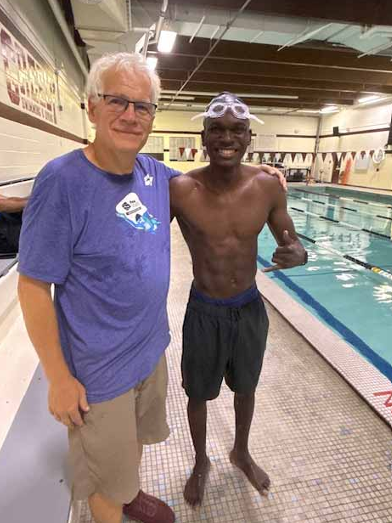
In the summer of 2024, Zach’s mom convinced longtime Greely High School Swim Coach Robert (Bob) Hale to teach Djino and his two friends how to swim. She could not have found a more perfect person for the job. In 2020, Hale was inducted into the Maine Swimming Hall of Fame in recognition of his more than 50-year career teaching and coaching swimming for middle school, high school, and club programs. A father and swimmer himself, Hale became an enthusiastic and supportive coach. His warmth and experience teaching people of all ages how to swim helped the young men heal from the trauma of their journey to Maine, and face their fear of drowning.
Even though the confident Djino brags that he “likes hard things,” the deep end of the pool terrified him. “It was hard. We feared the deep end. We all panicked as soon as we didn’t feel anything underneath our feet.”
Djino appreciated Hale’s calm and joking nature, even when he felt panic inside. “He taught us how to relax and float. He told us to focus on floating, relaxing our bodies to save energy, and moving our hands slowly to keep going. We started in the shallow end and then would step a little bit at a time into deeper water.” The process was slow going, however, and it was not until the fifth lesson that Djino could float to the deep end. He proudly reported, “I kind of know how to swim now. I’m not that fast yet, but I can move around.” The other two boys had not yet made it to the deep end before the summer lessons ended and a new school year began.
Hale reports that the biggest obstacle to Dinjo and his friends ultimately learning to swim was Maine’s lack of access to swimming pools. Other barriers to swim lessons for all Mainers are a shortage of lifeguards and swimming instructors.
The Nevada-based personal injury firm H&P Law’s study of 2023 population data and lifeguard employment data found that Maine ranked 7th on the list of states with the fewest lifeguards per 100,000 people.
There are even more barriers to immigrant Mainers learning to swim: a lack of transportation and the cost of lessons or pool memberships can be prohibitive for many. It is costly for towns and even larger cities to maintain and insure swimming pools. People living in more rural communities are even less likely to have access to indoor, year-round swim lessons. Cultural traditions and exposure to water-related trauma are also barriers. For example, some cultures or religions do not allow women to wear the types of bathing suits worn in the U.S., or to be seen by men without wearing more modest swim costumes. It could be even harder to find female translators, swim instructors, and lifeguards for women wanting to learn how to swim.
Swim lessons save lives, and not just for the person who learns how to swim. Drowning is one of the leading causes of preventable death in people under the age of 30, according to the American Red Cross. For example, YMCA lessons (one of the nation’s largest providers of affordable access to pools and instruction) also include water safety skills such as how to float, tread water, recognize dangerous situations, call for help, and sometimes even how to perform cardiopulmonary resuscitation (CPR). Health and economic disparities in access to swim lessons make the risk of drowning 2–8x higher for Black, Hispanic, and Native American children compared to White children, says the American Red Cross. The more people who have access to swimming lessons, the safer all of Maine’s communities could be.
The dynamic duo of Djino and Hale want to help new Mainers overcome these barriers. They have talked about how they could teach others from different cultures who want to learn to swim, and Hale says he was thrilled to hear about Dinjo’s plan: “When Dinjo asked me what I thought, my response was, I’m all over that. You know, you just gave me goosebumps saying you would like help. Oh my goodness!”
As each other’s teacher and student, Hale and Djino have formed a deep mutual affection and respect. Their shared experience of taking a leap of faith into the literal and figurative deep end, learning how to relax and float, and trusting one another connected them — despite cultural differences and barriers.
Unfortunately, Djino’s busy schedule as a college freshman put his and Hale’s ambitious plan on hold. Dinjo did share that he had found time to go swimming once with some new college friends, despite diving into extracurricular activities like student senate, the writing center, the journal editor, and starting a forum on American democracy. It remains to be seen whether the two can make their dream of helping more people learn to swim become a reality. The community of people who live in fear of Maine’s oceans, ponds, and lakes would be lucky (and safer) to have such wise teachers and guides as Djino and Bob Hale.
Editor’s Note: This article originally appeared in the early June 2026 print edition of Amjambo Africa.