
Kampala, Uganda – April 2, 2025 — Police in Kampala have arrested nine youth activists who stormed the headquarters of Stanbic Bank Uganda, protesting its involvement in financing the controversial East African Crude Oil Pipeline (EACOP) project. The activists, part of the Students Against EACOP Uganda group, were taken into custody at Kampala Central Police Station following their demonstration.
According to Patrick Onyango, spokesperson for Kampala Metropolitan Police, the suspects will be charged under the Common Nuisance law and are expected to appear in court either today or tomorrow. The arrested individuals were among over 50 activists who participated in the protest march.
Stanbic Bank is one of several financial institutions committed to funding the 1,443-kilometer heated pipeline, which will transport Uganda’s crude oil from the oil fields in mid-western Uganda to Tanzania’s Tanga port for export. On March 27, EACOP Ltd., the holding company responsible for the pipeline’s construction, announced the completion of its first round of debt financing with a consortium of five African and Middle Eastern banks. This development marks a slow but steady return of investor confidence in the project, despite persistent opposition from environmental groups.
South Africa’s Standard Bank and its Ugandan subsidiary, Stanbic Bank, lead the group of African banks funding the project. Other financiers include Egypt’s African Export–Import Bank (Afreximbank) and KCB Bank Uganda Ltd., a subsidiary of Kenya Commercial Bank (KCB) Group.
ADVERTISEMENT

The April 2 petition submitted by environmentalists to Stanbic Bank CEO Mumba Kenneth highlighted the concerns surrounding EACOP, emphasizing that 43 banks and 29 insurers worldwide have already rejected financing due to its potential environmental and social impacts. Activists argue that the project has displaced over 10,000 families, led to the arrest of more than 100 protesters, and sparked ongoing abductions.
“At a time when the world is grappling with the escalating effects of climate change, the decision to finance a massive fossil fuel infrastructure project is not only irresponsible; it is an active assault on our planet and our people,” reads the petition. “EACOP promises to intensify the climate crisis, exacerbating droughts, floods, and extreme weather events that disproportionately affect African communities, who have contributed the least to climate change yet bear the brunt of its severe consequences.”
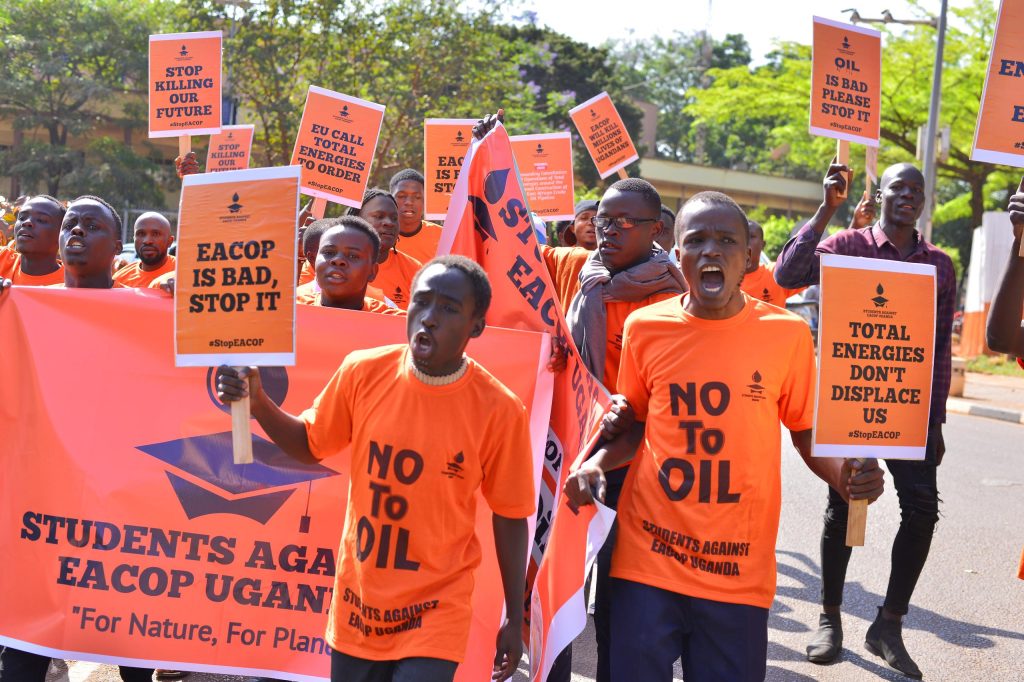
Yudah Kaye, Chief Mobilizer of Students Against EACOP Uganda, who led the petition handover, criticized the bank’s actions. “We want the bank to inform Ugandans if this is part of their Corporate Social Responsibility. They are using our hard-earned money to fund a project that harms our environment and has caused suffering to thousands of families,” Kaye stated.
The $5 billion (Shs18 trillion) EACOP project is jointly owned by TotalEnergies (62%), the Uganda National Oil Company Limited (15%), China National Offshore Oil Corporation (8%), and Tanzania’s Petroleum Development Corporation (15%). The pipeline will transport 216,000 barrels of crude oil per day at peak production. It is set to be the world’s longest heated pipeline, as Uganda’s crude oil is highly viscous and requires heating to remain flowable. The pipeline will pass through multiple sensitive ecological zones, including protected areas and water sources, raising concerns about biodiversity loss and potential oil spills.
EACOP has faced significant opposition from environmentalists, human rights groups, and climate activists, who argue that it contradicts global efforts to transition away from fossil fuels. Critics warn that the project could contribute to increased greenhouse gas emissions, disrupt local communities, and threaten the livelihoods of people who depend on agriculture and fishing. Additionally, concerns about land acquisition and compensation disputes have sparked protests from affected communities.
Despite opposition, the Ugandan and Tanzanian governments have defended the project, citing its potential to boost economic growth, create jobs, and enhance regional energy security. Supporters argue that EACOP will generate revenue for infrastructure development and social programs while positioning Uganda as a significant player in the global oil market.
The arrests have sparked further debate on the intersection of economic development and environmental responsibility in Uganda. While the government and investors argue that the pipeline will boost Uganda’s economy, activists maintain that the long-term environmental costs outweigh any potential benefits.
The fate of the nine detained protesters now rests in the hands of the courts, while the broader battle over EACOP’s legitimacy continues to unfold on both local and international fronts.