By Éloge Willy Kaneza
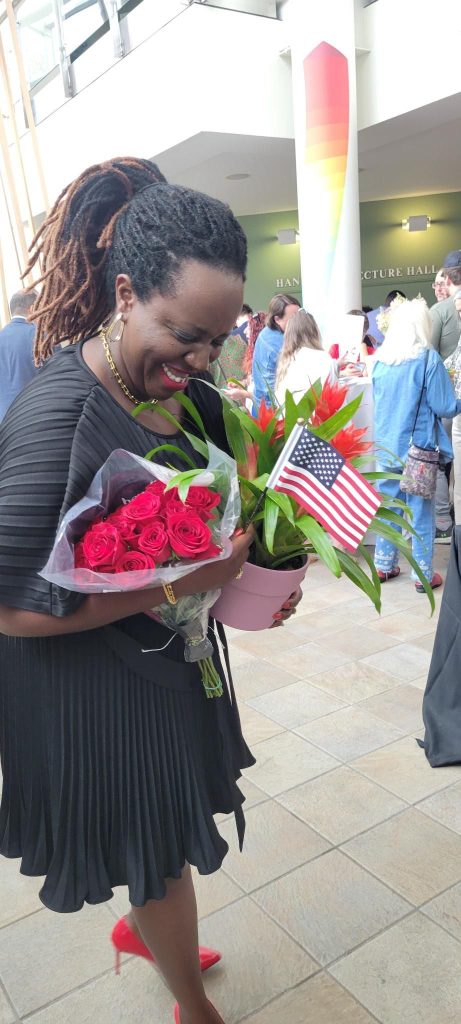
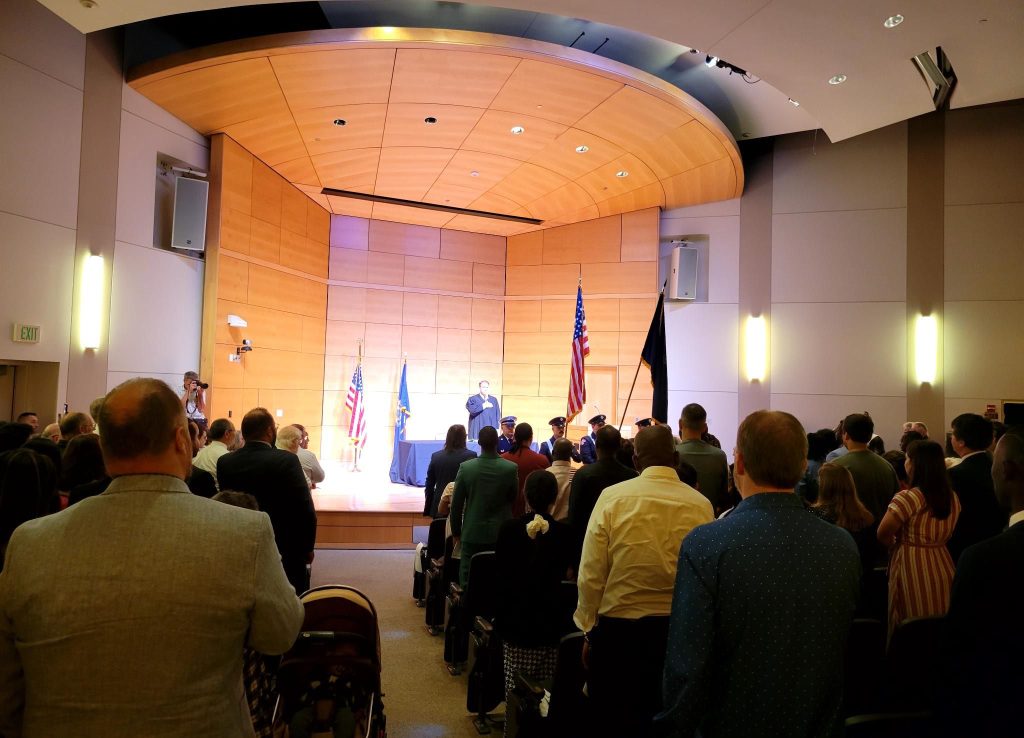
On Constitution Day, 50 people from 28 countries took the Oath of Allegiance to the United States and officially became U.S. citizens in a naturalization ceremony held at the University of Southern Maine. Families, friends, church members, and community leaders filled the hall, their faces glowing with pride and relief as they witnessed this life-changing moment. Some candidates were accompanied by their children, adding to the celebratory atmosphere.
Chief U.S. District Judge Lance E. Walker, who presided over the ceremony, delivered a heartfelt address, blending inspiration with a reminder of civic responsibility.
“Our founding ideas are noble, and they are true. But it is only by our actions that they have any meaning, any virtue. Citizenship is an action word,” Walker told the new Americans. “When you take action, remember that America’s advantage is in the unity of a diverse people. So please share your art, share your music, share your language, and especially, for me at any rate, please share your recipes with your fellow Americans.”
Walker called the day “a momentous event, not only for you but for generations of your family to come,” and urged the new citizens to record their stories so that future generations will be able to understand the journey of becoming American.
ADVERTISEMENT

“And before you leave today, take a moment and look at each other. You – individually and as a group – are now America.”
The judge reminded the audience that the history of the United States is one of immigration. Citing the Declaration of Independence, he noted that the principles of life, liberty, and the pursuit of happiness remain central to American identity, but must be actively pursued.
“The constitution is our civic compass. It creates the conditions of liberty, and liberty is a condition of happiness,” he said. “But, as Benjamin Franklin put it, the Constitution doesn’t guarantee happiness, it only guarantees the pursuit of it. You have to catch up with happiness yourself.”
Quoting Aristotle, Walker added that virtue is found not in words, but in repeated action and habit – a lesson he suggested the new citizens take to heart as they begin their American journey.
Amid the applause, joy, and flag-waving, the broader context of the ceremony could not be ignored. Across the country, including in Maine, U.S. Immigration and Customs Enforcement (ICE) has recently increased arrests, sparking fear within immigrant communities. Just blocks away from the university, in cafes, restaurants, and local stores, some African immigrants quietly discussed the contrast: a day of joy and inclusion, shadowed by anxiety over immigration enforcement.
The duality of emotions – joy, fear, and love for America – was palpable. Yet in that hall, at least for a moment, the emphasis was on unity. Judge Walker told the audience, “The United States is a land of fresh starts. Our country was not founded upon racial, ethnic, religious, or political identities. It was not founded on hereditary privilege or affiliation with favored family names.”
For the 50 new Americans – whose countries of origin ranged from neighboring Canada to as far away as Australia, Burundi, Democratic Republic of the Congo, and Rwanda – the day was one to remember.
Among them was Favor Kabwe, a young Congolese pastor naturalized alongside his Burundian wife and their two daughters. Overwhelmed with emotion, he told Amjambo Africa, “This is a new chapter in our journey, an important day.”
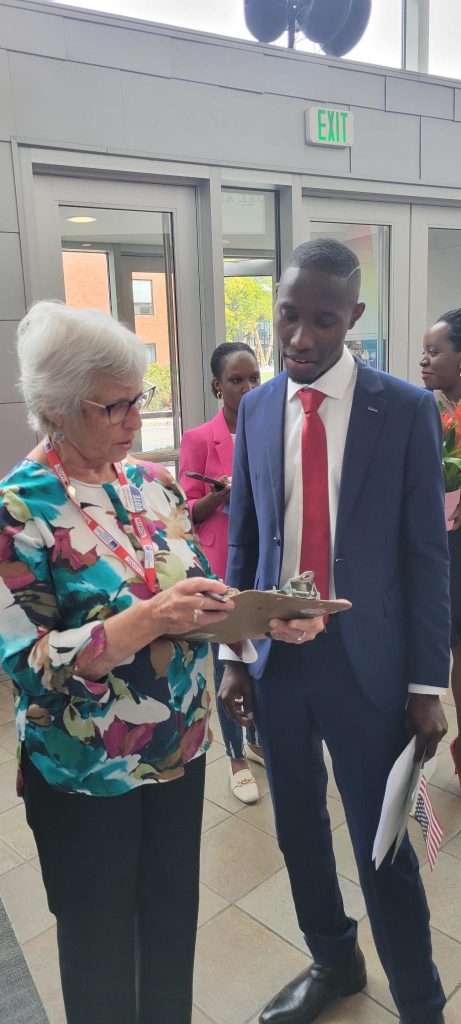
Historically, representatives of the League of Women Voters have distributed voting registration paperwork to new Americans at naturalization ceremonies. However, on August 29, 2025, U.S. Citizenship and Immigration Services (USCIS) issued guidance reversing long-standing voter registration practices at the conclusion of naturalization ceremonies.
Celina Stewart, CEO of the League of Women Voters, released a statement on September 2 addressing the recent guidance: “The USCIS decision to bar nonpartisan organizations from providing voter registration services at naturalization ceremonies is an attempt to keep new citizens from accessing their full rights. … USCIS is making it harder for new citizens to register to vote, which is yet another intimidation tactic and attack on the immigrant community.”
Karen Benoit, a member of the League of Women Voters in the Portland area, who was present at the ceremony, spoke to Amjambo Africa about the importance of voter registration: “Voting is the foundation of our democracy. It’s important that people understand this right as soon as they become citizens.”