On August 19, Amjambo Africa staff toured the Westbrook warehouse of Furniture Friends, a nonprofit dedicated to supplying new, unfurnished homes for low-income households.
Since 2012, the organization has operated under a clear mission: “Creating Homes. Rebuilding Lives.” Today, that work is carried out by a dedicated team of five full-time employees alongside a rotating series of some 400 volunteers.
Originally founded in 1997 as the Greater Portland Charitable Furniture Center, the small team is led by Executive Director Tae Chong, a former Portland City Council member, and Deputy Director Valerie Lippert.. Rounding out the staff are Sophia Doremus, community engagement and development coordinator, and warehouse staffers Brent DeLong and Ambrosio Kitadi.
During the tour, Chong discussed the organization’s impact. In 2024, Furniture Friends helped 110 families transition out of Portland shelters into their own homes. Because a household ranges from one to four people, that single effort helped hundreds of Mainers stabilize their living situations.
“If people who are unhoused move into a home without proper support, they will revert back to the shelter,” Chong explained.
Beyond the humanitarian impact, providing basic furnishings makes good financial sense for the community. According to Chong, it costs the city of Portland $60,000 per year to maintain a single shelter bed. Funding programs like Furniture Friends offers local and state governments a far more cost-effective way to keep people housed.
ADVERTISEMENT

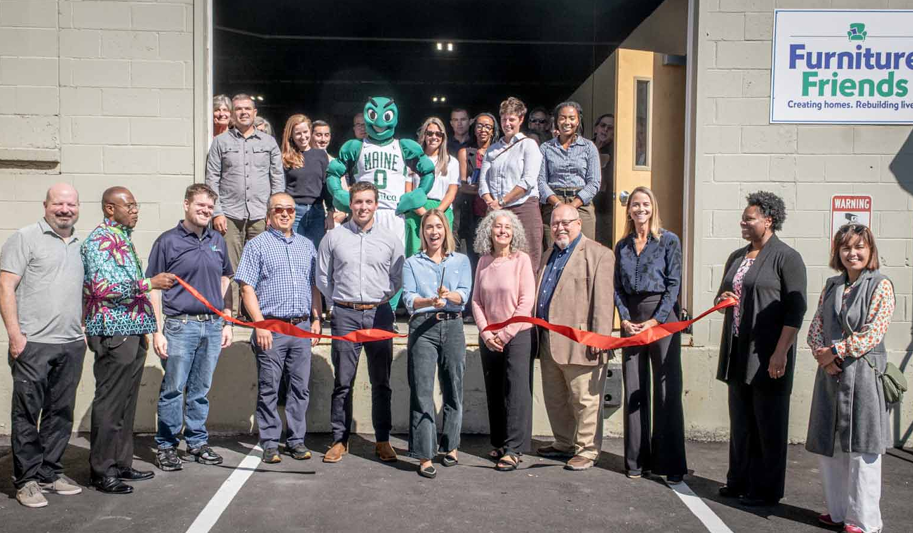
To keep pace with demand, Furniture Friends recently received major equipment donations from L.L. Bean. The contribution included scaffolding storage that more than doubled their warehouse capacity, as well as an electric lift. The lift removes the physical strain of heavy, repetitive lifting for staff and volunteers over time.
As the only furniture bank in the state, Furniture Friends serves thousands of residents from all walks of life, from lifelong Mainers to New Mainers and their families. “Poverty is poverty; it doesn’t matter if you’re a multigenerational Mainer or if you’re a New Mainer,” Chong said.
In 2025 alone, the organization assisted 1,831 Mainers across 864 households. They partnered with over 120 referring organizations throughout Cumberland County and beyond, serving communities in Cape Elizabeth, Falmouth, Freeport, Gorham, Windham, Portland, South Portland, Scarborough, Westbrook, and Yarmouth. Looking ahead, Furniture Friends hopes to expand services into Biddeford, Saco, and Old Orchard Beach.
Furniture Friends sources its inventory from a wide variety of donors, including local families upgrading their furniture, as well as colleges and hotels replacing entire sets of room items.
When a family qualifies for assistance, they work with a case manager to create a specific shopping list. This ensures their exact household needs are met efficiently.

ing the celebration of Furniture Friends’ expanded warehouse Photo | Mark Mattos
A critical segment of the nonprofit’s work involves clients in charity care and individuals recovering from severe or terminal medical conditions. “One of the first deliveries I ever did was for [a charity] care client,” Chong recalled. “He was recovering from a terminal disease and hadn’t slept in a bed for two years. He had been sleeping in a recliner, so his neck was crooked. We provided him a bed, and he was finally able to sleep on his back.”
Looking to the future, Furniture Friends is launching a 2026 pilot project with students from Portland Vocational School and LearningWorks. Students will build and stress-test dressers and box springs for client families. The partnership allows students to test potential career skills while seeing how their craft directly improves someone’s life. “We want high school vocational kids to be celebrated,” Chong said.
In addition to its independent work, Furniture Friends collaborates with MaineNeeds, a grassroots organization focused on providing basic winter gear and essential supplies. Together, they developed the SleepWell campaign, an initiative aimed at funding clean mattresses so no family has to sleep on the floor.
Chong emphasized that unequipped housing creates a “poverty tax,” an unfair barrier that denies people an equal chance to succeed. “In poverty, your health gets worse, your sleep gets worse, and your anxiety is already high,” Chong noted. “You need to recover so you have a fighting chance at an already uphill battle.” He compared providing a house without basic furnishings to handing someone a car with no gas or brakes.
Chong believes state subsidies for furniture in new housing developments would significantly ease this burden, sparing a working mother from sleeping on the floor before a 13-hour shift and creating a more liveable, sustainable Maine for everyone.