By Sheila Ponnie
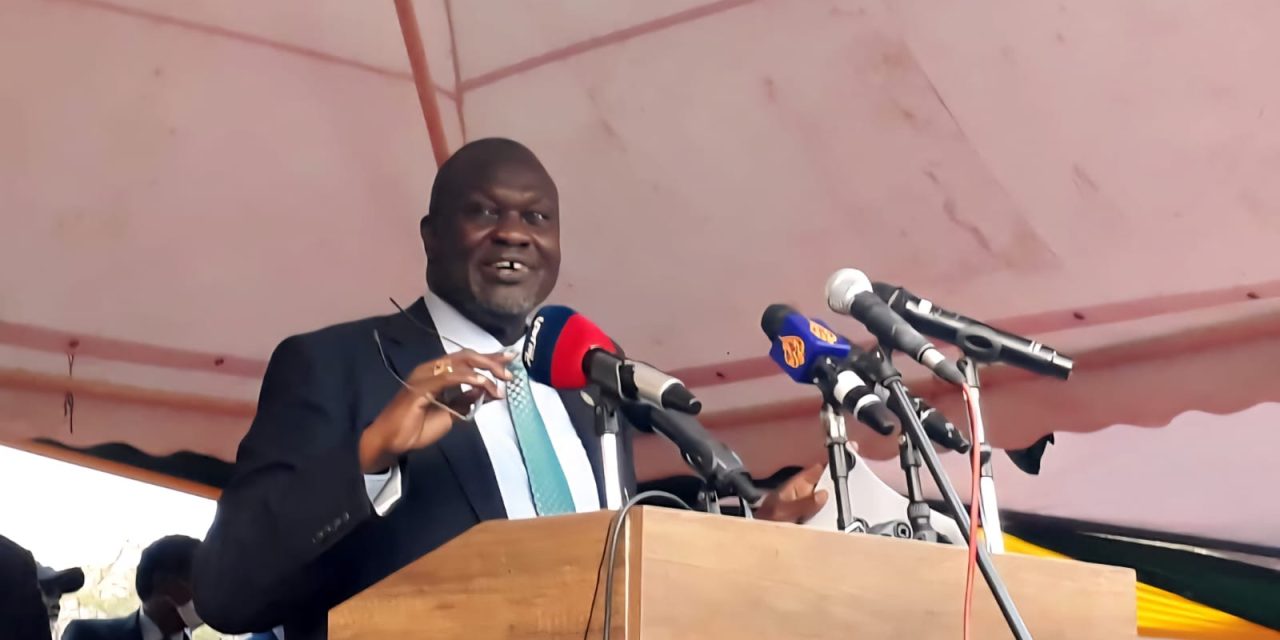
South Sudan’s First Vice President and opposition leader, Dr. Riek Machar, has been charged with treason, murder, conspiracy, terrorism, and crimes against humanity in a case that threatens to plunge the country’s fragile peace deal into crisis.
Justice Minister Dr. Joseph Geng Akech announced the charges at a press conference in Juba on Thursday, September 11, naming Machar and seven other senior figures, including Petroleum Minister Puot Kang Chuol and Deputy Chief of Staff General Gabriel Duop Lam.
Geng said the indictments follow an investigation into April attacks by Nuer armed youth, widely known as the White Army, on army barracks in Nasir, Upper Nile State. He confirmed that 83 people were interrogated, 21 indicted, and 76 released for lack of evidence.
“The accused have been informed of the charges and their constitutional rights, including the right to a fair trial and legal representation of their choice,” Geng told reporters. He added that the case will soon be heard before a competent court and cautioned the international community against politicizing the proceedings.
Hours after the announcement, President Salva Kiir suspended Machar from his role as First Vice President – a move analysts say raises serious constitutional and political questions.
ADVERTISEMENT

Boboya James Edimond, Executive Director of the Institute of Social Policy and Research (ISPR), said Kiir lacks the legal power to remove or suspend Machar under the 2018 peace agreement.
“The peace agreement ties the president’s hands,” Boboya explained. “He cannot fire or suspend the first vice president. Only the SPLM-IO, Machar’s party, can nominate a replacement if it chooses. This is why any attempt to sideline Machar outside the legal process risks delegitimizing the government.”
Boboya warned that the charges could destabilize the delicate power-sharing arrangement that ended South Sudan’s 2013–2018 civil war, during which hundreds of thousands were killed.
“The peace agreement is now hanging by a thin thread,” he said. “If Machar’s party walks away, we are likely to see a collapse of the political settlement and possibly renewed conflict.”
Political analysts say Machar’s indictment could embolden hardliners on both sides and fuel tensions in Upper Nile and Jonglei, where the White Army has a strong base.
The case has also drawn international attention. Diplomats and rights groups are urging Juba to ensure due process, protect witnesses, and avoid politicizing the judiciary. Human rights watchdogs warn that using criminal charges to settle political disputes could further erode public confidence in state institutions.
“This case will be a litmus test for South Sudan’s justice system,” one regional legal expert told reporters, requesting anonymity due to security concerns. “If the trial is perceived as politically motivated or unfair, it could spark unrest.”
South Sudan is scheduled to hold elections in December 2026, the first since its independence in 2011. But the growing rift between Kiir and Machar threatens preparations for the vote, with many opposition supporters now questioning whether a credible election can take place.
The stakes are enormous for the South Sudanese people, who continue to pay the highest price. Over 9 million citizens — three-quarters of the population — require humanitarian assistance. Persistent violence, famine conditions, and the climate crisis have driven one of the world’s worst humanitarian catastrophes.
As the country faces these intersecting crises, the unfolding political standoff underscores a critical question: will South Sudan’s leaders uphold the peace agreement, or risk unraveling the fragile stability painstakingly built since the 2018 deal?
South Sudan, the world’s youngest nation, has been fragile since gaining independence from Sudan in 2011 after decades of civil war. Political rivalries, largely along ethnic lines, quickly plunged the country into renewed conflict. A peace agreement signed in 2018, the Revitalized Agreement on the Resolution of the Conflict in South Sudan (R-ARCSS), restored a transitional unity government with President Salva Kiir and opposition leader Dr. Riek Machar as First Vice President. Despite these efforts, tensions between Kiir and Machar have persisted, with sporadic clashes and disputes threatening the country’s stability. The White Army, a largely Nuer youth militia, has played a recurring role in violent confrontations, further complicating the security landscape.