
By Éloge Kaneza
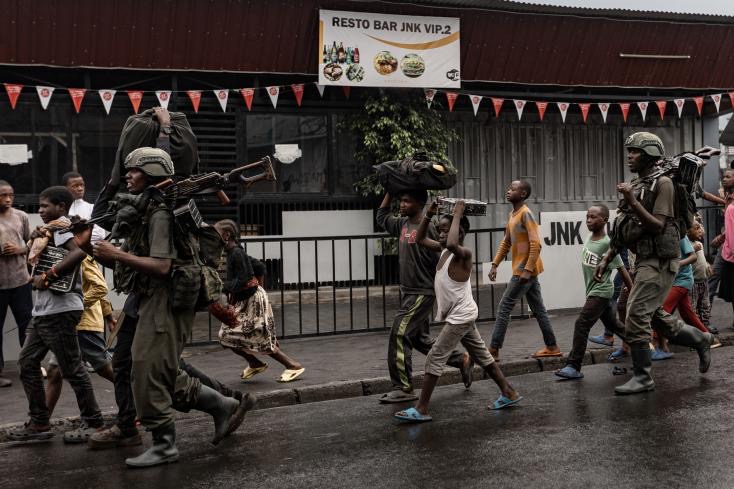
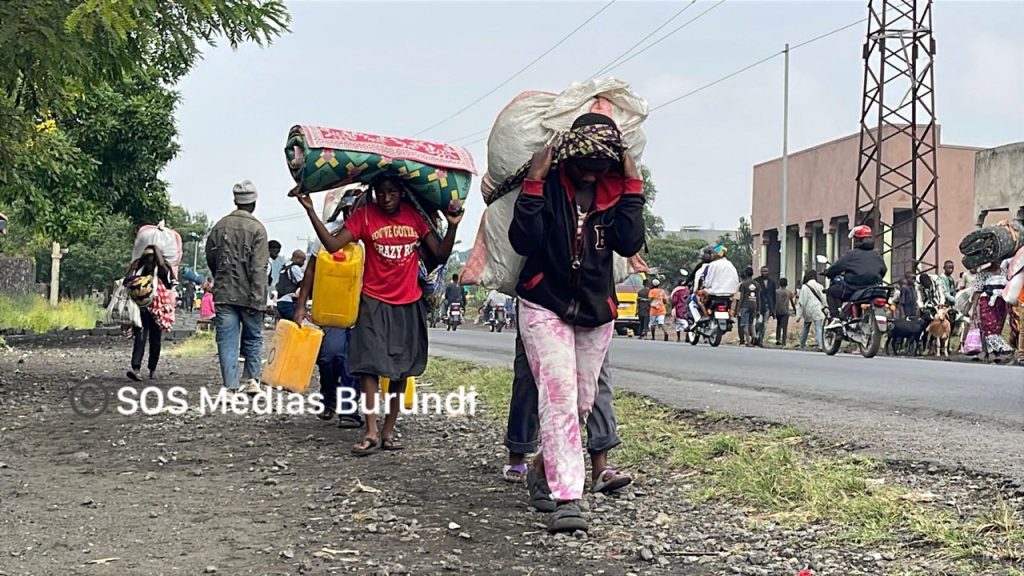
The city of Goma in North Kivu province, Democratic Republic of the Congo, fell to the M23 rebel group on Monday, January 27. President William Ruto of Kenya, head of the East African Community economic bloc, called for an urgent meeting in response, and President Paul Kagame of Rwanda, and President Félix Tshisekedi of DR Congo, have both confirmed their participation in that meeting, due to take place on January 29.
Patrick Muyaya, spokesperson for the Congolese government, issued a communiqué urging inhabitants of Goma not to panic.
However, Congolese military and civil leaders began leaving Goma on Sunday evening, ahead of the city’s fall, after the M23 captured Minova, a small city in the region.
Also, many dozens of Congolese troops have fled toward Rwanda.
“Soldiers entered our houses to take our civilian clothing so they would not be recognized. It was very dishonorable what happened,” a civilian told Amjambo Africa.
Several officials of the United Nations Organization Stabilization Mission in the DR Congo, known as MONUSCO, also fled toward Rwanda by bus.
Deaths in Rwanda
ADVERTISEMENT

According to Rwanda Broadcasting Agency, a state media outlet, Brig. Gen. Ronald Rwivanga said that on Monday five civilian deaths occurred in Rubavu, western Rwanda. He attributed the murders to FARDC, (Forces Armées de la République démocratique du Congo), and to FDLR (Forces Démocratiques de Libération du Rwanda) – which he described as a group of “genocidal Hutus” – and which he said had launched shells into Rwandan territory.
“At least 35 other civilians were injured and admitted to various health facilities,” according to the Rwandan army spokesperson.
East African Community weighs in
“Direct engagement with the M23 and all other stakeholders in the theater in eastern DRC is a necessity,” declared Ruto of Kenya, who holds the rotating one-year presidency at the head of the EAC.
Rwanda and the Democratic Republic of the Congo are part of the eight countries that make up the East African Community. Until now, the Congolese authorities have refused to negotiate with the M23, which they describe as “a terrorist group.”
The location of the summit has not been specified. Recently, Rwandan President Paul Kagame strongly criticized the organizers of summits and conferences on the Congolese crisis “who are more interested in taking photos and signing documents than in finding real solutions to the real problems posed,” he said.
The Kenyan president has emphasized the importance of understanding “the problems and
the root causes of the persistence of this conflict for many years.”
On Sunday, the vast central African country lodged a complaint with António Guterres, the Secretary-General of the United Nations, and on January 26, the Security Council convened an emergency meeting on the situation in eastern Congo. Congolese authorities have accused Rwanda of sending troops onto Congolese soil in broad daylight. And for the first time, Guterres called on Rwanda to “withdraw its troops” from the DRC.
“The Rwandan army penetrated Congolese soil in plain daylight,” declared Thérèse Wagner, Congolese Minister of Foreign Affairs, in New York, adding, “It’s essentially a declaration of war that does not use the name.”
Wagner called on the U.N. to impose sanctions against Rwanda, saying, “The Security Council must impose targeted sanctions including asset freezes and travel bans, not only against identified members of the chain of command of the Rwandan armed forces, but also against the political decision-makers responsible for this aggression.”
Wagner called for “a total embargo on the exports of all minerals labeled as Rwandan, in particular coltan and gold.”
In a press release released on Sunday, Olivier J.P. Nduhungirehe, the Rwandan Minister of Foreign Affairs and International Cooperation said that the fierce fighting around Goma was triggered by the constant violation of the ceasefire by the FARDC (Armed Forces of the Democratic Republic of Congo), the Hutu-FDLR genocidaires, the local militias maintained by the Congolese authorities, the European mercenaries, the soldiers of the FDNB (Burundi National Defense Force), the troops of the SADC (Southern African Development Community), and U.N. forces.
U.S. condemnation
“We condemn in the strongest possible terms the hostilities of Rwanda and the M23 in Goma,” said Dorothy Shea, acting U.S. ambassador to the U.N.
“Rwanda’s use of sophisticated weapons and systems, including blocking GPS signals, interferes with the humanitarian response, and endangers MONUSCO and those fleeing violence,” she insisted.
“These actions must stop immediately. The United States will consider all tools at its disposal to hold those responsible for the continued armed conflict, instability and insecurity in the DRC accountable,” warned the ambassador.








