By Rachel Ndjondjo and Eloge Willy Kaneza
On Saturday, March 1, Congolese Mainers gathered in Portland to call attention to the horrific violence in the eastern Democratic Republic of the Congo, as well as the Rwandan government’s complicity in the violence. They gathered at 180 Park Street and marched to Monument Square. Their slogan was “Free Congo, Stop the Killing.”
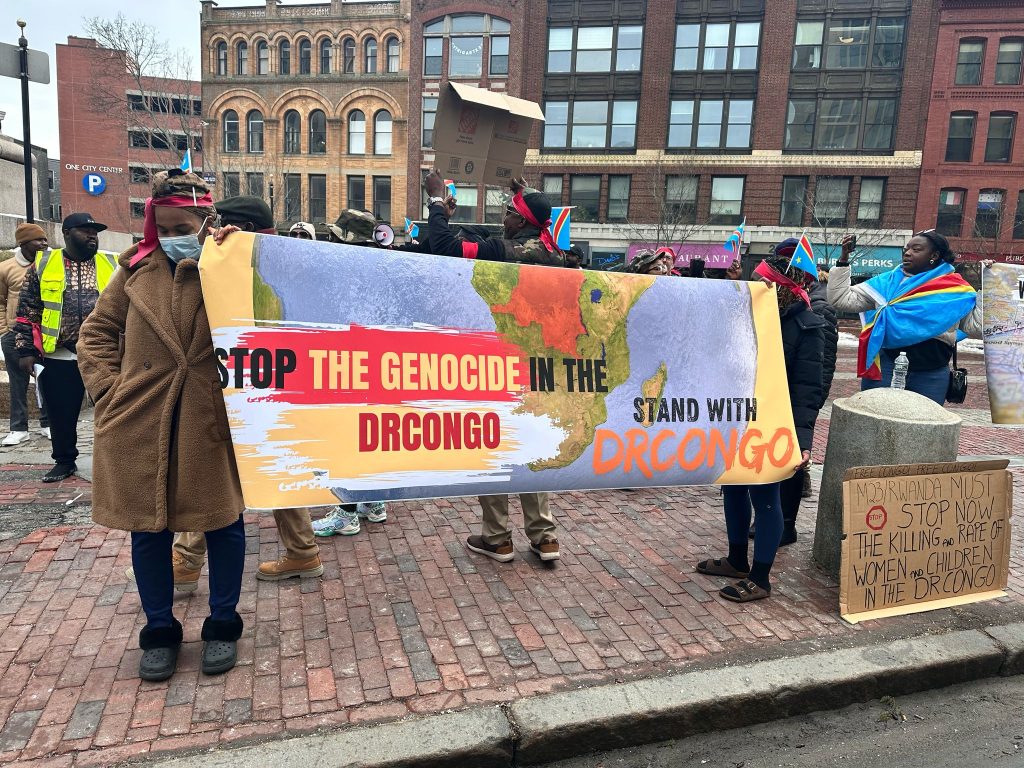
Patrick Mulonda, the president of the association of the Congolese community of Maine, known as COCOMaine, spoke about the protest.
“We came to protest against all the injustices and genocide happening in the Democratic Republic of Congo. It is a war that never ends, and we Congolese living in the United States are determined to raise our voices so that the international community can understand that we want this to stop,” Mulonda told Amjambo Africa.
Protestors, who expressed their dismay at what they consider an inadequate response from the international community to the atrocities taking place in eastern Congo, accused Rwanda’s President Paul Kagame of fueling the longstanding conflict – one that has endured for 30 years.
In 2024, the United Nations accused the Rwandan army of deploying at least 4,000 troops in eastern Congo in support of the M23 rebels who now control Congo’s borders with Burundi, Rwanda, and Uganda – in addition to the capitals of the provinces of North Kivu and South Kivu, two mineral-rich provinces in the east of the vast Central African country.
ADVERTISEMENT

Also present in Monument Square during the protest was a documentary film projected on the side of a van that purported to recount the origins of the Banyamulenge and Congolese Tutsis, and the genocide against them, but Patrick Mulonda disputed the film’s portrayal. He described the presence of the van as “a provocation to which we did not give in.’ The film played continuously for two days, between the hours of 9 a.m. and 5 p.m., beginning on the day before the protest.
The M23 rebel group describes themselves as representing the interests of Congolese Tutsis, and in fact the group is led by Congolese Tutsis who say they are being persecuted by the Congolese government and targeted by a genocidal effort by the Congolese government.
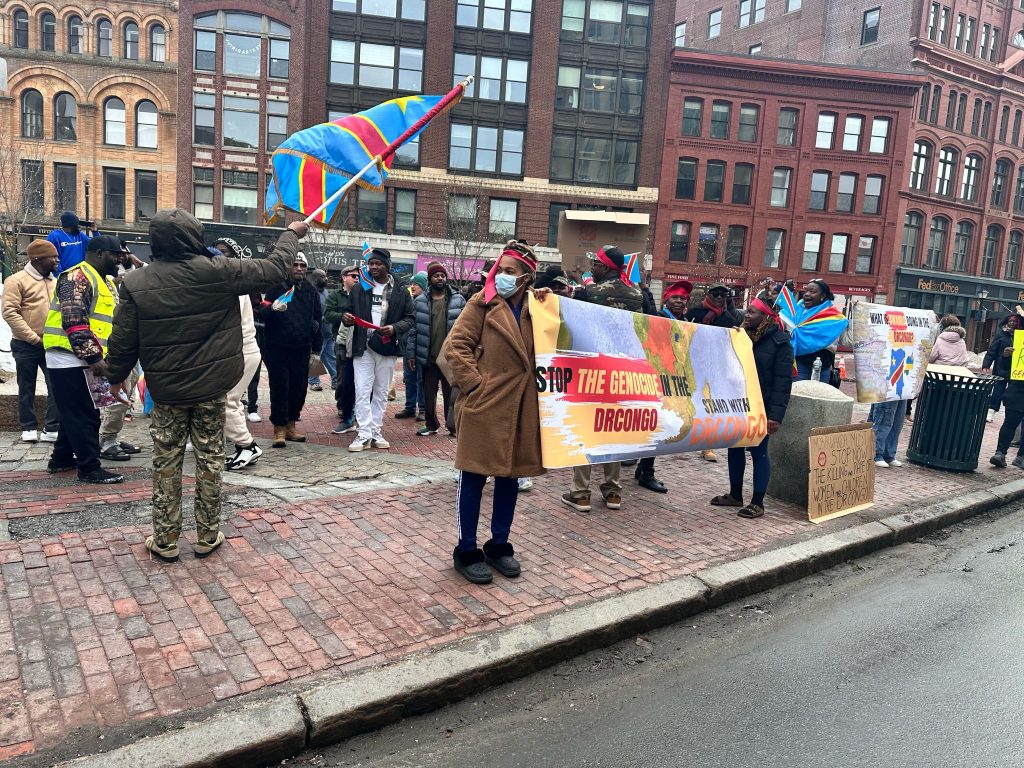
One protester, originally from the beleaguered city of Goma, which fell to the M23 rebel group on January 27, told Amjambo Africa, “The objective of this conflict is to take our land. If you look at all the peoples who combined their land in order for Congo to become the [enormous country of DR Congo] we know today – there were never Rwandese Tutsi in Congo. Unfortunately, today, the reason why Kagame is fighting us is to try and make people believe that there are Congolese Tutsis that we are mistreating.”
In February, in London and Brussels, there were similar protests.
Situation in the country
Also on March 1, at the same time protestors were gathering in Portland, Congolese authorities launched a campaign they are calling Congolais Telema, or “Congolese, Rise up.” The campaign is aimed at raising funds to finance the war effort. Prime Minister Judith Suminwa said that the Congolese government has already mobilized more than 1 billion CDF (Congolese francs), or approximately $350,000 to fight the rebels.
With the advance of the M23 rebels in eastern Congo, the U.S. and several other partner countries of Rwanda have recently sanctioned Rwanda for their support of the M23 rebels. The sanctions target individual Rwandan officials as well as the government as a whole. The Rwandan government said in a recent statement that “punitive measures, including sanctions, do not contribute to long-term security, peace and stability for all countries in the Great Lakes region. Such measures can only be interpreted as unwarranted external interference in the African-led process, which risks prolonging the resolution of the conflict.”
On Feb. 27, 2025, a bomb attack targeted an M23 rally in the city of Bukavu, the capital of South Kivu. At least 11 civilians, including a woman, were killed. Corneille Nangaa, head of the Congo River Alliance, a politico-military movement to which the M23 is affiliated, accused Congolese President Félix Tshisekedi of favoring the path of war.
However, Tshisekedi said he was appalled by the violence, which he attributed to “a foreign army.” He considers the populations of the areas controlled by M23 as people living under foreign domination.
“President Félix Tshisekedi was saddened to learn of the death of several compatriots following an explosion that took place during a forced meeting on Thursday at the Place de l’Indépendance in Bukavu, in the province of South Kivu,” the Congolese presidency wrote on its X account. “President Tshisekedi strongly condemns this heinous act that was perpetrated by a foreign army illegally present on Congolese soil.”
At a press conference in Bukavu after the attack, Corneille Nangaa, a political leader of the M23 who was present at the rally, said, “We have always wished to have a political solution to the multifaceted crisis in Congo, but unfortunately we see that Mr. Tshisekedi is committed to war.” Bertrand Bisimwa, another political leader of the M23, was also present at the rally.
On the same day as the rally, the M23 rebels set up a parallel administration for the province of South Kivu, which has a population of more than 7 million people. Previously, they had installed themselves as the provincial government of North Kivu. North Kivu is the most populated city of eastern Congo. The objective of the rally was to present the new administration to the South Kivu population.
Recently, President Évariste Ndayishimiye of Burundi told diplomats in Gitega, the capital, that the solution must come from the withdrawal of all non-invited forces in Congo and the destruction of local and international armed groups, among them the former génocidaires, which refers to those who carried out the Genocide Against the Tutsis in Rwanda, the Democratic Forces for the Liberation of Rwanda (FDLR). Kagame has been accusing Burundi of collaborating with the FDLR, the Congolese army, and local militias. In 2023, Burundi deployed about 10,000 troops to help the Congolese army and its allies to fight the M23.