By Brian Boyd
On view through November 16 at the Ogunquit Museum of American Art (OMAA), “Gisela McDaniel: Inina” (CHamoru for “glimmer of light”) is the artist’s first solo museum exhibition in the U.S. Born in Nebraska in 1995, McDaniel is descended on her mother’s side from the Indigenous CHamoru people of the western Pacific island of Guåhan (Guam). She grew up in Cleveland, studied art in Michigan, and now lives in New York. In 2025, Art Mag honored McDaniel in their annual list of the “30 Most Influential Artists under 30.”
Courtesy the artist and Pilar Corrias, London
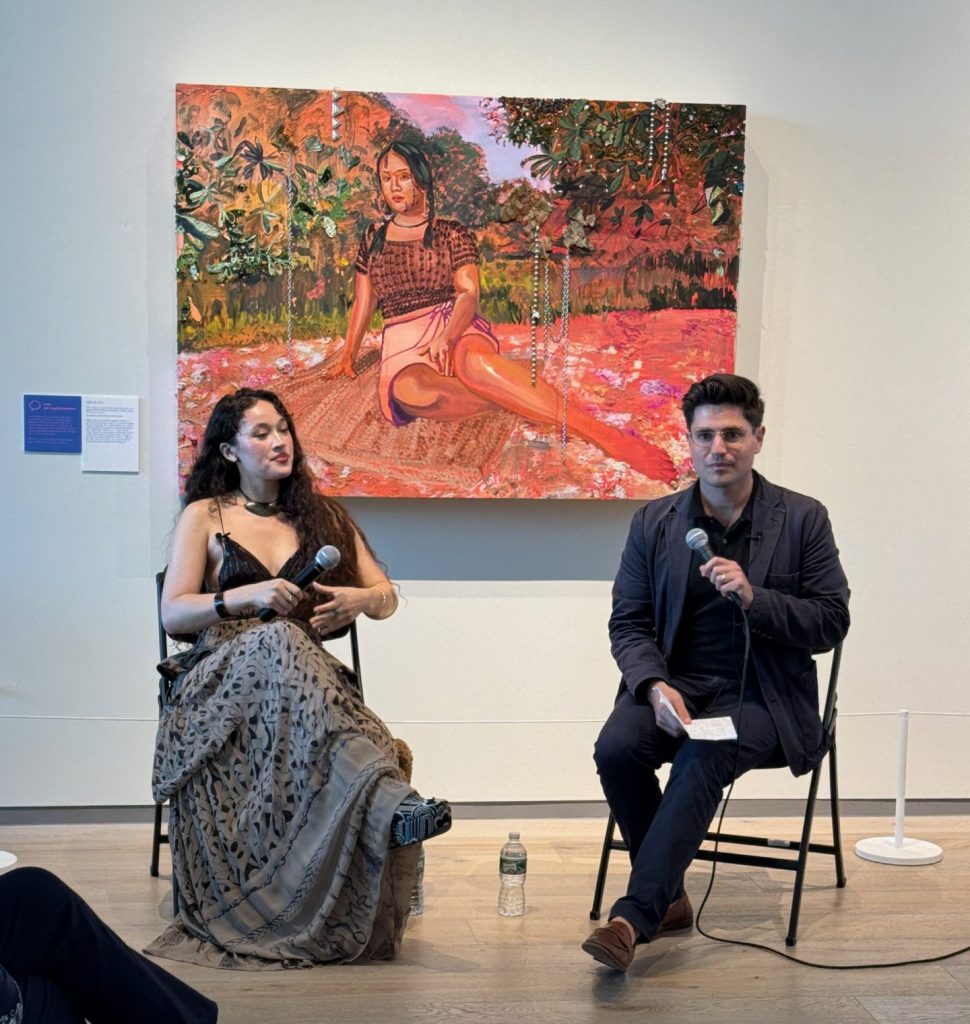
The large-scale exhibition in OMAA’s oceanside galleries draws on the artist’s spiritual affinity with CHamoru culture, while embracing personal stories of trauma, healing, and joy in diasporic and Indigenous communities worldwide. At the heart of McDaniel’s practice is the unusual amount of agency she gives to her sitters, whom she calls “subject-collaborators.” As she notes in her artist statement, McDaniel’s collaborators – mostly “women and non-binary people who identify as indigenous, multiracial, immigrant, and of color” – decide for themselves how they want to be portrayed. The sitters’ choices include their clothes, their environment, and even which personal keepsakes or totems will become part of the painting – “consensual artifacts,” in McDaniel’s words, that help express what is most important to them. At the OMAA show, visitors can listen to audio recordings of the sitters, creating, as McDaniel explains, “the possibility for empathy and greater understanding.”
McDaniel’s strategy in portraiture responds to the historical silencing of women’s voices. “A lot of the time when you see women and femmes in paintings, you don’t know who they are, and you don’t know if they liked their portrait, and you don’t know their story,” said McDaniel in an interview with OMAA curator Devon Zimmerman. “I’ve really been focusing on making sure people stay with stories they want to tell and that they want to be remembered with.”
The merging of nature and the human-made turns the paintings three-dimensional: shells, butterfly wings, and pufferfish spines embedded in resin appear alongside handmade jewelry and objects of emotional significance to the sitters, such as a lighter with the image of the late singer-songwriter Amy Winehouse.
ADVERTISEMENT

Colorful, vertical lines ornament the faces of many of her sitters, a gesture of both healing and protection that grew out of a series of portraits McDaniel made in Detroit of survivors of sexual violence. Combining the self-care aspect of Korean sheet masks and the more obscuring texture of ski masks, McDaniel set out to create what she calls a “hybrid between healing and preserving your identity.” More recently, these painted masks have evolved into markings that are less concealing while still serving as symbolic shields. “When the work started showing internationally,” said McDaniel in an interview at the exhibition, “I realized it was important for people to recognize themselves. … The masks started to fade, so you’ll see the lines on all the faces in the room, and it’s kind of remnants of thinking about adorning faces as protection.”
In “Nëna” (2021), a portrait of a close family friend who emigrated to the U.S. from Albania, the green and yellow markings on the smiling woman’s face echo the colors of the tall ferns around her, while the white blossoms on her blue floral dress merge with the flowers – both real and painted – in the vase she holds in her lap. A framed family photo on a table and a landscape painting above the sofa seem to invite absent loved ones and faraway places into the world of the here and now.
The young person in bright red pants and a tank top in the 2023 portrait “A Friend” sits on a boldly striped rug, encircled by a riot of fiery reds and oranges which seem to reflect, and dramatize, both the sky as seen through the window behind them and their own inner strength. In the accompanying audio statement, they talk about the feeling of dislocation that comes from moving between countries, languages, and cultures: “I spoke English, I knew it, because my dad is American. My mom was trying to get us to fit in so hard, she was like, ‘You can’t speak Spanish in the house.’ I was such a rebel about it. I was like ‘No.’ And I would keep speaking Spanish and I would get in trouble for it. … There’s a saying in Latina, like Spanish, that’s ‘Ni de acqui, ni de allá’ – ‘Neither from here nor there.’ I felt it so hard. And I felt like I was trying to be from there. But it was interesting because when I would go to visit Mexico, I almost felt like an outsider again sometimes.”
The tug between cultures is strongly on display in “Båli Mesgnon” (2021), a portrait of the artist’s close friend Lilly, a CHamoru lawyer and civil rights advocate living in New York. A photograph of Santa Marian Kamalen, the patron saint of Guåhan, lies on a rug next to passports representing her family ties to two distant places: Guåhan (U.S.) and the Republic of Seychelles, an island nation in the Indian Ocean. In this portrait, nature escapes the rectangle, with leaves and a large seashell perched atop the frame.
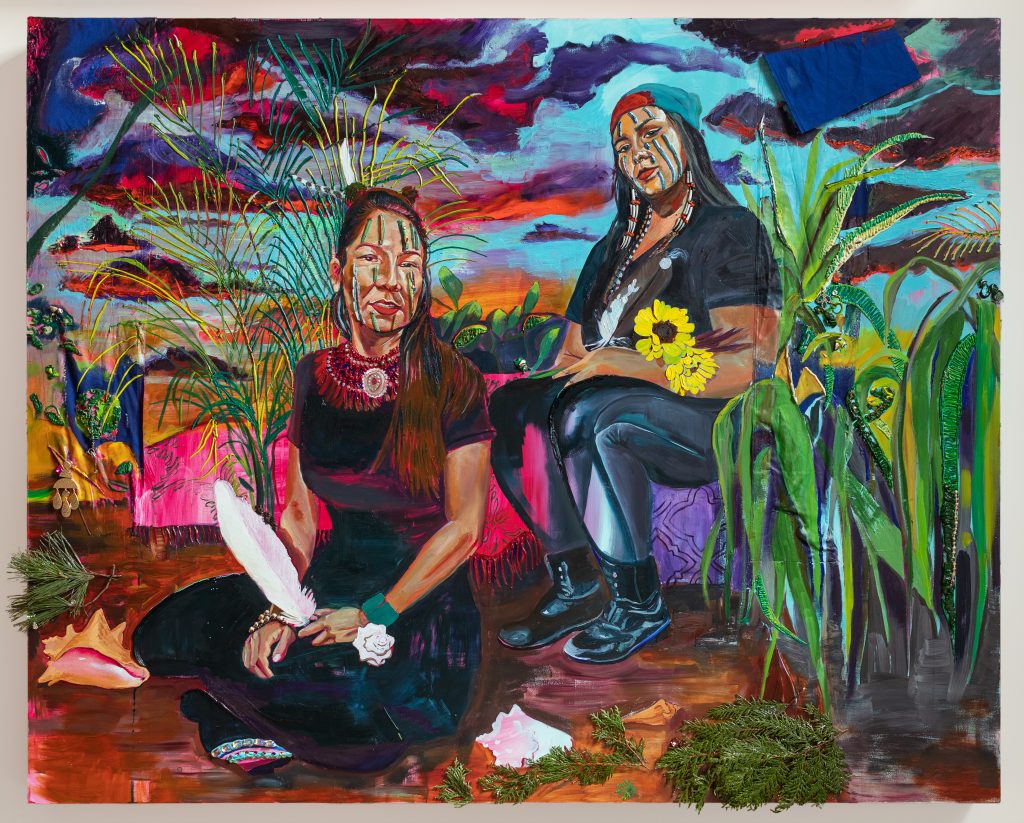
The line between inside and outside almost completely disappears in the 2020 painting “Created for Such a Time as This.” A twilight cloudburst of purple, red, and turquoise embraces the two principal figures at the center: Hadassah GreenSky Meshekey, a Detroit-based, Waganakising Odawa (Little Traverse Bay Bands) artist and activist, and her aunt, Courtney Miller. McDaniel’s carefully nurtured relationship with her subjects-collaborators makes for a tactile lodestone in the painting: fixed to the work are blackened pine branches used as smoke medicine during the collaborators’ conversations about survival, community, and hope.
Drawing inspiration from other artists who have empowered women’s voices, McDaniel remembers as a pivotal moment seeing a retrospective of the French artist Niki de Saint Phalle and noticing a dramatic evolution in her painting. Saint Phalle’s work, said McDaniel, “starts out really, really dark … and you see her body of work get really joyful over her life. I love that idea that you watched her work through things and it just got lighter and happier and there are these big luscious figures dancing in a garden … I was really influenced by the balancing of the dark and the light, and letting the light take over.”
In her luminous oil portraits, the diasporic Indigenous CHamoru artist Gisela McDaniel dissolves the usual boundary between indoors and outdoors. A living room in Detroit or New York becomes a jungle of luxuriant plants, with swathes of pink and red casting a sunset glow on faces as well as furniture. On a beach or by a waterfall on the island of Guåhan, women’s bodies and clothing absorb the tropical light, evoking a deep intimacy with nature, along with a protest against its destruction.
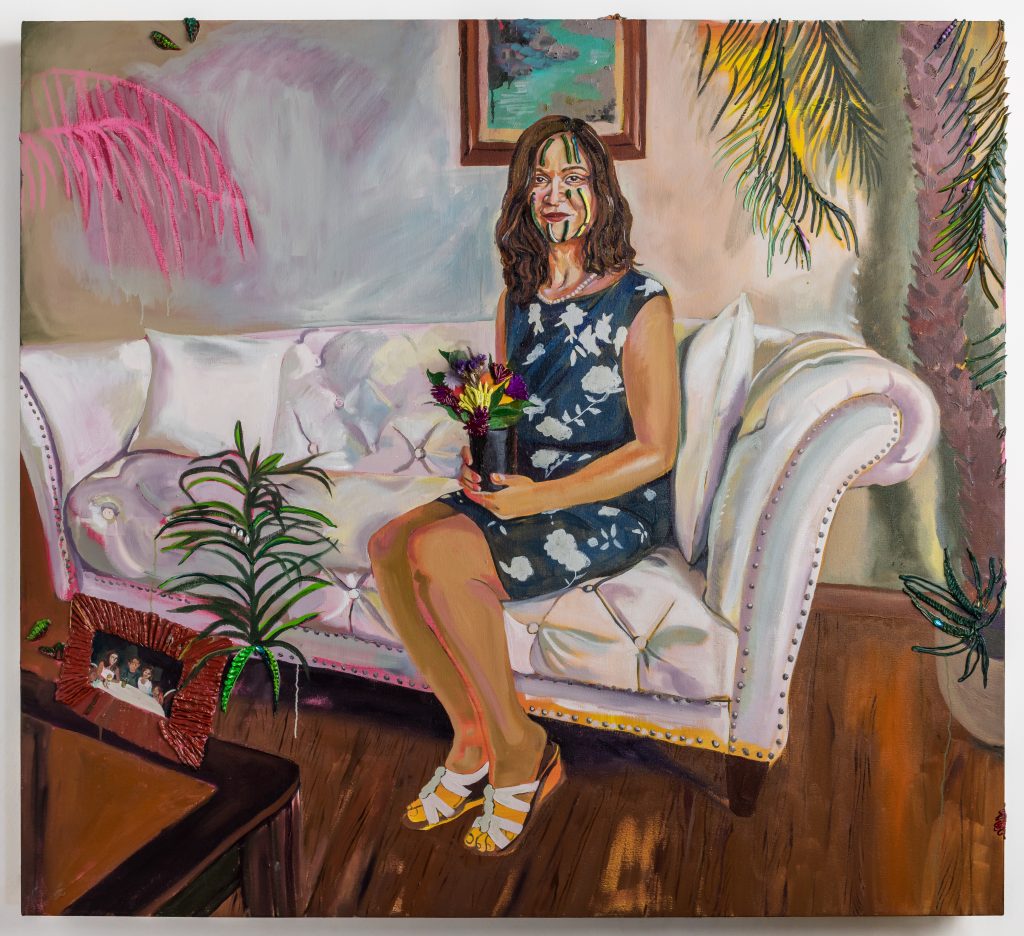
Gisela McDaniel, “Nëna,“ 2021, © Gisela McDaniel, Courtesy the artist and Pilar Corrias, London