When Mario Lamjock fled South Sudan’s civil war to Kenya’s Kakuma Refugee Camp about 20 years ago, his family survived solely on cash and food assistance from the United Nations (UN) World Food Programme.. But last year, they lost all assistance under a new aid model that categorizes refugees from most to least vulnerable.
“We were receiving small rations which we tried to manage. Currently, there’s nothing at all. We are really struggling and facing hardship,” Lamjock told Amjambo Africa. To sustain his family of eight, he now runs a retail business.
Kenya hosts close to 900,000 refugees and asylum seekers who are increasingly being pushed toward self-reliance as humanitarian assistance declines. A government move to restrict foreigners from running small businesses could make that transition harder for those whose livelihoods depend on small businesses, such as Lamjock.
“Wanting to stop us from operating small businesses is just the same as the UN removing us from aid assistance. It’s a potential hazard,” Lamjock said.
Following online protests from individuals and civil society groups who described the policy as xenophobic, the Kenyan government said the measure was aimed at migrants running businesses without documentation. The measure gives them a 90-day window to regularize their status and obtain necessary permits.
Kenya’s recent move comes amid efforts by several African countries to restrict foreign participation in certain parts of their informal economies. Last year, Tanzania banned migrants from engaging in certain businesses, saying they were reserved for citizens. In Ghana, foreigners are restricted from trading gold, while South Africa has seen renewed protests and tensions over migrant-owned businesses.
Self-reliance under pressure
When President William Ruto announced the decision to restrict foreigners from Kenya’s informal economy, he stated that the move sought to protect local traders and hawkers.
ADVERTISEMENT

However, with the country grappling with unemployment and economic hardship, many believe that migrants are being used as scapegoats to cover up governance failure.
“The government is trying to apportion blame on refugees and migrants who are already living precarious lives, while also trying to get itself out of the direct accountability that the informal Kenyan traders have been calling for, including the high cost of living and doing business,” Gordon Ogutu, an expert in migration governance and refugee integration and a research fellow at Ireland’s Dublin City University, told Amjambo Africa.
According to Ogutu, the move puts refugees, especially those in urban areas like Nairobi, at risk of attacks, as not everyone knows the difference between the displaced population and regular migrants.
Ogutu also argued that leaving refugees out of Kenya’s informal economy contradicts the country’s push for refugees’ self-reliance through the Shirika Plan. The plan was launched last year to transform displacement camps into settlements that allow for socioeconomic integration.
“This recent decision sends a very bad signal that, even though the government wants refugees to integrate and contribute meaningfully, there are certain areas and sectors that they must not venture into,” Ogutu said. “The president’s remarks go against the principles of the Shirika Plan and the overall image that Kenya wants to project to international donors and partners.”
The move was not the first time Kenyan leaders had blamed refugees for the country’s economic difficulties, Ogutu said, noting that previous presidents had also attributed poor economic outcomes to the displaced population.
“Refugees will suffer”
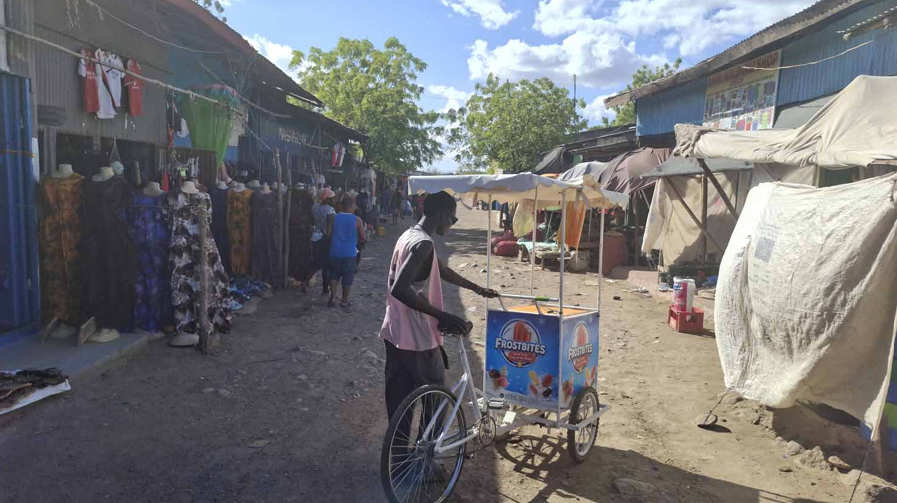
For refugees in Kakuma, small businesses are an important part of life and survival. Emmanuel Kinyera, who was born in the camp in 2000 to Ugandan parents, said the UN aid assistance he receives is not enough for his household of eight. “The aid we are receiving cannot sustain us. It’s too small,” Kinyera said.
Kinyera explained that many refugees in Kakuma depend on micro, small, and medium-sized businesses for their livelihoods, and that if the government prevents them from operating, they would have few alternatives. “Refugees will suffer because life is already complicated and challenging for us,” he said.
As Ogutu explained, the government’s 90-day window to regularize migrants’ status may present another challenge for refugees who want to continue operating legally. He said refugees already face challenges in obtaining identity documents. “There is a huge backlog of refugees who are seeking identity documents and even business licenses and permits to operate, especially in the city,” he said.
The rush to obtain documentation, he noted, could further expose these people to exploitation and harassment, particularly as they navigate a system that is still being developed to include them as part of Kenya’s national service delivery.
A question of competition
Some citizens on social media have argued that the restrictions are to protect local traders from foreign competition. Ogutu acknowledged concerns that some refugees and migrants accept lower wages or sell goods at lower prices. However, he argued that the government should address such concerns through clear and enforced labor and trade policies, rather than limiting refugees from running businesses.
“The government should recognize that no economic policy or actions should be taken without considering the effects and consequences that it will have on refugees in camps and the urban areas. They have become part of the Kenyan economy, and should not be treated as a separate entity,” Ogutu said.
For Lamjock, whose retail shop has become the main source of income for his family, the uncertainty is another challenge to an already difficult attempt to become self-reliant.
Editor’s Note: This article originally appeared in the October 2026 print edition of Amjambo Africa.