By Violet Ikong and Éloge Willy Kaneza
Since the outbreak of civil war in April 2023, Sudan has become one of the deadliest countries in Africa for journalists. According to the Sudanese Journalists Syndicate, more than 30 journalists have been killed while reporting on the conflict between the Sudanese Armed Forces (SAF) and the Rapid Support Forces (RSF), a paramilitary group that evolved from the Janjaweed militias accused of atrocities in Darfur two decades ago.
The latest casualty, Al-Nour Suleiman, a presenter and editor with El Fasher Radio, was killed by a drone strike reportedly carried out by the RSF in North Darfur. His death on October 5 followed that of photojournalist Al-Shykh Al-Samany Saadaldyn Mousa Abdulla, who died in a drone attack in Al-Butana five months earlier.
“These risks are constant,” said N, a female journalist based in Darfur, speaking to Amjambo Africa under strict anonymity for her personal protection. “I have traveled multiple times between army- and RSF-controlled areas via smuggling routes. Once, I had to bury my mobile phone underground to avoid searches by RSF fighters.”
Censorship, attacks, and daily threats
The Sudanese Journalists Syndicate has documented over 500 crimes against journalists since the war began, including arrests, detentions, physical assaults, and the destruction of media offices. N told Amjambo that these abuses are part of a systematic campaign by both SAF and RSF to suppress independent reporting.
“Sudanese journalists struggle to access information, and even when we do, heavy censorship prevents proper reporting,” she said. “Photography is prohibited unless official permission is granted, and even then, journalists face strict surveillance. Reporting on organizations or issues that conflict with the controlling faction can lead to interrogation or worse.”
Journalists face different threats depending on who controls the area. “The RSF often considers us spies for the army, which can lead to torture or death,” N explained. “In army-controlled areas, the danger is detention or travel bans if our work contradicts their narrative.”
Sudan’s deadliest year for press
In its 2024 Killed List, the International Federation of Journalists (IFJ) named Sudan the deadliest country for journalists in Africa. Of the six journalists killed on the continent that year, four were reportedly killed by RSF forces and two by SAF-linked attacks.
Multiple journalism organizations, among them IFJ, Committee to Protect Journalists (CPJ), Reporters Without Borders, and the Sudanese Journalists Syndicate, have confirmed that the war has forced more than 400 journalists to flee to neighboring countries – Egypt, South Sudan, Chad, and Libya – seeking refuge from harassment and violence.
Marwan, a journalist working in El Fasher, told Amjambo Africa, “We are heavily monitored by the RSF. I now work with extreme caution. Any mistake in gathering, reporting, or transmitting information could put me in immediate danger.”
Media clampdown, shrinking space for truth
Sudan’s repression of journalists has deepened as the war drags on. In the 2025 World Press Freedom Index by Reporters Without Borders, Sudan ranks 156th out of 180 countries, down from 149th in 2024.
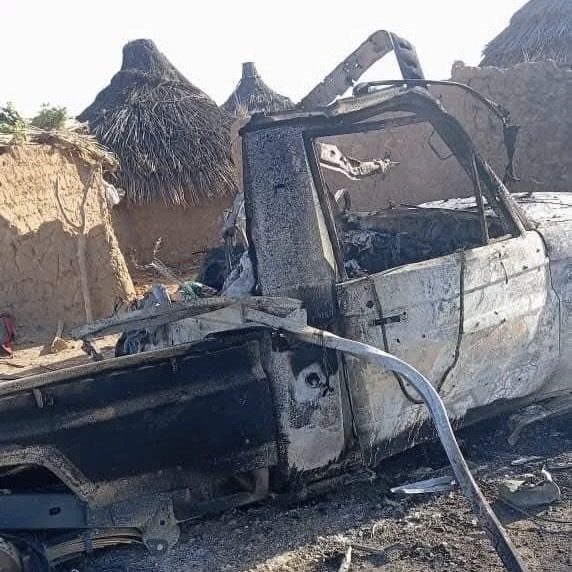
Photo : A burnt vehicle in Darfur, following an attack by the Rapid Support Forces (RSF). credit: Sudan War Monitor
Authorities have further tightened control by reducing media licenses from one year to just one week, making it nearly impossible for independent outlets to operate. Many journalists now work anonymously, publishing reports under institutional bylines rather than their own names.
ADVERTISEMENT

“I have published numerous reports without my name or location,” said N. “I once crossed the desert for two weeks seeking safety, and I still report from central Sudan to cover events in Darfur. Every story could be my last.”
Siege of El Fasher: city cut off from world
In the western Darfur region, the city of El Fasher has endured one of the most severe humanitarian blockades of the war. According to an October 2025 Committee to Protect Journalists report,“Hunted, Raped, Starved: Sudan’s Journalists Under Siege in El-Fasher,” the RSF has encircled the city since May 2024, cutting off food, medicine, and communications for more than 16 months.
Satellite imagery analyzed by humanitarian groups shows earthen walls erected by RSF forces around much of the city, sealing it off from aid convoys. Only a limited airdrop in late September 2025 managed to deliver small amounts of food and medicine to army-held neighborhoods – the first delivery in nearly five months.
Seven journalists interviewed by CPJ by phone described unbearable conditions: encroaching starvation, relentless shelling, and constant fear of discovery.
“We have been left to die slowly,” said one reporter trapped in El Fasher. “We don’t know if we’ll be killed by bombs, hunger, or disease – but we continue to report because silence would be worse.”
Hunted, raped, starved: journalists under siege
One female journalist told CPJ she was beaten and gang-raped by RSF fighters after they discovered her identity during a raid. “It was because of my work,” she said.
The Darfur Women Journalists Forum has recorded at least six rape cases involving female journalists since the war began – four in El Fasher alone. Survivors receive no post-rape care; hospitals are closed or destroyed, and medicines are unavailable.
“There were no doctors, no painkillers, no antibiotics,” the journalist told CPJ. “I had to heal by myself.”
Women journalists also face daily indignities. Without access to sanitary supplies, many are forced to improvise with cloth and avoid public reporting during menstruation for fear of humiliation.
Another journalist who requested anonymity with CPJ described being detained for 45 days, tortured, and threatened into abandoning her work. Informants and betrayal are common: “You never know who will reveal your name,” she said. “Even friends can become spies when they’re hungry.”
Starvation as weapon
The RSF’s siege has devastated El Fasher’s markets and supply chains. Residents, including journalists, now survive on animal feed known as ambaz, which is made from peanut shells and is unsafe for human consumption. Those who eat it report severe diarrhea, poisoning, and malnutrition. Entire families have died after consuming contaminated forage.
Food inflation is staggering: sugar that once cost $2 (USD) per kilogram now sells for nearly $28, while rice, flour, and milk exceed $80 per kilogram.
“Starvation is a weapon here,” said one journalist. “They want to silence us by making us too weak to speak.”
Some risk their lives to escape the city at night, walking 60 kilometers or more through the desert to find food. Others collapse from hunger but continue to write when they can.
Reporting in darkness
Electricity and internet access are intermittent, forcing reporters to write offline and send their stories through precarious channels.
“We cannot publish live. We document, we hide our files, and when the signal comes, we send,” one journalist told CPJ. “Journalism here is not a profession – it is a moral duty.”
Even amid fear, journalists in El Fasher remain defiant. “We are the voice of people who have none,” one told CPJ. “This is not only a war between the army and the RSF. It is a war against the truth.”
Humanitarian crisis compounds risk
Beyond physical violence and censorship, journalists in Sudan – like millions of civilians – face acute shortages of food, water, and medicine.
“The humanitarian situation in El Fasher is terrible,” Marwan told Amjambo Africa. “Hunger, thirst, and death prevail across the city. People rely on God to survive this war.”
Aid delivery remains largely paralyzed. The World Food Programme (WFP) and other agencies have struggled to reach Darfur for over a year, as RSF forces continue to block or attack convoys, according to CPJ.
Calls for protection, solidarity
Both N and Marwan stressed the urgent need for international support – financial, psychological, and logistical – for journalists reporting from Sudan.
“Current support is very limited,” said N. “Given the economic hardship and movement restrictions, many journalists have no choice but to stop reporting. Some are detained for doing their jobs, and there is little intervention to protect us.”
War against truth
As the conflict enters its third year, journalists in Sudan continue to document the war’s human toll. They are driven by the belief that truth is resistance, and that journalism stands as one of the last defenses against total darkness. Their testimonies paint a stark picture.
“The support being given to journalists is very limited,” N said. “Many of us now work under unbearable conditions, but we continue – because silence would mean surrender.”