
By Andy O’Brien
At a public hearing in Augusta on Feb. 24, educators and law enforcement personnel were among those who urged the Maine Legislature to reject Governor Janet Mills’s proposed cuts to programs for children.
The governor’s biennial budget (LD 210) includes $1.5 million in reductions in wage subsidies for childcare workers, cuts to tuition assistance for families, $3.6 million in slashes to Head Start programs, and the elimination of a program that helps low-paid childcare educators cover the costs of childcare for their own children.
The governor’s proposed budget reverses important changes made just last year, including a raise in the income threshold for the Child Care Affordability Program that allowed many more families to qualify for help paying for childcare. The 2024 budget also funded wage supplements to help childcare providers recruit and retain employees after half of the state’s childcare providers closed their doors during the coronavirus pandemic.
ADVERTISEMENT

Meaghan Woodsome, Chief Administrative Officer of the YMCA of Southern Maine, said the investments last year have helped her organization overcome a critical staffing shortage that limited the Y’s ability “to provide desperately needed childcare to working Maine parents.”
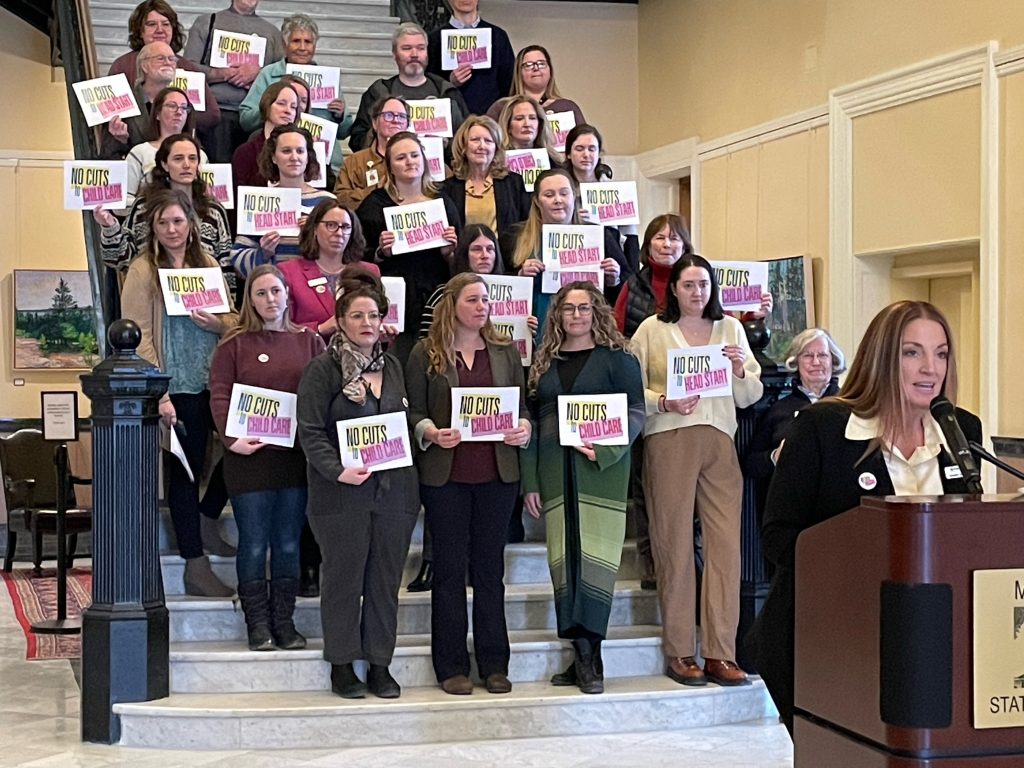
The Maine Association for the Education of Young Children estimates that the governor’s cuts to childcare workers’ wage subsidies would reduce wages by $2,000 per person per year. Wages would be reduced from $16.40/hr. (just over $34,000 annually) to $15.15/hr. (or $31,500 annually).
Testifying on behalf of the Maine Chapter of the American Academy of Pediatrics, child psychiatrist Douglas R. Robbins was among many who spoke about the critical importance of programs that support healthy child development. Robbins cited several studies that have found Head Start and Early Head Start in Maine have helped reverse the effects of poverty on children’s development.
“Because of Head Start, over 1,700 vulnerable children are 93 percent less likely to end up in foster care,” said Robbins. “Their physical health is improved, with less obesity, and 50 percent less mortality in the ages 5-9. They are 22 percent more likely to graduate high school, 13 percent less likely to ever be arrested, and 8 percent less likely to become teen parents. These are remarkable positive effects.”
Auburn Police Chief Jason Moen testified that high-quality early childhood education programs like Head Start help children perform better in school.
“We know from this research, as well as from our own professional experiences, that a child who is successful in school is more likely to avoid brushes with the law as he or she grows up,” he said. “Studies show the connection between high-quality early education programs and long-term crime prevention.”










