By Elena Ray
According to Mahassein Obaid Arbab of Auburn, food in her home country of Sudan is much more than physical nourishment – it’s a social and communal affair, the language of welcome, the keeper of memory, and at the root of the rhythm of daily life. Arbab, who is 79 years old, has been a Sudanese human rights activist for most of her life. She is an American citizen.
For members of the Sudanese diaspora, who live thousands of miles away from their country of origin, cooking with the authentic flavors of Sudan is key to the preservation and expression of culture. And the many African-owned businesses on Lewiston’s Lisbon Street are indispensable because, according to Arbab, they offer all the essential ingredients used in traditional Sudanese cooking. Therefore, even far away from home, the flavors of Sudan can be recreated and shared with a new country and generation.
Sudanese cuisine
Spices are foundational to all Sudanese cooking – black pepper, cardamom, cinnamon, coriander, fenugreek, turmeric.
“You should be able to smell how good your food is by how rich the spices are,” Arbab said.
And flavorful stews are the centerpiece of Sudanese cuisine. The most beloved is mullah, a rich stew often made with lamb, chicken, or okra and simmered with onion, garlic, and tomato – sometimes the flavor is deepened with peanut butter. Another favorite stew is goraasa be dama, a beef stew with green peppers that is spiced with cardamom and cinnamon.
ADVERTISEMENT

The stews are served in a common pot, around which family and friends gather, using pieces of kisra to scoop the shared meal directly from the central platter. Arab emphasized that this practice of eating together from one dish is an important part of Sudanese culture, and reflects the centrality of community.
When Arbab was young, she remembers that bread accompanied all meals.
“Every morning when you [went] out into the street, the smell of bread [was] coming from all the homes,” she recalled.
Every day, most Sudanese families baked their own kisra (a thin, spongy flatbread made from sorghum flour) in large stone ovens. The slightly sour tang of kisra provided a perfect counterpoint to savory dishes, Arbab said. Gourassa, a thicker flatbread that resembles a pancake, is another type of flatbread that can be sweetened by adding sugar or honey.
Arbab grew up along the Nile River, where the rhythms of life and food were deeply interwoven and the river was not just a geographical feature; it was a source of sustenance, a communal gathering place, and the heart of the local economy.
One of Arbab’s favorite meals as a child was bolti – tilapia – caught fresh from the Nile. When cooked, it has a flaky white texture and mild, slightly sweet flavor. But not everyone in Sudan lives near the Nile; for those who do not, tilapia is preserved by sun-drying, which involves gutting and salting the fish, then laying it out on open air racks. Tilapia is a common fish for many across the diaspora, and is available in grocery stores throughout the world.
Community at center of life
Sudan’s culinary tradition is inherently communal and local, and places the highest value on food that is fresh and minimally processed. Meat from a trusted local butcher or an animal you have raised yourself is considered best. Every family, if they could, kept goats for milk and cheese. In fact, according to Arbab, “It was considered shameful for a family to not own a goat.” And virtually all produce is sourced fresh from daily markets or family plots, with vegetables often traveling from earth to table in a matter of hours. In the north of the country, where dates are abundant, fruit was never purchased, but picked from trees when ripe.
From a young age, Arbab was passionate about food, cooking, the kitchen as the hub of home and communal life, and sharing meals with others. At 12 years old she started to cook alongside her mother and grandmother.
According to Arbab, the act of cooking and eating with one’s family and neighbors creates a sense of collective closeness and mutual caring that is cherished in Sudanese culture. “In Sudan, it is a sin for your neighbors to smell your food and not share it with them. Your neighbors are your family. Every neighborhood is one large, extended family,” she said.
Arbab herself lived in a close-knit family group that included siblings and cousins.“There were 27 of us children,” she recalled. After dinner, it was a nightly ritual for all the children to gather around their grandmother and listen to her tell stories.
While she now lives in Auburn, Arbab continues to extend the Sudanese values of hospitality and communal responsibility to her Maine community. For the past decade, she has been a volunteer at the St. Mary’s Nutrition Center – now Gather to Grow – cooking meals for people living with food insecurity. Every year, in celebration of World Refugee Day, Arbab is one of a group of asylum seekers and refugees who prepare and serve an array of traditional African dishes outdoors in Lewiston’s Simard-Payne Memorial Park.
Cooking tilapia with Mahassein Obaid Arbab
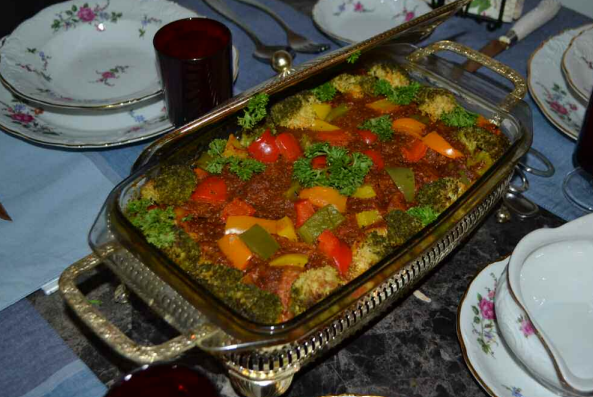
First, soak the fresh fish in saltwater and flour to eliminate any odor, then dry thoroughly. Dust the tilapia fillets with flour, cumin, salt, and pepper before pan-frying until lightly crisped. In a separate skillet, sauté onions, add garlic, cumin, coriander, and cardamom for flavor, then add tomato paste to thicken the sauce. Layer the ingredients by placing half the fried fish over the onions, followed by bell peppers and broccoli, then the remaining fish. Bake briefly to let the flavors marinate, then pour a rich, seasoned tomato sauce over the tilapia and vegetables. Add a fresh garnish of cilantro.