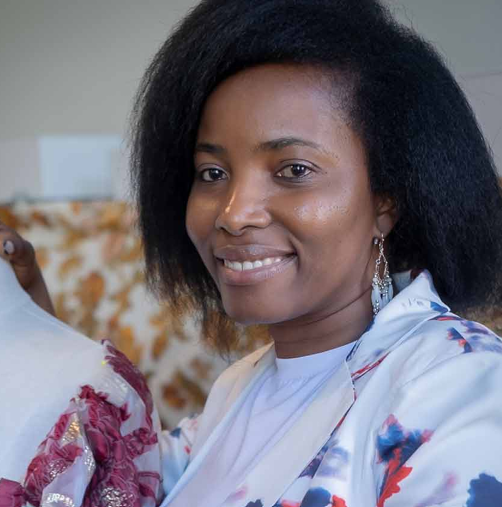
For Apphia Kamanda, sewing is much more than a profession. It is a passion rooted in her childhood, a practical skill and, today, a way to help others build a future of their own.
Originally from the Democratic Republic of Congo, Kamanda has lived in the United States since 2011. She recently launched Amstylia Academy, a school focused on sewing, fashion and professional skills development. Her goal is to give people who want to learn a trade the tools they need not only to find employment, but also to build their own businesses.
Her interest in creativity began in childhood. Her father was a sculptor. Several other members of her family were also involved in the arts, including architecture, poetry and photography.
As a child, Kamanda watched her father transform wood and stone into works of art. She sometimes accompanied him to exhibitions where his creations were displayed and sold.
“I would say to myself, ‘Wow, this is really fascinating. I want to do something like this, too.’”
Her brothers followed in their father’s footsteps and pursued sculpture. Kamanda chose a different material: fabric.“I wanted to work with materials like my father, but with clothing,” she said.
Growing up in the Congo, she was particularly inspired by the importance people placed on clothing and appearance, especially for ceremonies and special occasions. For her, fashion was a way to create, but also a way for people to express their personality and style. She studied modeling and styling at the Institut supérieur des arts et métiers (ISAM), graduating in 2004.
After moving to the U.S., Kamanda had to adapt to a new professional environment and a different way of working. She spent two years at Westbrook Adult Education, where she taught sewing and professional development.
Her work went beyond teaching students how to operate a sewing machine or make a garment. She also helped them search for jobs, prepare résumés and portfolios, get ready for interviews, explore freelance opportunities and understand different paths to independent work.
“Every day that we teach, we also learn,” she said. The experience showed her that professional integration requires more than technical skills. People also need to know how to communicate, be punctual and reliable, and understand what employers expect.
ADVERTISEMENT

“There are things you learn here that we don’t do back home,” she said. Over time, she noticed that her students had different goals. “There are people who want to learn in order to find a job, and there are others who have an entrepreneurial spirit,” she said.
That realization helped inspire Amstylia Academy. For Kamanda, vocational training can be a first step toward economic independence. A person can learn a skill, use it to generate income and eventually turn it into a business.
But learning how to sew is only part of the equation, she said. People also need to know how to set prices, find customers, use social media, present their work professionally and understand the basics of running a business.
“What is essential is not just teaching the technique. If someone wants to be independent, you also have to address the business side,” she said.
For Kamanda, mindset is just as important. Fear of failure, lack of confidence and fear of being judged can prevent people from putting their skills to work. She is also working on an unpublished book titled Your First Stitch Is Your Mindset. The central idea is that success begins with the way people see themselves and the possibilities available to them. “I can do it. If someone else has succeeded, I can, too,” she said.
That philosophy is especially relevant to immigrants rebuilding their professional lives in a new environment. For some, skills acquired in their home countries are not immediately recognized or put to use in the U.S. They may have to start over, learn new approaches and rebuild the confidence needed to move forward.
Kamanda emphasizes perseverance. “It won’t always be easy, but no matter what the obstacles are, you have to keep going,” she said. The experiences of her former students have also given her concrete examples of what vocational training can lead to.
Some people she has trained have gone into clothing alterations, custom garment making and wedding-related services. Others have developed businesses in more specialized areas, including costumes and furniture. For Kamanda, these journeys show that a skill can become a profession and that practical training can open the door to entrepreneurship.
Amstylia Academy is now taking another step forward.
The school has opened a space at Dana Warp Mill, a former industrial complex in Westbrook that has been redeveloped to house businesses, workshops, studios and a variety of creative activities. The site reflects Westbrook’s industrial history while providing space for entrepreneurs, artisans and other creators today.
For Amstylia Academy, the new location offers an opportunity to expand its activities in an environment where different projects, businesses and trades can come together.
The school offers sewing and fashion training, custom garment creation, advanced alterations, wedding-related services, upcycling and various workshops. A recent opening ceremony brought together members of the Westbrook community.
But Kamanda wants the academy to reach beyond its physical location. She also plans to develop online classes to reach people living in other states and even other countries, as well as those whose schedules make it difficult to attend classes in person. “That way, we will be able to reach more people in the community,” she said. She recognizes, however, that expanding the academy will require additional resources and work.
For Kamanda, entrepreneurship is not a new idea. It has been part of her story since childhood. Her grandmother taught her how to knit. Together, they made items to sell, an experience that helped Kamanda understand at an early age the connection between having a practical skill and being able to earn an income.
In Congo, she already had her own studio. She trained students there and made custom clothing. Her journey in the U.S., therefore, represents less of a break than another chapter in a story that began long before she arrived.
Today, she wants to pass that experience on to others, particularly people who already have skills but hesitate to turn them into professional opportunities.
Her message is direct: Believe in yourself and start with what you have. Economic independence can sometimes begin with a skill, a sewing machine, an idea and the willingness to turn that idea into a project. “As soon as you overcome the mindset that is holding you back, you have already taken a big step,” she said.
Through Amstylia Academy, Kamanda is seeking to build a bridge between vocational training, employment and entrepreneurship. Her ambition is to give people rebuilding their lives in the United States the tools they need to become more independent and, eventually, create opportunities for themselves and others.
Her story remains deeply connected to that of her father. He transformed wood and stone into works of art. She chose fabric. Today, through Amstylia Academy, she wants to pass on that same ability to create — not only to make clothing, but to give others the tools they need to shape their own futures.
Editor’s Note: This article originally appeared in the October 2026 print edition of Amjambo Africa.