On more than 50 acres in Wales, Maine, Omasombo Katuka is growing African vegetables, building a family business, and helping immigrant communities reconnect with the foods they grew up eating.
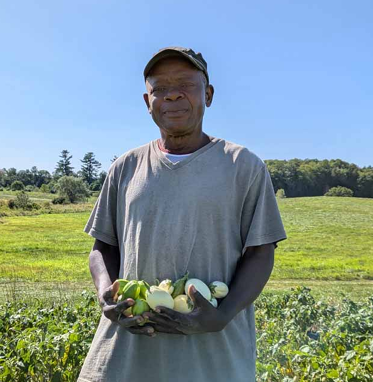
Rows of African eggplant, corn, squash leaves, sweet potato leaves, and other vegetables stretch across the farm. For customers from Maine’s African communities, the farm offers something that can be difficult to find in American grocery stores: foods that taste like home.
Katuka knows these crops can grow in Maine. What still surprises him is how often other people did not know. He remembers finding vegetables growing on farms that owners did not realize could be eaten or sold. He would ask whether he could take some of the produce, bring it to customers, and see whether people wanted it.
They did.
Over time, Katuka became more than a farmer. He became an informal teacher, showing other farmers and customers that African crops could grow in Maine.
“People who came like 20 years, I was the one who present[ed] to them like African plant[s] for the first time,” Katuka said. “And now many farmers already learn from me, and they grow with eggplant and the other vegetable[s].”
Customers call looking for squash leaves, corn, and other familiar vegetables. One Congolese customer told Katuka he had not eaten that kind of corn in about 20 years.
Now, customers do not just ask whether the farm has African vegetables. They ask when the next harvest will be ready.
From Congo to Maine
Katuka was born in Kasaï, in the central region of the Democratic Republic of the Congo, where farming was part of his childhood. His parents had a large farm and taught him how to work the land.
Farming, however, was not his only profession. Katuka was also a teacher before leaving Congo.
Around 2000, after political problems in Congo, he went to Tanzania and spent about 10 years in refugee camps.
Katuka came to the United States in 2010 with his wife and children. His wife, Poya Ndjadi, was born and raised in Burundi and completed her schooling in Congo. They initially settled in Nashville, Tennessee, before moving to Maine in 2012.
In May 2012, he began training with Cultivating Community, learning how farming in the United States differed from farming in Africa.
The training covered soil, land, equipment, irrigation, water, and farm safety. Katuka traveled to other states, including New York and North Carolina, for additional training.
As an immigrant learning English as a second language, Katuka said the program gave him practical skills and helped him understand systems that were unfamiliar to him. “I was so excited to continue with them,” he said.
In 2018, he completed his training and described himself as a “graduate farmer.”
When food became a business
During his training, Katuka began working with farms serving African communities in Maine. From around 2012 to 2014, he worked with Somali farmers and noticed African eggplant and other unfamiliar vegetables growing on their farms. He asked whether he could take some of the produce and sell it to his customers. He began making money from the vegetables.
He also visited a successful farmer in Vermont, learning from her experience and continuing to work with African seeds. The more he learned, the more he understood that there was a market.
African immigrants were looking for foods they knew from home, while many of those foods were difficult to find locally.
One person who helped Katuka recognize that potential was Khadija, who worked with a food pantry. She purchased Katuka’s produce for people in the community and told him they liked it.
ADVERTISEMENT

Khadija eventually connected him with someone who helped him obtain farmland.
In 2023, Katuka obtained his own farm in Wales. In 2024, he began developing OK Community Farm as a business.
Building from the ground up
Katuka had spent more than a decade searching for land. In 2018, he traveled to Bowling Green, Kentucky, to learn how to purchase farmland, but the effort did not work out.
When he finally obtained the Wales property, he knew he had found something more important than a place to plant vegetables. “Because now it’s like we are home,” Katuka said. “That is our home now.”
There was no water system, electricity, house, cooler, or washing station when Katuka arrived on the farm in Wales. The family had to reinvest its earnings in the farm to build the infrastructure needed to operate.
Before having washing facilities on the property, Katuka sometimes had to harvest vegetables in one place and transport them somewhere else to wash them before delivering them to customers.
That made farming slower, harder, and more expensive.
The family is still paying back people who helped Katuka obtain the land. Those supporters gave him time to establish the farm before requiring repayment.
“The small money that we get, now we already put everything in the farm,” he said.
Equipment remains his biggest challenge. Tasks that could take 30 minutes or an hour with the right machinery can take several days or even weeks when done by hand. “Equipment is the number one,” Katuka said.
Financing is another challenge. Government programs can help with certain projects, such as wells or equipment, but farmers still need enough income to cover their remaining costs.
Labor, he said, is not the biggest problem. People regularly call asking whether there is work available on the farm.
Feeding a community
The farm’s customers come from across Maine’s African communities, including Senegalese, Togolese, Burundian, Rwandan, Congolese, and Angolan communities.
Producing food is only half of farming, Katuka has learned. A farmer also needs to know where the food will be sold. “You can have a lot of stuff like this,” he said. “If you’re not selling, you are working for nothing.”
Katuka has built his customer base through churches, farmers’ markets, direct calls, and word of mouth. He sells at farmers’ markets, including Kennedy Park in Lewiston, and travels to Portland and other communities. He also brings produce to apartment complexes where African immigrants live.
Sometimes the process is simple: Katuka parks, sets up a tent, and calls customers. Within an hour or two, the vegetables can be gone.
Demand for African vegetables has continued to grow. Katuka said customers call looking for corn, squash leaves, and other foods they remember from home.
African eggplant has become one of the farm’s most important crops. Katuka estimates that he can deliver 300 to 500 pounds a week through food pantry networks and other outlets. Customers have become accustomed to it. “When come[s] the eggplant?” Katuka recalled them asking when a delivery did not arrive.
Maine’s short growing season presents a challenge, but Katuka has learned how to work with the climate. The demand encourages him to plant more.
Growing almost everything
Although African foods are the farm’s specialty, OK Community Farm grows much more.
Katuka said the farm produces corn, several varieties of eggplant, onions, garlic, sweet potatoes, sweet potato leaves, African spinach, beets, carrots, watermelon, cabbage, and squash leaves, among other crops.
“We grow almost everything,” Katuka said. “But our specialty that we need to grow and have more money is African foods.”
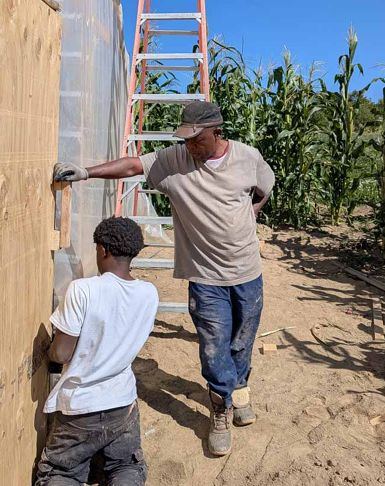
house on their farm
For Katuka, the goal is not simply to preserve familiar foods. He sees African agriculture as a business that can grow while serving communities throughout Maine and eventually beyond.
The family needs machinery that can reduce the physical demands of farming and make it possible to cultivate more land efficiently.
A family business
At the center of OK Community Farm is Katuka’s family.
Ndjadi works alongside him. Their son David, a recent Bates College graduate, spends long days working on the farm with his father.
Ndjadi has developed a deep connection to the land. “When I am working in my farm, I forget even that it is night until it turns dark,” she said.
She also takes joy in seeing people come to the farm, watch the family work, and leave with fresh vegetables. “When you are blessed, you bless others,” she said.
Families sometimes bring their children to the farm. Katuka sees those visits as another form of education, giving children a chance to see vegetables growing in the soil rather than assuming food simply appears on a grocery store shelf.
David grew up watching his parents build economic security while adapting to life in a new country. The farm was only a few minutes from Bates, allowing him to return home during the school year to help when his family needed him.
David said his parents spent the better part of 15 years working toward the land they now own. At times, the family drove more than 40 miles each way simply to farm.
He sees farming as a business and as part of the legacy his family is building. The work has taught him patience, resourcefulness, and practical problem solving. He believes that when farming is treated as a business — with attention to efficiency, growth, and reinvestment — it can support families and contribute to generational wealth.
While David plans to pursue commercial real estate, he sees the farm as part of the foundation his family has built. As the firstborn son, he hopes the family’s future will eventually look different from its past: more secure, more comfortable, and, most importantly, together.
More than a farm
Katuka is already thinking beyond Wales. He hopes OK Community Farm can eventually expand to other states, including Texas, where a longer growing season could allow the family to produce more food and serve more communities.
The family continues to invest in infrastructure. Equipment is still needed, financing remains a challenge, and the people who helped Katuka acquire the land still need to be repaid.
Yet the farm is already feeding people, creating work, and keeping African foods available to communities far from where those foods originated.
Recently, a family from Burundi visited the farm with three children. Katuka said they were happy to see what the family was building and to understand where the food sold in their community comes from.
For Katuka, the farm is about more than vegetables. It is about dignity, family, and belonging. It is about showing children what their parents can build and giving immigrants access to foods that remind them of home. And it is about proving that African seeds can take root in Maine soil.
“We are doing something that people love,” Katuka said. “And you impact the community, and that is a good thing for us.”