Thousands of miles from Kinshasa in the Democratic Republic of Congo, Amos Mukobo Kazadi is growing more than vegetables in the heart of Maine. In his fields, he is cultivating a taste of his childhood, while responding to a need shared by many immigrant families: access to fresh, local African produce, rather than relying on imported or frozen products.
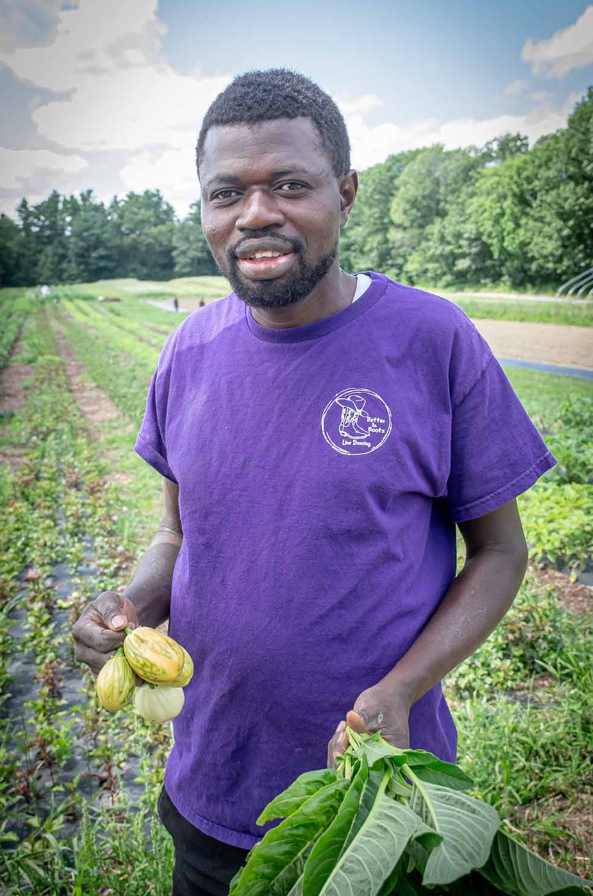
On about two-and-a-half acres (two hectares) of rented land, Kazadi grows amaranth, sorrel, small eggplants, African spinach, and sweet potato leaves. He has also introduced cassava to his fields — which he describes as a first in Maine — and hopes to expand the range of African crops grown in the state.
But his ambition extends far beyond his own farming practice. Kazadi hopes one day to buy his own land, expand his operation, create jobs, and help other immigrants get started in agriculture. “I want to pass it on to others so that my work can continue even after I die.”
From Kinshasa to Maine
Born in the Ngaba commune and raised in Kingasani, Kinshasa, specifically in Bikuku, Kazadi grew up in a family where farming was part of everyday life. His mother, who still lives in Mbakana, on the Batéké Plateau, grows corn, eggplants, and cassava leaves, among other crops. As a child and later as a young man, Kazadi watched her work and helped on the farm.
Yet when he left the Congo, agriculture was not part of his professional plan. Kazadi had studied to become a nurse. To help pay for his education, he had sold handkerchiefs on the street.
In 2012, he decided to enter the U.S. Diversity Visa lottery. He was selected in 2013 and began the process of moving to the U.S. When Kazadi and his wife, Laurienne Kitenge Kayembe, arrived in December 2014, Maine was their first destination.
He hoped to continue his nursing studies. “When I came to the United States, I had no idea that one day I would be farming here,” he recalled. Several years later, the idea of farming would gradually take root.
COVID-19 Changes His Path
The turning point came in 2020. In June of that year, Kazadi contracted COVID-19. The pandemic had also disrupted his professional life. He did not work for about a year and a half.
At the same time, travel restrictions, border closures, and disruptions to supply chains made access to certain food products more difficult. Kazadi began asking himself a question: Why not use the land available in Maine to grow some of the foods African communities need?
Today, he considers that difficult period a defining moment in his journey.
Learning In the Fields
When he decided to start farming, he did not know where to begin. Kazadi never studied agronomy, but he believes growing up in Africa gave him a foundation. “I may not be an agronomist, but you always learn,” he said.
He turned to the internet and searched for mentorship programs. He eventually connected with Cultivating Community in Portland and met an interested mentor. The organization also provided him with a small plot where he could begin farming. From there, Kazadi attended meetings, built relationships, and took part in training programs.
“I went to meetings, then more meetings, to meet people and make friends, until I finally found this place,” he said. Today, he still takes part in online training sessions and programs, reads extensively, and exchanges knowledge with other farmers. “If I get a little stuck, I go to my neighbors,” he said.
His Mother Remains His First Mentor
Despite the farmers and organizations that support him in Maine, Kazadi still turns to his mother for advice.
He calls her regularly and shows her his crops over video chat. “She continues to coach me over the phone,” he said. When something is not growing properly, his mother tells him what to remove, what to leave, and when to wait before harvesting. Sometimes, she sends him videos to demonstrate particular techniques.
ADVERTISEMENT

For Kazadi, that relationship represents a connection between the farming knowledge his mother passed down from the Congo and the new techniques he’s learned in Maine.
Growing African Flavors
Today, Kazadi grows several crops familiar to African communities. He is now working to refine his cassava growing methods and determine how the crop can adapt to Maine’s conditions. He is considering using greenhouses to continue his experiments.
He hopes to gradually introduce more African crops to Maine. Cassava holds a special place in that vision because it is an important staple in many African households.
“Everything We Eat Comes From Africa.”
For Kazadi, local production is directly connected to access to familiar, quality food. He said many of the products consumed by African communities in the United States are imported, sometimes frozen, and then sold in specialty stores. In his view, the taste does not always compare to that of freshly harvested produce. He pointed particularly to sorrel.
Growing these products locally, he believes, would allow people to reconnect with familiar flavors while reducing dependence on imported foods. “If we grow our own products from back home here in the soil, it also allows us to eat organic and natural food,” he says.
Demand Outpaces His Production Capacity
Kazadi’s customers are primarily of African origin. Congolese and Burundians are among his main customers, while people from West Africa also buy his produce. He sells through community networks, and is not yet focused on maximizing profits. His priority is to increase production and allow more people to have access to fresh African produce. “We are only at the beginning,” he said.
Amaranth is, in his experience, one of the most sought-after crops. Small eggplants and sorrel are also popular. The challenge now is meeting demand. “People need this,” Kazadi says. His production capacity remains limited by the amount of land available, the short growing season, and his financial resources.
Much Bigger Dreams
Kazadi does not own the land he currently farms, he rents it. His long-term goal is to buy his own farmland. “If God gives me the opportunity, I will buy my own land. It will be better,” he said.
Once he owns the property, he wants to expand production and create a farm capable of providing work for others. He envisions a cooperative farm — a place where immigrants could learn, work, and develop their agricultural skills. For Kazadi, the farm should become a collective project. “What I have, I cannot keep for myself,” he said.
A Father of Four Working for the Future
Behind the farmer is also a father who wants to build a better future for his family.
Kazadi and Kayembe have four children. Despite his family responsibilities, Kazadi devotes much of his time to his fields. For him, farming is not simply a job. It is a project he hopes to pass on to his children and, beyond them, to future generations.
Some days begin very early. “I come here at 4 a.m.,” he said. He may work until 9 or 10 a.m., go home to get some sleep, and then return. On Saturdays, he sometimes spends the entire day in the fields. “If it’s not dark, I can’t leave,” he says with a laugh.
He acknowledged that the work is exhausting but said he has a particular energy when he is on the farm. “I can’t go five minutes without thinking about the land, about farming,” he said.
The Challenges Are Many
Despite his enthusiasm, Kazadi faces numerous challenges. Farming in Maine presents challenges different from those Kazadi experienced in Africa. Weeds, animals, and changing weather conditions can cause significant losses. A frost can destroy crops within hours. Sometimes, plants he orders online are lost because they need to be planted quickly and cannot be kept for several days.
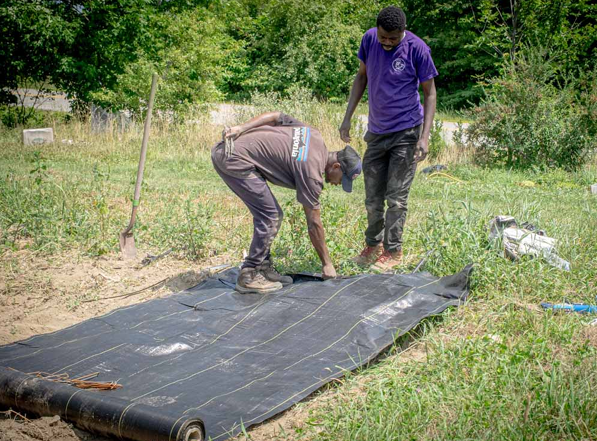
Kazadi has had to learn new methods. He uses tarps, for example, to control weeds around his crops.
Financing is another major challenge. Kazadi wants to hire workers, increase production, and establish his cooperative. But to achieve those goals, he said repeatedly, “I need support.”
He continues to work with various mentors, including people connected to the Maine Organic Farmers and Gardeners Association (MOFGA). “MOFGA also plays a major role in my farming here,” he said. When he encounters problems with insects, he can send photos to his advisers so they can identify the problem and determine how to respond.
One of the main obstacles facing immigrants who want to get into farming, Kazadi said, is English. Even when an immigrant has several years of farming experience in Africa, they may struggle to know where to find help or how to access available programs.
Kazadi believes more training, mentorship programs, and multilingual support are needed. “We have many people who did farming in Africa, but they don’t know how to connect with us,” he said.
Giving Other Immigrants a Chance
Kazadi does not want to develop only his own farm. He wants to pass on what he is learning. He encourages immigrants with agricultural experience in Africa to consider pursuing farming in the U.S.
In his view, training and financing could help many more people get started. He envisions the creation of a school or program specifically for immigrants interested in agriculture. “It will require funding. We will need to open a school, offer training and apprenticeship programs,” he said. For him, investing in agriculture can also contribute to immigrants’ economic integration.
“Everyone Eats.”
His message to the Congolese, African, and immigrant communities is, above all, a call to take initiative. Kazadi encourages those who can to consider farming and other forms of entrepreneurship. “Everyone eats,” he said. He believes that local production of some of the resources communities consume can help meet a collective need.
He also calls on consumers to support farmers making that effort. “People need to respect our products and encourage those who sacrifice so that we can eat organic food,” he said. And he sums up his philosophy with an expression he has known since childhood: “Unity is strength.”
Amos Mukobo Kazadi’s journey is that of an immigrant who has lived several lives: a student and aspiring nurse in Kinshasa, a newcomer to the United States, a worker whose life was disrupted by COVID-19, and a self-taught farmer. Today, he has become a producer seeking to meet a concrete need in his community.
His story is part of a broader movement of farmers and agricultural producers supported by organizations and leaders across Maine’s agricultural sector. He has been featured in resources connected to Broadturn Farm and is part of the 2026 cohort of the Braiding Seeds Fellowship, a program designed to support farmers and food justice leaders.
Kazadi’s vision, however, is much larger: Through his fields, Kazadi is not simply trying to grow vegetables. He is trying to grow possibilities — for his family, for Maine’s African communities, and for newcomers who already possess agricultural knowledge. And perhaps, tomorrow, for a broader American market.
His dream is ultimately simple but ambitious: to grow here the foods he knew in Africa, nourish families who need them, and pass on to the next generation land, knowledge, and the conviction that it is possible to build something — even far from home — for one’s community, for future generations, and for everyone seeking to rebuild their lives far from their country of origin.
Editor’s Note: Eloge Willy Kaneza contributed to this report.
This report is part of Ladder to the Moon Network’s ‘What’s Carried Forward’ photojournalism series.