
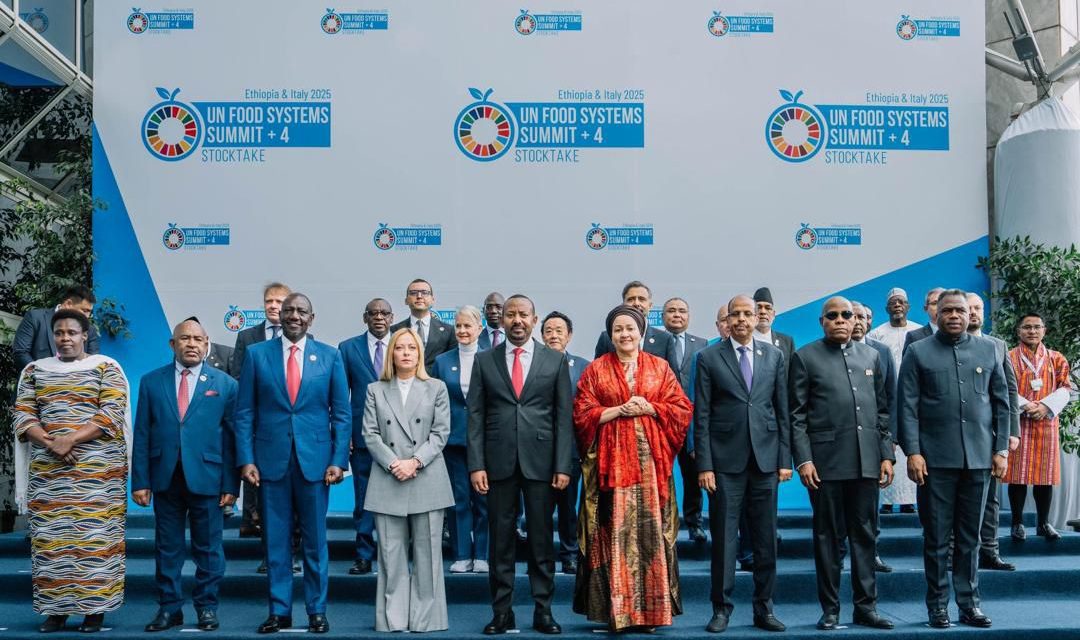
By Samuel Getachew
ADDIS ABABA, ETHIOPIA – The 2nd UN Food Systems Summit, known as Stocktake (UNFSS+4), took place in late July in Ethiopia amid rising levels of hunger in Africa. The summit host country itself faces a severe humanitarian crisis, fueled by climate change, violence, famine, and the displacement of millions of its citizens. An estimated 20 million people in Ethiopia are in need of emergency food aid.
Humanitarian organizations blame the Trump administration’s suspension of humanitarian assistance for some of the hunger. Representatives of the World Food Programme (WFP), one of the most active humanitarian agencies in Ethiopia, say its budget has been cut by a third since January 2025, with a nearly 40 percent reduction in its workforce. Some of its operations have closed entirely, including in the province of Tigray, which is still recovering from war.
“The cuts in humanitarian support and aid have been difficult and invisible for many people. Millions are out of reach of [help] as resources dwindle,” said Gebrehiwot Gebre-Egziabher, who heads the Tigray Disaster Risk Management Commission.
Meanwhile, the safety of humanitarian food delivery personnel has become impossible to guarantee, with troubling attacks on drivers and staff members, some of which have resulted in their death. In the war-torn Amhara region alone, 14 aid workers were killed last year.
“As an idealist, I want to see humanitarian aid delivered to every person who needs it, but we have limited resources, the country has security issues it has yet to solve, there is a growing challenge of donor fatigue, and there is competition with the humanitarian needs of global hotspots like Gaza,” said a WFP worker who requested anonymity.
Like many others all around Ethiopia, Asnakech Dubale, aged 27, fled to Addis Ababa to seek safety and a solution to hunger for herself and her children. Her husband, a farmer, had disappeared during the conflicts that have plagued Ethiopia in the past decade. Now she is forced to beg for food, and she has no idea if her husband is alive or dead.
“There are many days that I survive on a loaf of bread and the leftovers that I am given by strangers. I provide for my children, but I have no shelter, no future for my children, no education, and it seems nobody cares about us,” Dubale said.
Last year, as humanitarian organizations sent warnings of an impending famine in Ethiopia, Prime Minister Abiy Ahmed told parliamentarians that “there are no people dying due to hunger in Ethiopia.”
The Ethiopian government claims the nation will soon be able to feed its own population. However, observers are skeptical. The World Bank has downgraded Ethiopia’s income ranking to “unclassified” because of questionable economic data that experts say are linked to a desire for positive headlines.
ADVERTISEMENT

In Bole, Addis Ababa’s once elegant and leafy neighborhood, now a bustling commercial district, Kibrom Assgedom, a frail-looking 48-year-old man, relies on begging from strangers to survive. He migrated from the Tigray region this year.
“I beg to just survive, and I pray in the nearby church to speed up my death, as my suffering has been too much, from war, poverty and now famine,” Assgedom said. He explained that he is a survivor of the war in Tigray that destroyed his livelihood and displaced a majority of his family members, making them all victims of chronic hunger.
Assgedom and the majority of others begging on the streets to survive were removed from the downtown sections of Addis Ababa for the duration of UNFSS+4, apparently to provide the illusion of a refurbished city of green spaces, skyscrapers, and street lights, as opposed to images of a suffering population fighting hunger.
Meanwhile, Médecins Sans Frontières (MSF), the Nobel Peace Prize–winning international humanitarian organization, has announced an impending humanitarian crisis unfolding in Northern Nigeria which it called “alarming.”
“MSF teams are caring for an ever-increasing number of malnourished children in therapeutic feeding centers, with increasingly severe conditions,” read a statement, listing insecurity, violence, disease outbreaks, and lack of health care as reasons for the worsening situation.








