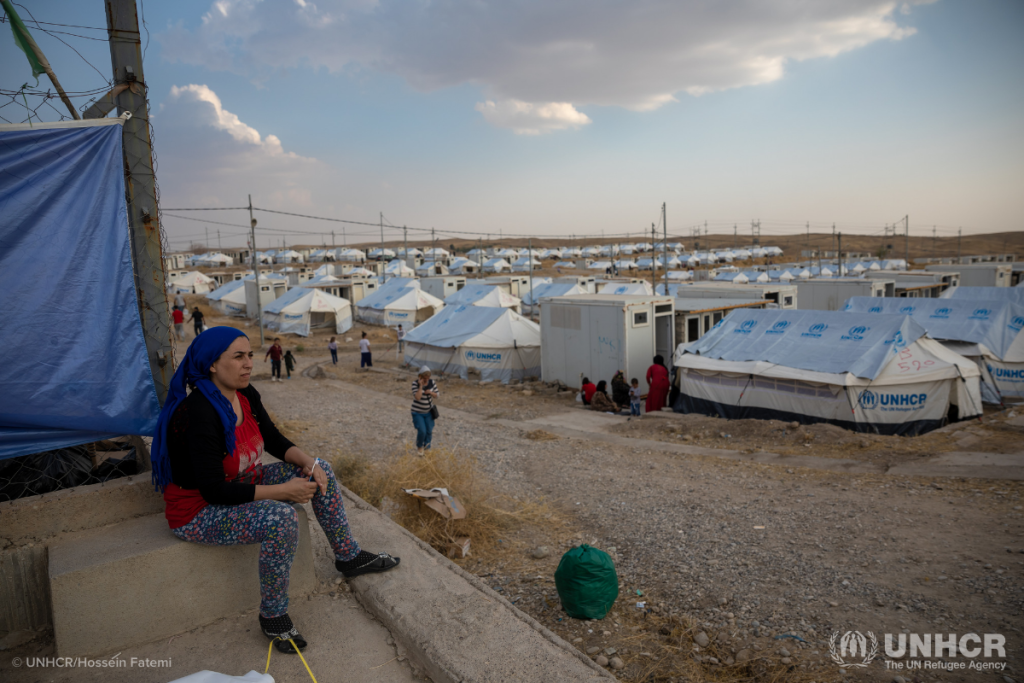
Syrian refugees camp/credit:UNHCR
At a traffic stop in Bole, one of Addis Ababa’s most trendy neighborhoods, Osman Al-Hurry stood with his wife and children, begging for money. The neighborhood is popular with Ethiopia’s middle class, as well as foreign diplomats, and tourists. On the eve of the African Union summit mid-February, the streets were busier than ever.
An engineer by profession, and a native of Damascus, Al-Hurry arrived in Ethiopia two years ago. With his light complexion, he stood out in a crowd of destitute, displaced Ethiopians who had traveled to the capital from the north to escape famine.
Holding a toddler by one hand and his proceeds from a day of begging in the other, he declared the day financially successful. Thankful for the hospitality he has received in Ethiopia, he noted that Ethiopia often reminded him of home.
“Ethiopian people are kind and welcoming, and I want to live in Addis Ababa permanently,” Al-Hurry said, emphasizing the connection he feels as one of the Syrian refugees in Ethiopia. “I’d like to open a restaurant if I can’t find a job in engineering.”
Finding employment as an engineer has proved an uphill battle, and the kind of middle class life Al-Hurry enjoyed in Syria so far has been out of reach for him in Ethiopia:

“Oftentimes we get about 800 birr a day [about $6 USD] and sometimes, especially on holidays, we can get up to 10,000 birr [about $80] … we dream of better days ahead.”
ADVERTISEMENT

The day he spoke to Amjambo Africa, Al-Hurry said he was fortunate – he had earned triple his usual daily earnings. He was not alone in saying that despite the overthrow of the Assad family dynasty, he’d like to remain in Ethiopia. Syrian refugees in Ethiopia have found an oasis there, and consider it their adopted homeland.
The Syrian presence is felt throughout the country, particularly in the restaurant business. Shawarma, a dish made with meat, and Syrian bread have both become popular with Ethiopians, and there is now a Syrian restaurant on almost every major street in Addis Ababa. And the “Bole Mikahel” neighborhood, where an Amjambo reporter met Al-Hurry, is well known as a Syrian enclave.
However, recently many people living or working in the Bole Mikahel neighborhood have been forced from their homes. This was due to a construction project funded by the World Bank, which will include a new asphalt road leading to nearby Bole International Airport.
An Ethiopian woman who spoke on condition of anonymity said that, because of the project, landlords were issuing eviction notices in the neighborhood. She said they fear tenants will be forced to share the limited housing that remains, and expect overcrowding will result in damage to the apartments.
And many restaurants in the neighborhood have been razed to make way for the roads. But with restaurant work a key to the survival of many Syrian refugees in Ethiopia, these closings hit hard. Most refugees from Syria survived by working in restaurants, and now, lacking stable jobs, they were struggling to make ends meet.
Mohammed Ahmed remained in the Bole area with his extended family. But in mid-February his family received an eviction notice from his landlord, claiming they were damaging his property due to overcrowding, and now he worried that he soon would have nowhere to live. Furthermore, although he was getting by selling homemade perfumes, that was becoming harder due to harassment by security officers, who he said were encouraged by store owners who complained that his prices undercut their sales.
“One of the challenges of living in Ethiopia is finding a place to call home, where we can lay our foundation, and see our children be educated. Ethiopia has weak tenant rights and we live in fear that we can be evicted anytime,” Ahmed said.
But some Syrian refugees in Ethiopia reported that they were thriving. Amjambo spoke with Muhammed Abdulkader, age 21, who together with his parents is the proud owner of a Syrian restaurant called Syriana. Syriana sells Syrian sweets as well as Mediterranean cuisine, and it has become very popular with Ethiopians.
“Owning and introducing food that is different from what locals are used to is difficult and financially draining, but over the years, it has picked up, and we are elated with our success and the diversity of our customers,” Abdulkader said.
Abdulkader said his grandfather, an exporter who had traveled to Ethiopia before the Syrian civil war, moved three generations of his family to Addis Ababa 14 years ago. Only 7 years old when the family arrived, Abdulkader now speaks fluent Amharic and markets the business to thousands of Ethiopian followers on TikTok.
Hailemeskel Gebreselassie, age 41, has been frequenting Syriana since it opened.
“The first time I ate shawarma, it tasted different, but once I got used to the taste it has become a ritual for me, and I come often as it’s so affordable,” Gebreselassie said.
He said the restaurant’s food reflects the diversity of Ethiopia, which is the diplomatic capital of Africa and home to a wide variety of people.
Gebreselassie said there was now a growing sentiment among Ethiopians that Syrians, particularly Syrian refugees in Ethiopia, would be a boon to the local economy – especially in construction, as the government implements huge modernization projects.
Ahmood Barre, a Syrian architect who lives near Bole International Airport, was eyeing citizenship and planning to look for a job in the construction sector. He was hopeful that his community would be able to integrate with the local Ethiopians and thrive.
“Ethiopia is building mega projects – hotels and high-rise real estate. I just hope I will be part of the project, contribute, and leave a legacy behind, rather than stay in Syria [and just dream] of a different life,” Barre said. “I want to be part of Ethiopia’s future.”