By Ignatius Ssuuna
June 25, 2025
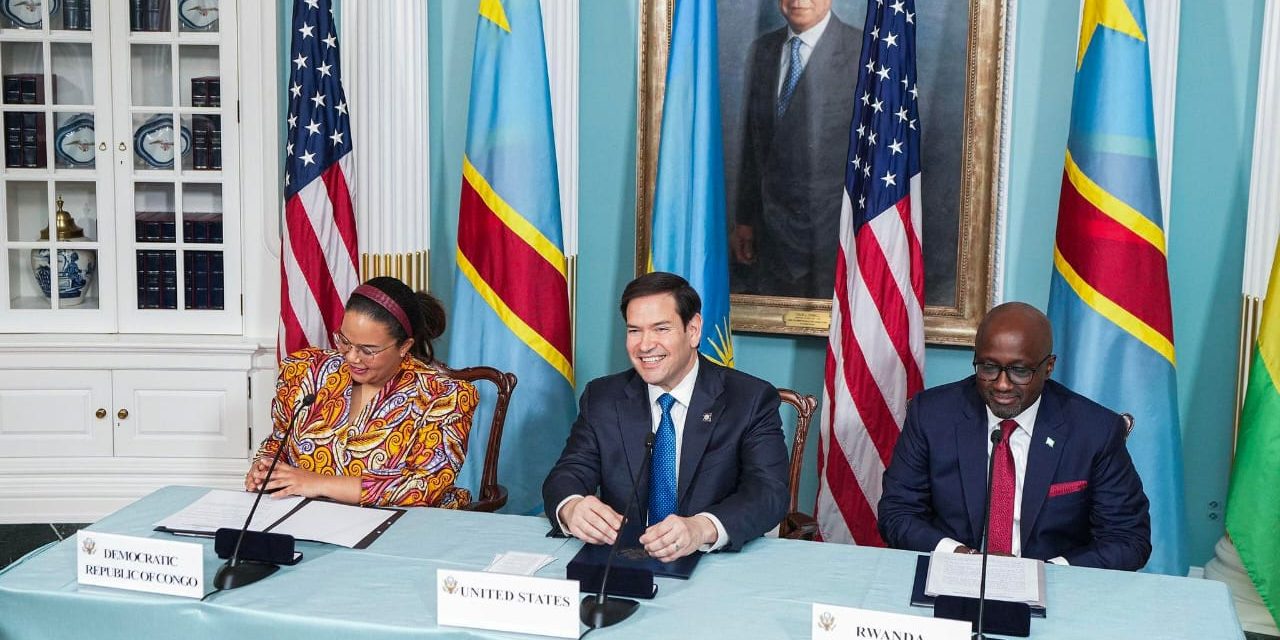
KIGALI, Rwanda – Technical teams from Rwanda and the Democratic Republic of Congo (DRC) have finalized a draft peace agreement aimed at ending the protracted conflict in eastern Congo. The deal is scheduled to be signed on June 27 in Washington, D.C., and was confirmed this week by the United States, which facilitated the landmark negotiations.
U.S. senior advisor for Africa, Massad Boulos, described the recent three-day session as a “constructive dialogue” centered on political, security, and economic interests in the region.“Proud to lead three days of peace talks, which resulted in the initialing of the peace agreement by delegations from the DRC and Rwanda,” Boulos posted on X (formerly Twitter) last Wednesday. “Next week, we look forward to hosting the Foreign Ministers to sign the agreement on June 27, witnessed by U.S. Secretary of State Marco Rubio.”
The agreement could represent a turning point in efforts to stabilize eastern DRC, where more than 237,000 people have been displaced since January 2025 due to ongoing fighting between the Congolese army (FARDC) and the M23 rebel group. U.N. experts have linked M23 to Rwandan support—a claim Kigali continues to deny.
ADVERTISEMENT

The M23, a Tutsi-led rebel group, has taken control of vast territories in North and South Kivu provinces and has remained in charge of their respective provincial capitals since early 2025. Despite Rwanda’s denials, a 2024 U.N. report estimated that up to 4,000 Rwandan troops were active inside the DRC. In a notable policy shift, the U.S. State Departmentofficially designated M23 as a Rwanda-backed force in 2024 and called on Rwanda to withdraw all its forces and missile systemsfrom Congolese territory.
Rwanda insists its actions are in self-defense, citing persistent threats from the FDLR, a militia group with origins in the perpetrators of the 1994 Genocide Against the Tutsi.
According to U.S. officials, the draft peace agreement includes several major provisions:
- Mutual respect for territorial integrity and prohibition of hostilities
- Disengagement, disarmament, and conditional reintegration of non-state armed groups
- Establishment of a Joint Security Coordination Mechanism, referencing the October 31, 2024, CONOPS framework
- Facilitation of the safe return and reintegration of refugees and displaced persons
- Enhanced access for humanitarian organizations
- Development of a regional economic cooperation and investment framework
“These talks built on momentum from the April 25 Declaration of Principles hosted by Secretary Rubio,” said Allison M. Hooker, U.S. Under Secretary of State for Political Affairs. “We look forward to the ministerial signing of the agreement on June 27 and to its timely implementation.”
The process has also involved the State of Qatar, which participated in the latest discussions to ensure alignment between its efforts and those of the United States. A joint U.S.-Qatar statement praised both Rwanda and the DRC for their commitment to dialogue and regional stability. “The DRC and Rwanda expressed appreciation for the valuable contributions of the United States and Qatar as partners in advancing a peaceful resolution,” the statement noted.
The U.S.-brokered agreement also signals renewed Western interest in the mineral-rich region, which holds reserves of tantalum, gold, cobalt, copper, and lithium—resources crucial for the global clean energy transition.
In an article by Amjambo Africa, the U.S. role in pushing for this deal has raised both hope and skepticism. Some view it as an opportunity for peace, while others question the geopolitical interests at play. Read more on U.S. involvement here.
On the ground, reactions among civilians remain cautious but hopeful. “There is some relief among people in eastern Congo that peace could return eventually,” said Ruth Alonga, a journalist based in Goma.
“This agreement is clear to everybody, but the problem can rise when implementation begins,” added Justin Cyala, a resident of Bukavu, also speaking to Amjambo Africa.