For Chris Lyon and Ben Conniff, confronting racism requires more than saying, “I’m not racist.”
It requires looking inward, examining personal biases, understanding how systems produce unequal outcomes, and building relationships across racial and cultural lines.
It also requires something less abstract: showing up.
Lyon and Conniff are members of White Men for Racial Justice, a community of white men who come together to examine their experiences with race, have difficult conversations, and learn how to take meaningful action against racial inequity.
White Men for Racial Justice (WMRJ) is an anti-racist, pro-justice community of practice for white men committed to examining their own relationship to race, challenging white supremacy, and taking action within their communities and spheres of influence. WMRJ describes its work as rooted in personal transformation, mutual accountability, and action aimed at dismantling systems of racial and economic inequality.
The organization was formed in 2020 after George Floyd’s murder, when Kevin Eppler and Jay Coen Gilbert brought together about 100 white men for a Zoom conversation about racism and their role in confronting it. Eppler, a co-founder and steward of WMRJ, is also an educator, curriculum designer, facilitator and equity consultant.. Gilbert is a co-founder of B Lab and the B Corporation movement and serves as executive chair of Imperative 21, a global network with a goal of driving economic change.
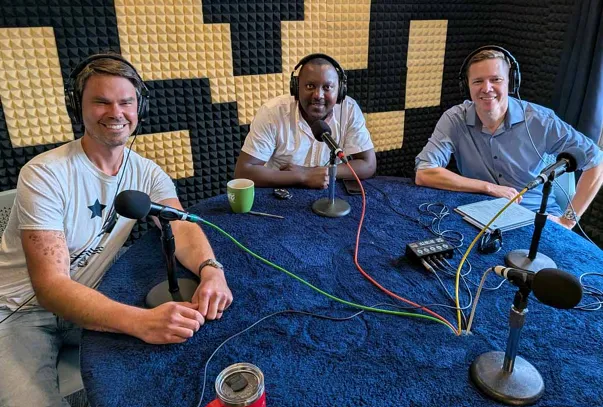
Photo | Éloge Willy Kaneza
Today, WMRJ has grown into a national network of hundreds of members across 37 states.Its Maine group has about 60 members, according to Lyon, who said Maine’s group had only one member about four years ago.
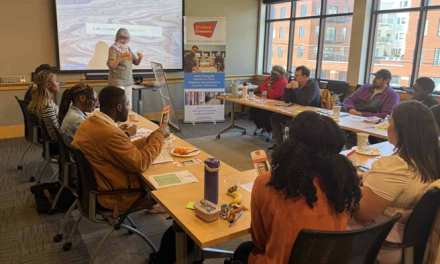
Members meet in peer circles and at virtual and in-person gatherings where they have candid and sometimes challenging conversations about race, privilege, whiteness, and their own experiences and biases. WMRJ said its national community gathers every Tuesday virtually and meets in person several times a year for immersive community weekends and local gatherings. During those gatherings, members reflect on what they have learned, challenge one another, practice having difficult conversations, and consider how to translate learning into action.
WMRJ describes its approach as a continuous cycle of learning, reflection, and action. Members hold one another accountable while listening to Black people, Indigenous people, and other activists of color who have long led racial justice work.
The group pointed to concrete actions by its members. WMRJ said members have supported school board efforts around teaching a more complete racial history, participated in a conference on racial reparations, and engaged in local conversations about gun violence and immigrant communities. In Pennsylvania, more than 30 WMRJ members signed letters supporting the release of Tyree Wallace, who had served 26 years of a life-without-parole sentence for a crime he did not commit. Several members attended a rally outside Philadelphia City Hall.
Lyon and Conniff discussed their experiences during a recent episode of Amjambo Time, Amjambo Africa’s live program on WMPG. Their conversation touched on race, privilege, allyship, immigration, and Maine’s changing demographics. Beneath those topics was a common message: White Americans who want to contribute to racial justice must move beyond good intentions and take responsibility for the work.
A moment that changed Lyon’s thinking
Lyon’s journey into racial justice work began with discomfort.
In 2020, while in Burlington, Vermont, he was having dinner when a Black Lives Matter protest passed nearby. He supported the movement and believed Black people deserved recognition and the freedom to live their lives fully. But as the protest passed, he noticed that he felt tense.
That contradiction — supporting the cause while feeling uncomfortable in its presence — made him want to understand himself better. “I wanted to explore that more,” he said.
Eventually, someone he trusted invited him to join White Men for Racial Justice.
Conniff confronts the gap between beliefs and action
Conniff’s path into racial justice work was shaped by the murder of George Floyd in 2020.
At the time, Conniff was helping run Luke’s Lobster, a seafood restaurant group with a diverse team of managers around the country.
After Floyd was killed, some managers reached out to company leadership. “They asked us why we hadn’t checked in on them,” Conniff said. “Why we weren’t engaging with them about what was clearly this huge issue that we were all experiencing, but that they were experiencing in a very different, profound way.”
ADVERTISEMENT

The question forced Conniff to examine his own behavior. He had always considered himself opposed to racism. But he began asking what he had actually done to oppose racism. .
“When I look at it in honest accounting, what had I done?” he said. “What had I really done to support the cause of anti-racism or to support the people of color in my life?”
He realized there was a gap between his beliefs and his actions. A trusted friend eventually invited him into White Men for Racial Justice.
“I was one of the good guys,” Conniff said, describing his mindset before joining the group. He believed that because he had never consciously considered himself racist, he was already on the right side of the issue. But the group encouraged him to examine how he may have benefited from systems of racial inequality without recognizing it.
“If I was actually going to be helpful in anti-racist movements, I needed to actually look at myself,” Conniff said.
Allyship means showing up
For Lyon, allyship is not about making one public statement or attending one protest. It is about consistency. “I think for me, it’s about showing up continually and being able to self-reflect on how you showed up,” he said.
That includes listening when someone says an action caused harm, even when the harm was unintended.
“There’s no perfect way to show up as an ally,” Lyon said.
A white person may attend a racial justice march and receive praise for being there. But Lyon said the more important question is whether that person will still be present afterward. “What if he is?” Lyon said. “And what if he is the next day?” For him, repeated presence builds trust.
Learning from Maine’s immigrant communities
Maine’s increasingly diverse population has given both men opportunities to learn from people whose backgrounds differ from their own.
Conniff said one of the most important lessons has been recognizing the diversity of experience, knowledge, and perspectives within immigrant communities and communities of color. “I gain so much from relationships with diverse individuals that I have now that I would not have if I weren’t doing this work,” he said.
According to Conniff, some white Mainers, particularly outside the Portland area, may have limited direct contact with immigrants. Without those relationships, people may rely heavily on social media or traditional media to form their understanding of immigrant communities. “Sometimes [these understandings are] misleading. Sometimes they’re malicious,” Conniff said.
Personal relationships, he believes, can challenge stereotypes by allowing people to know their neighbors directly.
When lived experience complicates beliefs
Lyon said racial justice work has taught him that listening to people with lived experience can complicate even strongly held beliefs.
He recalled a conversation during a period of increased immigration enforcement in Maine. Lyon said he opposed using Maine jails to detain people for immigration purposes. But someone whose friends and family members had been detained challenged his thinking. That person said that if loved ones were going to be detained, they would rather have them held closer to home than transferred far away.
The conversation did not erase Lyon’s concerns about immigration detention. But it introduced a perspective he had not considered. “I think that just highlights how challenging all this really is,” he said.
For Lyon, racial justice requires making room for that complexity.
“Proximity, presence, and practice”
Lyon described his approach to racial justice using three words: proximity, presence, and practice. “Going to a predominantly Black space as a white person is a really good start,” Lyon said.
For him, proximity means developing genuine relationships rather than relying on assumptions. Presence means continuing to show up, especially when doing so is difficult or uncomfortable. Practice means continually examining one’s behavior and learning from experience.
That philosophy reflects WMRJ’s broader approach, which emphasizes that learning and action are interconnected and that racial justice is ongoing work, not something that can be mastered through a single training or conversation.
Finding joy instead of guilt
Both men emphasized that racial justice should not be understood only through sacrifice or guilt. Conniff said he has gained joy, community, and deeper relationships through the work.
White people who remain on the sidelines because they are afraid of saying the wrong thing may be missing opportunities for meaningful relationships, Conniff said. “I’m just a much happier person who feels much more community, much less isolation, and much more love than before I started,” he said.
That emphasis on community is also central to WMRJ’s model. The organization describes its gatherings as spaces where white men can be vulnerable, examine difficult emotions, and learn alongside others without pretending that the work will always be comfortable or perfect.
A vision for Maine
Lyon said he hopes Maine will increasingly recognize the importance of immigrants and refugees to the state’s future.
Their contributions, he said, go beyond the economy. Immigrants bring skills, perspectives, cultures, and experiences that can strengthen communities. “I look forward to that day, a few years in the future, when we realize how deeply thankful we should be for the immigrant community here in Maine,” Lyon said.
Immigrants and members of multicultural communities should understand that their value to Maine extends far beyond their economic contributions, said Conniff. “It’s really just who you are as a person,” Conniff said. “You have so much value.”
He hopes Maine will reach a point where discrimination and violence are no longer accepted and immigrants can participate openly in community life.
“We can do better”
Near the end of the conversation, Lyon and Conniff were asked what they wanted Americans to take away from their work.
Lyon’s answer was direct. “We can do better, we can handle the truth,” he said.
Conniff offered a phrase associated with the group’s work: “Love is the revolution.”
For both men, racial justice is not a one-time project. It is a practice of learning, listening, reflecting, building relationships, accepting accountability, and showing up.
Their message to white Americans is not simply to avoid racism. It is to ask what they can do with the privileges, relationships, and opportunities they have. And their message to Maine’s immigrant and multicultural communities is equally direct: Their presence matters.
As Maine becomes more diverse, Lyon and Conniff believe white Mainers have a role to play — not by speaking for communities of color, but by listening to them, standing with them, and helping create a state where everyone has an opportunity to belong. The starting point is simple: show up, keep learning, and be willing to change.