By Rachel Ndjondjo
Originally from the Democratic Republic of Congo, Apphia Kamanda Mpay arrived in the U.S. in 2011 and moved to Maine the following year. At 41, this mother of two, a naturalized U.S. citizen, embodies the resilience, industry, and commitment to community support found in so many new Americans.
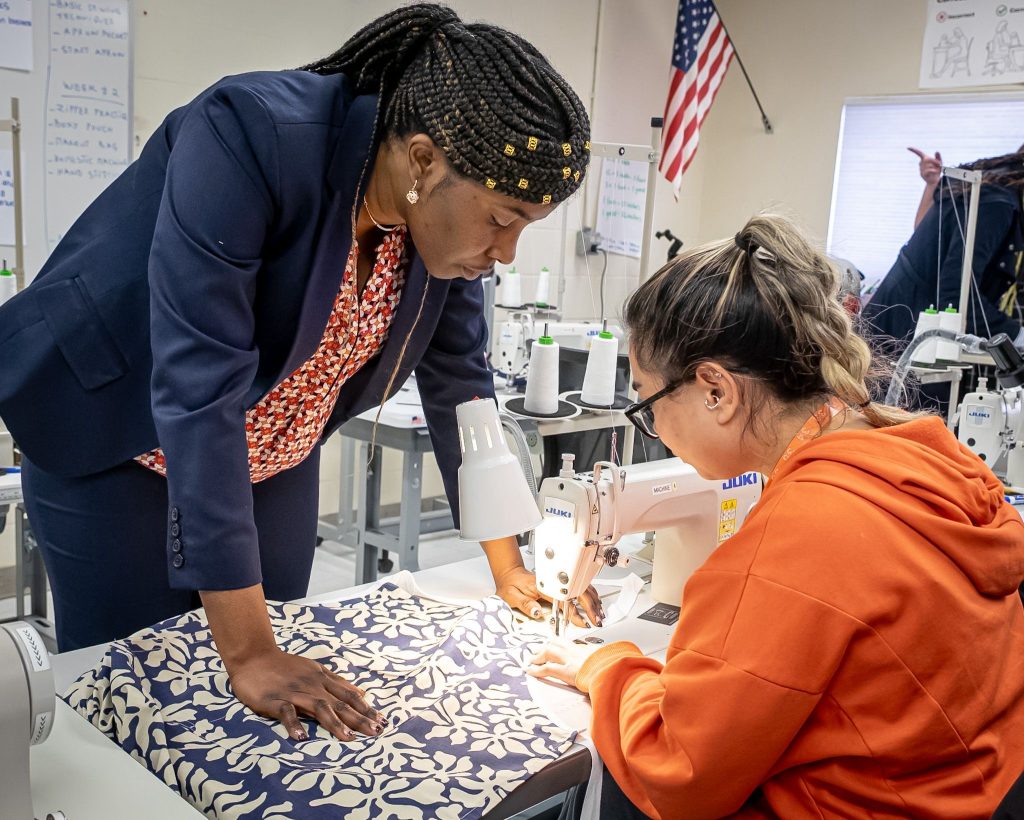
A familiar face in Maine’s local textile and fashion scene, Mpay teaches sewing skills to fellow immigrants. Apphia Mode et Style is her design label.
As a child growing up in DR Congo, Mpay’s creative instincts and interest in fashion design emerged at a young age.
“Since I was a little girl, I used to create dress models for dolls—we call them bana bitendi in my country. So, I already had this passion in me during childhood,” Mpay said.
ADVERTISEMENT

She grew up surrounded by creative people: “I come from a family of artists. My father is even an art professor. I have three brothers and one sister, and they are all artists,” she said.
Mpay’s father tried to steer her away from life as an artist: “Growing up, my father wanted me to study medicine, but I also wanted to pursue art like my siblings. I even started university in medicine, but since it wasn’t really my choice, I dropped out and went to another university to study fashion design.”
Before entering the university, she learned to sew. “I was waiting for my high school exam results, and I asked myself what I could do in the meantime. And I decided to enroll in a sewing center. It was easy for me to adapt because I already had art in my blood—nearly my entire family are artists, even my uncles and cousins.”
After she moved to Maine, despite the complexities of establishing herself in a new culture, Mpay knew she wanted to find a way to continue her artistic journey. So in 2015, she enrolled at Common Threads of Maine, which at the time was newly founded by Dori Waxman to train people for work in the textile industry. She had such a wonderful experience that after finishing her coursework, she stayed on as a teacher.
Ten years later, Waxman has retired, but Mpay is still actively teaching sewing, using the same curriculum pioneered by Waxman. Classes are now located at the Westbrook Adult Education Workforce program. Over the years, the school – founded as Common Threads of Maine – has helped over 200 participants, mostly immigrants, complete a 12-week training program. Around 82% of Common Thread’s students have gone on to secure jobs with local companies like American Roots, L.L. Bean, and Sea Bags.
Mpay reflected on the transition of classes to Westbrook. “Where we were before, the school was a little bigger than here–this classroom can only accommodate six students. Before, we had at least 13 students.” However, Mpay said that watching her students grow in the new location is just as fulfilling as it was when she worked with Waxman.
“My favorite moments are seeing progress—watching someone who knew nothing about sewing begin to create amazing things. I had one student who started with zero knowledge, and now she’s a great designer. I even see her showcasing her creations in fashion shows. That makes me so proud.”
Mpay noted clear differences between studying sewing in Congo and the U.S.
“There’s a big difference. In Congo, you can learn both pattern cutting and sewing together. There’s more of a generalist approach. But here, perfection is key—you must specialize. It’s hard to do both. Either you learn to sew, or you learn to cut. So that’s how we divide the work.”
Over the past decade, Mpay has been so busy teaching sewing she has not yet showcased her own designs publicly, but she said she has ambitions to do so.
“One day I want to organize my own show and display my own work,” she said.
But collaboration and community will always remain important to her, she said. “I often support designers who participate in fashion shows and showcase their creations. Personally, I haven’t shown myself in a fashion show yet… I would love to collaborate with other designers. It’s part of my plans.”