By Raymond P. Diamond
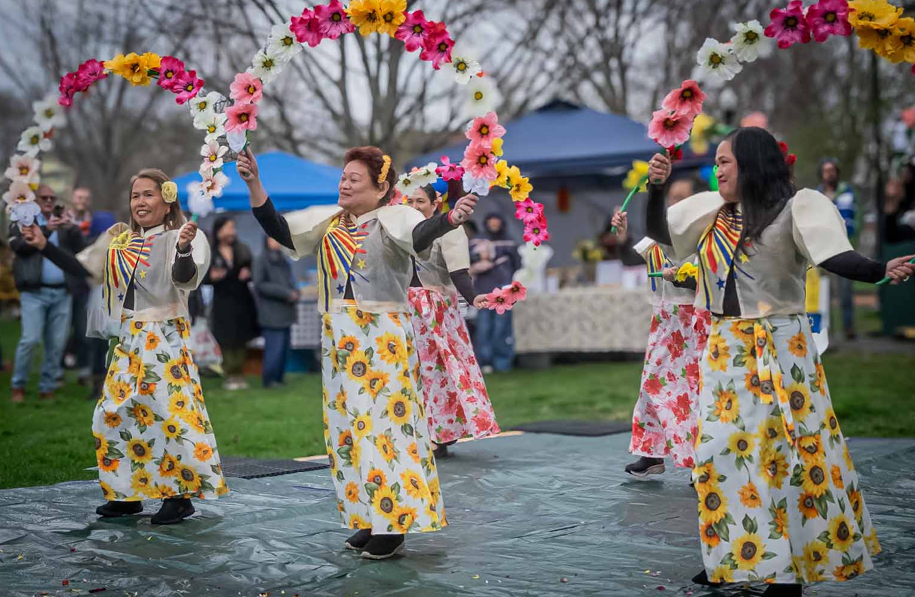
May 2 marked 2026’s annual SEAFest (Southeast Asian Heritage Festival), held at Westbrook’s Riverbank Park. Despite a rainy, downcast day, over 700 people, representing the state’s wide diversity, attended over the course of the seven-hour event. The event featured a series of Southeast Asian entertainment sets, including but not limited to Boston’s ShinDaiko Drummers, Khmer Maine Dance Co., and Filipino-American Samahan of Maine.
“The kids [at the festival], when you look around, they’re not just bringing their Asian friends; they are bringing kids from school, white, Black, Hispanic. So, for me, that means that they’re proud of their culture and they want to share it with their friends too,” said Marpheen Chann, executive director of Khmer Maine, SEAFest organizer, and author of the memoir Moon In Full. “It doesn’t matter what party or beliefs you have, you’re going to join in… because it looks fun.”
Over 30 tents and booths were set up, featuring vendors, food, original crafts and art, and booths offering information or promoting nonprofit, education-based, immigrant-centered organizations.
Representatives from educational and community-based organizations like I’m Your Neighbour Books (IYNB) and Noble Adult & Community Education in Berwick were at booths to tell event-goers more about what their programming offers.
IYNB is a book-donation-based organization in collaboration with the Maine Department of Education. Ange Ishimwe, who was at the organization’s booth, started interning with IYNB in 2025 through their Pine Project. The Pine Project’s goal is to “…enhance students’ understanding of diverse experiences and foster an inclusive school environment.” The project focuses on serving immigrant communities and providing picture books featuring immigrant and new generation families.

Ishimwe, who immigrated at 10 to the United States, stressed the importance of projects like their Sanctuary Stories programming, given the current political climate concerning immigration enforcement. Sanctuary Stories is an ongoing project where IYNB personally chooses books for children who have been impacted by ICE, in order to “include stories of families dealing with immigration issues and/or stories that simply embrace [families] in the joy of community.”
Ellie Chow, assistant director at Noble Adult & Community Education, and Sokha Khlung represented an adult education program that serves Mainers throughout Berwick, South Berwick, North Berwick, and Lebanon. Chow and Khlung shared that while adult education programs like Noble’s are “known for the academic side” of what they do, like high school equivalency testing, Noble Education offers more.
Noble offers English as a second or additional language. Chow elaborated, saying that their English language programming is for “anyone who’s coming to the country and wants to learn English.” She specified that their English classes have a wide range of proficiency levels, from individuals with PhDs from other countries to elderly students beginning to learn the alphabet.
ADVERTISEMENT

Outside of more traditional, academic adult educational programming, Noble serves its communities, providing enrichment and community-building classes such as community sewing, knitting, quilting, and ceramics.
Khlung relayed her personal long-standing relationship with adult education programming. She has been around these environments since she was a child alongside her mother, who was a beneficiary of this kind of programming herself. Discussing the diversity in the categories of classes that Noble offers, Khlung said that Noble’s high school equivalency classes host students ranging from 17 to their 60s.
When asked about the impact that the prior year’s ICE activity has had on Noble’s adult education programming, which serves both immigrants and other Mainers who have lived in the United States all their lives, Chow indicated that while it is a “big step coming to adult education,” their English programming is typically attended fully remotely.
Many of Noble Education’s students make this choice out of fear and concern with possibly putting themselves in a vulnerable position. With sociological, transportation-related, or financial barriers present, Noble Education’s remote programming is one way to make adult education even more accessible.
In addition to educational and social programming like Noble and IYNB, there was an informational tent staffed by Oriana Farnham of the Asian American Legal Defense and Education Fund.
Farnham’s primary goal in attending SEAFest was to share and ensure that attendees were aware of their rights if they are stopped by ICE, like their rights to remain silent, to ask questions or request a lawyer, and to peacefully walk away if not under arrest. Farnhem noted that the Education Fund has recently filed two lawsuits to protect Temporary Protection Status for immigrants from Burma and Yemen and has provided some deportation legal defense for immigrants.
Amjambo Africa staff was fortunate enough to speak to critical figures in the organization of SEAFest, including Chann and Filipino American Samahan of Maine President Sarah Boothby.
Chann, 35, born in California and adopted as a child in Maine, is an American of Cambodian and Vietnamese descent. Khmer Maine, where Chann is the executive director,, is an “organization working to improve the quality of life and the social and economic well-being of Cambodians in Maine through cultural exchange, community building, and civic engagement.” Khmer Maine serves a Cambodian community of over 2,500 people in Maine. However, as the organization grows, Chann says that they are trying to serve other Southeast Asian communities.
While Chann was pleased with the turnout and the overall execution of this year’s SEAFest, he noted a series of changes. In response to the current political environment and hostility towards immigrant populations across the country, Chann made it a point to establish several individuals as legal observers or assigned to security as a precaution to keep the festival safe.
According to Chann,, “Southeast Asians are among the highest populations to get deported, because the Trump administration basically forced Cambodia and Vietnam into an agreement … to accept deportees,” even if the deportees were not originally born in these countries. In February, however, Congress introduced H.R.7608, the Southeast Asian Deportation Relief Act of 2026, which, if made law, would “…halt removal of certain nationals of Cambodia, Laos, and Vietnam, and for other purposes.”
The UCLA Asian American Studies Center stated in their April 2026 Research Brief: “Under Trump, the number of arrests [of Asians] jumped, non-criminals were more targeted, and at-large apprehensions disrupted communities. While these harmful impacts continuously increased in the early months, there was a pause in the escalation at the start of 2026, as evident in the statistics. As mentioned in the brief’s introduction, this was due to worsening public opinion. The administration appears to have pivoted politically.”
Filipino American Samahan of Maine is a nonprofit organization supporting Filipino Americans in Maine. Boothby noted that Samahan of Maine’s support also supports Vietnamese and Laotian Mainers.
Samahan of Maine started as a social club in 2021, when the organization’s growth was stifled due to the COVID-19 pandemic. In December 2024, the nonprofit acquired 501(c) status. Since then, its programming and social event hosting have grown.
Boothby herself has lived for over 40 years in Maine. Describing her experience initially moving here as an immigrant, Boothby said, “When I came here… it’s so hard. I [didn’t] know anyone. It’s painful.” She continued, “Maine is my home.”
Her aspirations for future SEAFests in Maine include more sponsorship and more advertisement opportunities. She also hopes that people from away will travel to Maine specifically to experience this festival.
The overall tone of the festival itself was one of hope and joy, focusing on appreciating all that Maine’s Southeast Asian communities contribute to the state.