By Eloge Willy Kaneza – June 2025
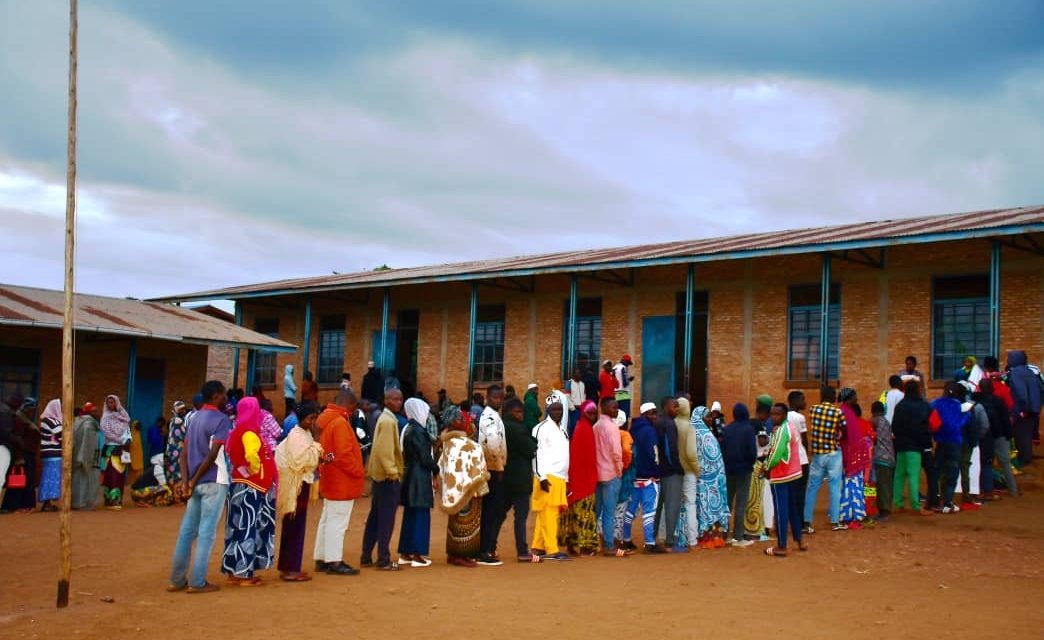
On June 5, millions of Burundians went to the polls to cast their votes in legislative and communal elections. But despite the official narrative of “peace and democratic maturity,” the process has been widely denounced as fraudulent, intimidating, and tightly controlled by the ruling CNDD-FDD party.
“This country is sinking,” said longtime opposition leader Agathon Rwasa in an exclusive interview with Amjambo Africa. “And who will restore it, if there is no alternative?”
“We need the ink, so they leave us alone”
In multiple provinces across the country, citizens told Amjambo Africa that their participation in the elections was not an act of democratic choice, but of survival.
“We already know who is going to win,” said one voter in Ngozi. “But we need this cursed ink on our fingers to show the Imbonerakure and the local authorities so they leave us in peace.”
In Burundi, voters receive an indelible ink mark on their fingers after casting their ballot — a fraud-prevention system which has reportedly become a tool for verifying loyalty to the ruling party.
Surveillance, arrests, and obstruction
Throughout the voting process, Amjambo Africa and international monitors documented cases of Imbonerakure members entering polling stations, intimidating voters, and even escorting them into voting booths. In some areas, Imbonerakure who disrupted the polling process were briefly arrested, but then quietly released without prosecution. Imbonerakure are youth members of the ruling CNDD-FDD party.
Meanwhile, in several provinces, local journalists and opposition-appointed observers were denied access during the crucial vote-counting phase. In some cases, those who insisted on monitoring the count were detained or even convicted, particularly in the Southwest.
ADVERTISEMENT

“You can’t speak of a transparent vote if no one independent is allowed to observe the count,” said a local journalist in the city of Bururi. “It’s like voting behind closed curtains, then locking the door.”
Opposition parties also reported that military and police units were deployed to their offices and gatherings in multiple areas, adding an atmosphere of direct intimidation during and after the vote.
A system designed to exclude
Agathon Rwasa, the most prominent opposition figure in the country, was barred from running after a new electoral rule required a two-year separation from party leadership to qualify as an independent, a change implemented only months before the election.
“They rewrote the law just to stop me,” Rwasa said. “This is not law. This is vengeance made official.”
According to a statement from the Europe – Central Africa Network (EurAc), “These decisions led to the exclusion of Agathon Rwasa, the last major opposition figure still in the country.” The report also stated: “The Electoral Code was amended several times between June and December 2024… These reforms appear tailored to exclude him.”
One party to rule them all
At a press conference at party headquarters in Bujumbura, CNDD-FDD Secretary-General Révérien Ndikuriyo boasted, “We’ve won at 90%, but it is the CENI (Independent National Electoral Commission of Burundi) that will announce the results.” He dismissed other contenders as “small parties with no political ideology.”
The CNDD-FDD — once a Hutu rebel movement — has ruled Burundi since 2005, following the Arusha Peace Accords. But critics, including the United Nations, accuse the party of building a single-party state, where dissent is met with fear, violence, or exile.
Captured institutions, collapsing economy
EurAc’s report highlights a complete lack of institutional independence in Burundi. CENI is led by a former CNDD-FDD minister, and the judiciary consistently delays or blocks opposition legal cases. Rwasa’s legal challenge against a state-backed “fake” party congress has been pending in the Supreme Court for over a year without explanation.
“They use silence as a weapon,” Rwasa said. “They don’t deny us justice. They just never deliver it.” Meanwhile, Burundi’s economy is spiraling out of control. Inflation hit 45.5% in April 2025, fuel shortages have lasted over four years, and essential goods like flour, oil, and sugar are out of reach.
“They’ve ruined the economy. And they still call it governance,” said Rwasa. “People are hungry, jobless, and afraid.”
A call for unity and dialogue
Rwasa and others are calling for a national conference — a democratic reset, involving political parties, civil society, and ordinary citizens.
“We need to stop pretending that more elections will solve this,” Rwasa said. “We need to rebuild the house, not repaint its broken walls.”
EurAc echoes this demand, urging the international community — especially the European Union — to stop recognizing flawed electoral processes and support meaningful democratic reform.
Hope still alive
Despite arrests, intimidation, hunger, and fear, the spirit of resistance is still alive in Burundi.
“As long as I can still breathe,” Rwasa told us, “I will move forward. Maybe only a little at a time, but I will not stop.”
“This country is not theirs alone. It belongs to all of us and to those yet to be born.”